
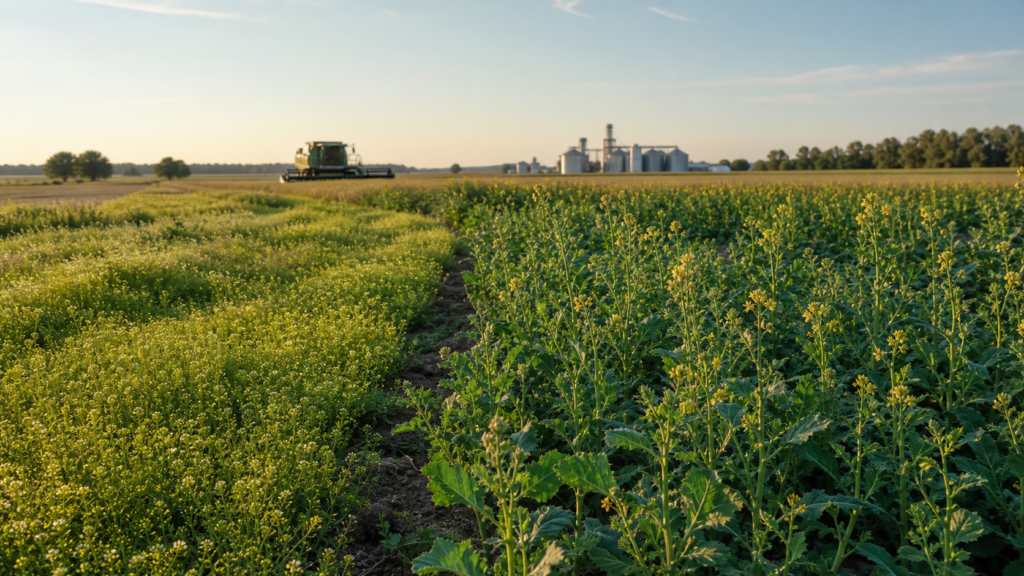
Two intermediate oilseeds are now being asked to do far more than produce seed. Bayer and bp announced on 6 May 2026 a long-term strategic alliance to commercialise and scale camelina under the newgold seed brand, initially in North America, for biodiesel, renewable diesel and sustainable aviation fuel (SAF). The alliance combines Bayer’s breeding, seed technology and farmer network with bp’s fuel and refining capabilities, but it remains an emerging platform rather than evidence of large current delivered volumes. Nuseed’s carinata case is different: it has a documented ten-year strategic offtake and market-development agreement with bp and public evidence of contract production, certification, shipment, crushing and oil delivery steps. Grapevine Energy, formerly Global Clean Energy Holdings, adds a third model through Sustainable Oils LLC, which is owned by Grapevine Energy Holdings LLC and develops proprietary camelina varieties for a farm-to-fuel platform.
Those examples matter because the SAF industry increasingly treats intermediate oilseeds as proof that new lipid supply can be added without expanding conventional food-crop acreage. The assumption is plausible in some rotations, but it is not self-proving. Camelina and carinata become useful only when a planted hectare turns into harvested seed, segregated oil, usable meal, certified carbon performance and a contractable feedstock stream that a refinery can underwrite. A crop name does not settle questions about water, nitrogen, machinery time, farmer risk or the yield of the following crop.
Commercial platforms are not the same as delivered supply
Camelina is gaining attention because it can fit into shorter agricultural windows. Public company announcements point to a model built around flexible insertion into rotations, lower input requirements and expanding commercial origination. Bayer says camelina can be grown as an intermediate crop, within rotations or on underutilised land, while bp brings fuel and refining expertise to the newgold alliance. The important discipline is to separate intended commercialisation from physical production: the Bayer-bp announcement describes market development, not already planted, harvested or delivered volumes at refinery scale.
Grapevine and Sustainable Oils offer a more mature camelina origination story, but their figures also need classification. Sustainable Oils says growers in Montana, western Kansas and eastern Colorado have planted its camelina with favourable results since 2020; that is a planted-programme statement, not a quantified audited acreage total. The same materials say Sustainable Oils will need more than one million acres to meet anticipated future demand, which is a projected requirement, not acreage already planted. Grapevine’s Central Valley Renewables subsidiary has a multi-year arrangement with Vitol to purchase up to 220 million gallons per year of renewable diesel made from various feedstocks, including camelina oil from Sustainable Oils. That is a purchase-capacity or offtake framework associated with the wider renewable-diesel platform; it does not prove that the full volume will necessarily be produced from camelina.
Carinata is being developed in a more closed, identity-preserved way. Nuseed describes it as a non-food crop grown between main crops, with documented and independently certified farming practices, crush into lower-carbon oil and a protein meal coproduct. Its ten-year agreement with bp is described as a strategic offtake and market-development arrangement under which bp, or its affiliates, purchase Nuseed Carinata oil to process or sell into biofuel markets. The most useful public evidence is the chain itself: Nuseed reported that a certified shipment left San Pedro, Argentina, in early January 2023 after contract production in Argentina and Uruguay, moved to France for processing by Saipol, and was intended to result in certified carinata oil delivered to bp. That is a stronger execution record than a general target for acres or demand.
The commercial distinction is therefore not simply camelina versus carinata. Camelina currently benefits from shorter-cycle flexibility and several emerging platforms. Carinata has a clearer public example of coordinated contracting, certification, shipment, processing and oil offtake. Both still depend on growers accepting agronomic risk, crushers handling small or specialist oilseeds, and fuel buyers paying for quality and verified carbon performance.
Why camelina fits short windows
Camelina sativa is a small-seeded oilseed in the Brassicaceae family. In the High Plains positioning used by Sustainable Oils, the crop is described as short season, typically around 85 to 110 days, and suited to dryland rotations where fallow replacement or double-cropping is possible. Agronomy guides from the northern United States also present camelina as relatively tolerant of cold and drought compared with many conventional oilseeds. Those traits explain why it is attractive in temperate, cold or semi-arid systems where the intermediate-crop window is narrow and the next cash crop cannot be delayed.
The same features create management risk. Camelina seed is very small, so shallow placement, seedbed quality, early moisture and weed control matter. A weak stand can lose the calendar advantage that made the crop attractive. Spring and winter materials create different options: spring types can fit colder regions or late decisions after winter cereals, while winter types can provide soil cover when fields would otherwise be bare. In either case, shattering risk, lodging, harvest timing and the ability to dry and store small seed determine whether the crop remains a practical commercial proposition.
Yield and oil content should be discussed by environment, not as universal constants. Montana and High Plains materials commonly frame camelina as a dryland oilseed with moderate yield expectations, while trial performance elsewhere can differ sharply with rainfall, soil depth, sowing date, fertility and weed pressure. Oil content is often attractive for fuel markets, but oil per hectare is only useful after cleaning, drying, storage, transport, crushing losses and quality deductions. For a farmer, the relevant comparison may be fallow, a non-harvested cover crop, a second crop, or earlier planting of the main crop.
Where carinata earns a longer season
Brassica carinata, often called Ethiopian mustard, is a taller and more vigorous oilseed than camelina. It can produce more canopy and biomass, which may support soil cover, rooting and weed suppression in mild-winter systems with enough moisture for establishment. UF/IFAS guidance for the south-eastern United States treats carinata as a winter oilseed whose fit depends on sowing into the cool season and harvesting before summer crops are compromised. The longer cycle can be useful where the rotation has time; it can be expensive where the following crop needs an early planting date or stored soil water.
Carinata’s greater biomass potential is therefore both an asset and a cost. More cover can reduce bare-soil exposure and improve capture of residual nutrients, but the crop can also require nitrogen and sulphur attention, use soil water and create a tighter harvest window. If the spring is wet, if seed moisture is high, or if harvest delays the next crop, the energy-feedstock contract may be less valuable than the lost opportunity in the main crop. Commercial claims about soil improvement or following-crop benefits need local evidence rather than assumption.
This is why the contract architecture matters. A grower needs seed, technical assistance, quality specifications, a delivery point, payment timing and a clear rule for crop failure. A fuel customer needs evidence that certified seed becomes traceable oil and that the meal has a legitimate market. Nuseed’s public value-chain material is commercially relevant because it connects contract growers, data collection, certification, logistics partners, crushing and a buyer for the resulting oil. It does not remove agronomic risk from the farm, but it can reduce market and traceability risk for the rest of the chain.
Second-crop rapeseed is the awkward benchmark
Carinata should not be assessed in isolation. In several regions, selected rapeseed or canola varieties already offer mature genetics, established seed supply, familiar agronomy, known harvest systems and existing crushing infrastructure. Market liquidity can also matter. If an energy premium weakens, a conventional oilseed may still have food, feed or industrial outlets, whereas a specialist fuel crop may depend more heavily on the contract that brought it into the rotation.
Carinata’s advantage is different. Warm-winter adaptation, biomass and rooting, non-food industrial identity, contract structure and certification integration may make it easier to segregate for low-carbon fuel markets. High-erucic industrial rapeseed can also serve non-food markets, but it may not bring the same fuel-customer architecture. The comparison is therefore not a simple biological ranking. In some places rapeseed wins through familiarity and infrastructure; in others carinata may win because the commercial platform makes traceability, offtake and carbon accounting easier to organise.
| Question | Camelina | Carinata | Second-crop rapeseed or canola |
|---|---|---|---|
| Best fit | Shorter windows, lower disruption, temperate or semi-arid systems | Mild winters, longer windows, stronger contract platform | Regions with existing seed, agronomy and crushing capacity |
| Main risk | Establishment, small seed, variable yield and aggregation scale | Later harvest, moisture use, nitrogen demand and contract dependence | Food-market interaction, eligibility, segregation and displacement questions |
| Bankability test | Can planted and contracted hectares become reliable delivered oil? | Can the integrated chain retain farmers, certify supply and deliver oil? | Can the crop prove additionality and low-carbon identity? |
The rotation decides the economics
Tonnes of seed per hectare are insufficient. A farmer evaluates the intermediate crop through the gross margin of the whole rotation: seed, fertiliser, herbicide, fungicide, machinery, diesel, drying, storage, delivery distance, insurance, crop-failure risk and payment timing. A low-input crop with poor yield may still have a high delivered cost per tonne of oil. A higher-biomass crop may improve soil cover yet draw down water or nutrients that the following crop needed.
The strongest cases occur where the crop uses a fallow or cover-crop window productively, creates additional income, reduces bare-soil exposure, captures nutrients, diversifies weed management and does not compromise the main crop. The weakest cases appear when an energy-feedstock programme treats the intermediate crop as free additional output while the farm absorbs establishment risk, diesel use, certification paperwork and a tighter planting calendar. A contract can transfer market risk, but it may leave most agronomic risk with the grower unless failure provisions, pricing formulas and technical support are explicit.
Soil carbon and lifecycle claims need boundaries
Both crops are often associated with soil-carbon benefits because they keep living cover on land that might otherwise be bare. That is plausible in some systems, but it is not automatic. Baseline conditions, sampling depth, spatial variability, root carbon, above-ground residue removal, soil water and the effect on the following crop determine the result. If the land already carried a cover crop, supported grazing, or used the same window for another soil-building practice, the additional benefit changes.
Lifecycle accounting is equally sensitive. A crop may look low carbon at field level while its delivered oil requires drying, long-distance aggregation, crushing, pretreatment, hydrogen and international shipping. Per-hectare gains can look attractive while emissions per tonne of oil remain weak if yield is low. Certification schemes and fuel standards therefore need chain-of-custody data, allocation to coproducts and evidence that the crop did not create additional land demand or hidden displacement. Neither camelina nor carinata qualifies under Annex IX or comparable frameworks simply by crop identity.
Crushing is where hectares become feedstock
The missing middle between field and HEFA refinery is often underpriced. Seed must be aggregated, cleaned, dried, stored, transported and crushed. Oil must be separated, stored, pretreated and delivered with chain-of-custody documentation. Batches may need segregation by region, contract, certification scheme or carbon score. Meal must be moved into feed or other markets with appropriate approvals and pricing.
This is where commercial models diverge. A platform with seed genetics and grower contracts may still depend on third-party crushing. A renewable-fuel facility may secure purchase commitments without assuming crop-production risk. A crusher with origination capability can reduce distance between farmer and fuel buyer, but only if it can handle small-seeded crops, manage quality and place the meal. Nuseed’s San Pedro to Saipol movement is valuable evidence because it describes a delivered shipment and processing route, not merely a production target.
Refineries buy oil quality, not crop narratives
Hydroprocessed esters and fatty acids (HEFA) units can process vegetable oils and other lipid feedstocks into renewable diesel, SAF and related products, but refineries care about chemistry. Free fatty acids, phosphorus, metals, moisture, contaminants and oxidative stability affect pretreatment, hydrogen consumption, catalyst life and product slate. The same crop can produce different refinery value depending on harvest, storage, crushing and oil handling.
Meal also affects the margin. Camelina and carinata meals can contribute protein value, but feed approval, glucosinolate levels, nutritional performance, regional demand and logistics determine whether meal is a real revenue stream or an avoided disposal cost. If the energy buyer captures the carbon premium, the originator captures the logistics margin and the grower carries the crop risk, repeat supply will be fragile. Durable feedstock development needs value to reach the farmer as well as the fuel market.
What investors can finance
A refinery, investor or lender needs more than hectares. It needs contract coverage, geographic diversification, yield history, P10, P50 and P90 supply ranges, crop insurance, crushing agreements, delivered oil cost, quality data, traceability, certification evidence, lifecycle emissions and fallback feedstocks. It also needs farmer retention. A first-year contract is useful; a repeatable production basin is bankable.
The lack of comparable public hectare and delivery data is itself important. Bayer-bp can credibly combine seed technology, grower access and refining demand, but public evidence of planted, harvested and delivered newgold volumes is still emerging. Sustainable Oils has growers, proprietary camelina and a downstream platform, but projected acreage need should not be confused with current planted area. Nuseed has the clearest public example of certified field-to-crusher-to-energy-buyer execution, although its model still depends on suitable winter windows, grower economics and successful oilseed logistics.
A useful feedstock is a system, not a crop label
Intermediate oilseeds are one of the more credible ways to add lipid supply for renewable diesel and SAF without simply bidding against existing food oil markets. Camelina and carinata address different production windows and commercial problems. Camelina’s shorter cycle, small-seed agronomy and lower disruption can help it enter rotations across diverse dryland and temperate regions, especially where broad origination networks recruit growers. Carinata’s longer season, biomass and warm-winter fit can be powerful where the crop calendar allows it and where contract production, certification, crushing and offtake are organised together.
The decisive comparison is not which crop sounds more sustainable. It is which farming system improves the full rotation, pays the farmer for risk, preserves the following crop, moves seed through cleaning and crushing, places meal into a real market, and delivers oil with a verified carbon score at a cost a refinery can finance. Camelina currently benefits from flexibility and several emerging commercial platforms. Carinata has a stronger documented example of vertically coordinated production, certification, processing and energy-buyer offtake. Neither has demonstrated unlimited scalable supply, and both remain constrained by yield stability, water and nutrient effects, grower retention, crushing access, logistics, certification and delivered oil cost.
Sources and further reading
Bayer and bp announcement on scaling newgold camelina as an intermediate crop; Sustainable Oils camelina platform, grower demand and Vitol renewable-diesel arrangement; Grapevine Energy upstream operations and Sustainable Oils ownership; Grapevine Energy downstream renewable fuels facility; Nuseed Carinata platform; Nuseed and bp ten-year strategic offtake and market-development agreement; Nuseed certified carinata shipment from San Pedro to Saipol for bp agreement; Nuseed certification and traceability description; Nuseed-Saipol commercial offtake agreement; ICAO CORSIA eligible fuels materials; RED III; ReFuelEU Aviation; USDA-NRCS/Montana camelina plant guide; UF/IFAS carinata production guidance.
Related BEC reading: SAF feedstock supply chains and reliable supply development, Acelen and the biological timeline of macaúba, Pongamia and bankable SAF feedstock development, Europe’s biomass bankability gap, lignocellulosic intermediates and the HEFA infrastructure model, and regenerative agriculture applied to bioenergy.