
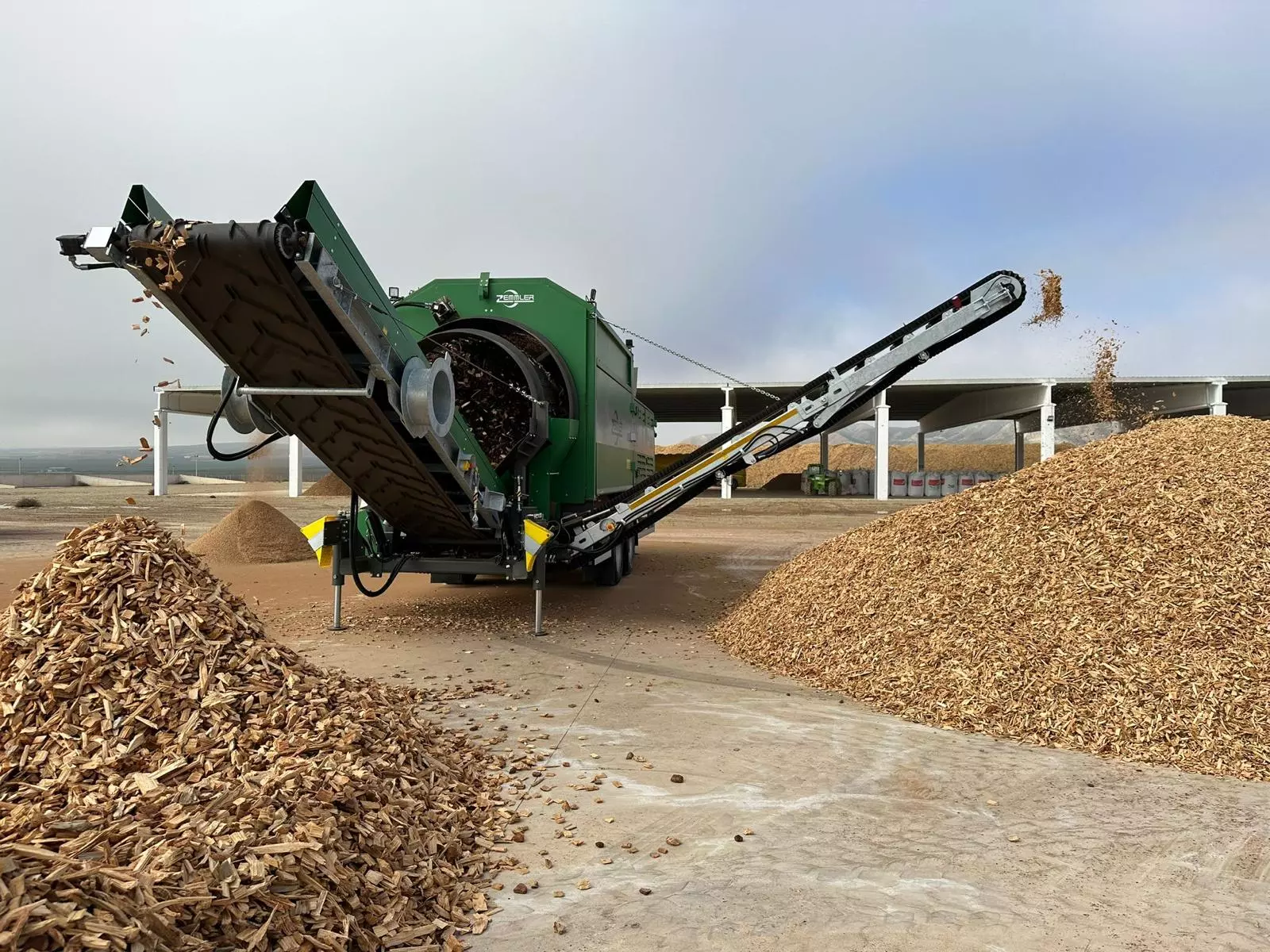
Veolia has inaugurated a new integrated composting and biomass facility in Fuentes de Ebro, Zaragoza, bringing organic-waste recovery, agricultural nutrient recycling and solid-biomass production together within a single regional platform.
The installation is designed to process more than 50,000 tonnes of organic residues, sewage sludge, and agricultural and forestry biomass annually. Rather than treating these materials as unrelated waste streams, the project connects them to two productive outlets: agricultural fertiliser products and renewable solid fuels for industrial heat.
Two complementary resource-recovery systems
The facility comprises two distinct but complementary operating lines.
The first is a composting plant with capacity to treat approximately 27,000 tonnes of organic residues per year. It includes separate treatment routes for sewage sludge suitable for agronomic application and for other organic materials intended for the manufacture of fertiliser products.
The second is a biomass-processing platform with capacity to handle approximately 15,000 tonnes of agricultural and forestry residues annually. The material is classified, prepared and reduced in size to produce solid biofuels, including wood chips and pellets, for use in industrial boilers and heating networks.
This combination is significant because it links three areas that are often developed separately: waste management, agricultural soil inputs and renewable thermal energy.
Organic materials can be returned to productive use through composting and fertiliser manufacture, while locally available agricultural and forestry residues can replace part of the fossil-fuel consumption associated with industrial heat.
Why regional integration matters
Projects of this type are particularly relevant in agricultural regions where several underused resource streams coexist.
Municipal organic waste, sewage sludge, pruning residues, forestry material and agricultural by-products are frequently generated by different actors, under different contractual arrangements and at different times of the year. Without local processing capacity, these materials may travel long distances, remain underutilised or incur disposal and management costs.
A regional facility can create a more structured market for these resources by connecting municipalities, wastewater operators, farmers, forestry contractors and industrial energy users.
The potential benefits extend beyond waste diversion. Compost and compliant organic amendments can help return nutrients and organic matter to agricultural soils, while processed biomass can provide a lower-carbon fuel for industrial boilers and district-heating systems.
However, these benefits depend on the quality of the incoming material and on the ability of the facility to consistently produce outputs that meet agricultural, environmental and energy-use requirements.
Installed capacity is not the same as secured feedstock
The announcement of processing capacity is an important project milestone, but the long-term performance of any biomass or organic-resource facility ultimately depends on the supply chain behind it.
Agricultural and forestry residues are rarely available as a uniform, year-round commodity. Their commercial value is influenced by seasonality, moisture content, particle size, ash, contamination, storage losses and transport distance.
A residue that appears inexpensive at source may become significantly more costly once collection, loading, drying, preprocessing, storage and transport are included.
The same principle applies to organic residues and sewage sludge. Their suitability for agricultural use depends on composition, traceability, treatment, regulatory compliance and the existence of a reliable market for the final compost or fertiliser product.
For this reason, resource mapping and feedstock characterisation are as important as installed processing capacity. Facilities require a clear understanding of where each resource is located, how much is genuinely recoverable, when it is available and what delivered cost can be supported by the final product market.
Biomass quality will determine its energy value
Producing chips or pellets does not automatically make every agricultural or forestry residue interchangeable.
Industrial users require fuels that are compatible with their boiler technology and operating permits. Moisture, ash, mineral content, bulk density, particle distribution and combustion behaviour can all affect efficiency, handling, emissions and maintenance.
Agricultural residues may also present characteristics that differ substantially from conventional woody biomass. Some materials can have higher ash levels, lower bulk density or greater concentrations of alkali metals and silica. These factors influence fuel preparation, boiler performance and the economic distance over which the resource can be transported.
A robust biomass platform therefore needs more than a processing line. It requires feedstock specifications, supplier protocols, quality control, storage planning and appropriate matching between each fuel and its intended industrial user.
This is where integrated regional projects can create additional value: by turning variable local residues into more consistent, marketable products.
A model for decentralised circular bioeconomy infrastructure
The Fuentes de Ebro facility illustrates the growing convergence between agriculture, waste management and renewable energy.
Medium-scale decentralised infrastructure can be especially effective where feedstock resources are dispersed but concentrated enough to support collection within an economically viable radius. The model can also reduce exposure to imported fuels and create additional outlets for materials that previously had limited commercial value.
For Aragón, the project is consistent with a wider opportunity to combine agricultural production, forestry management, organic-resource recovery and renewable industrial heat.
The region has extensive agricultural activity, food-processing industries, municipalities generating organic waste, forestry resources and potential demand for thermal decarbonisation. Connecting these sectors through well-designed logistics and product markets can strengthen local value chains.
Veolia has positioned the project within its GreenUp strategy, which integrates water, energy and waste solutions. The installation has also received support from European funds and the Government of Aragón, including public assistance covering part of the equipment costs associated with fertiliser finishing and biomass processing.
From resource recovery to functioning markets
The strategic value of the facility lies not only in the volume it can process, but in its ability to create reliable markets on both sides of the operation.
On the supply side, it must secure consistent quantities of appropriate organic, agricultural and forestry materials. On the demand side, it must maintain viable outlets for compost, fertiliser products, wood chips and pellets.
This requires coordination across several sectors and a clear understanding of logistics, regulation, product quality and end-user economics.
If these elements are successfully integrated, the Fuentes de Ebro facility can provide a practical example of how local residues can support agricultural soils, industrial decarbonisation and regional circular-economy development.
The broader lesson is that biomass and organic-resource projects are not built around processing capacity alone. Their bankability and long-term performance depend on the design of the entire value chain—from resource availability and contracting to quality control, logistics and final product demand.
⸻