
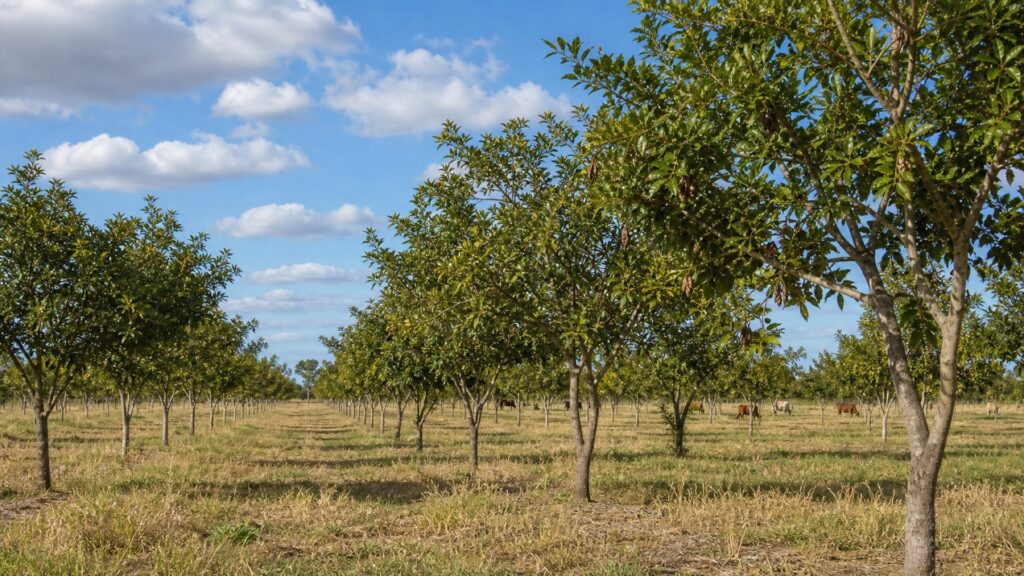
A 2026 Australian study published in the Journal of Environmental Management estimates that around 30 million hectares may be climatically and environmentally suitable for Pongamia pinnata in Australia. The result is important because sustainable aviation fuel (SAF) developers are looking for scalable low-carbon oils beyond the existing pool of waste fats, vegetable oils and animal fats. It is also easy to misread. Modelled suitability is not available land, contracted land or financeable feedstock.
Pongamia can be a serious candidate only where land, climate, farm economics, harvest logistics, oil extraction, carbon accounting and offtake converge. A hectare can be suitable in a spatial model and still be unavailable because it is better used for grazing, cropping, conservation, carbon projects, horticulture, irrigation or cultural and biodiversity values. The Australian opportunity is therefore a land-use filter, not a feedstock forecast.
The 30-million-hectare result starts the analysis
The study should be read as a screening tool. It considers suitability across geography, climate variables and environmental exclusions, then helps identify where further field investigation may be warranted. The most useful next step is to move down the land ladder: climatically suitable, environmentally acceptable, legally available, agriculturally low-opportunity-cost, commercially accessible, contracted and financeable.
| Land category | Meaning for Pongamia | Common failure point |
|---|---|---|
| Climatically suitable | Temperature and rainfall filters suggest the tree may establish | Local extremes, frost, drought or flooding |
| Environmentally acceptable | Biodiversity, carbon and water impacts can be managed | Native vegetation or habitat conflict |
| Legally available | Tenure, planning and water rules permit planting | Land-use restrictions or unclear rights |
| Low opportunity cost | The crop does not displace a more valuable use | Competition with grazing, cropping or carbon projects |
| Commercially accessible | Nurseries, roads, labour, harvest and extraction exist | Logistics cost exceeds oil value |
| Financeable | Yield, cost, carbon and contracts support capital | Evidence is too thin for lenders |
Biophysical suitability is not one condition
Broad «marginal land» claims are weak because constraints differ. Rainfall amount, rainfall distribution, temperature, frost, drought, salinity, acidity, fertility, waterlogging, flooding, soil depth and establishment water all affect performance differently. A genotype that tolerates drought may not tolerate prolonged waterlogging. A site that survives dryland establishment may still produce insufficient pod yield for commercial oil supply.
Australia’s strongest Pongamia case will be where dryland performance is validated. If commercial yields require reliable irrigation or high-value soils, the crop competes with food production and horticulture. If selected planting material can perform in dry subtropical grazing systems with moderate inputs, Pongamia becomes more interesting as an oil crop that adds income without demanding scarce irrigation water.
Establishment water should be treated separately from mature dryland performance. A tree may need careful watering, weed control and protection in its early years before it can express later drought tolerance. That creates a financing and operations issue for broadacre planting: water points, labour, replacement seedlings and establishment monitoring must be budgeted before any oil revenue exists.
Biology and yield evidence need careful labels
Pongamia biology is promising but still needs disciplined evidence. Development files should distinguish genotype, propagation method, nursery quality, establishment survival, mortality, age to first production, age to maturity, alternate bearing, pod yield, seed yield, oil content, extraction efficiency and oil quality. Experimental yields, greenhouse results and company-reported trials are not the same as multi-year commercial plantation records.
The crop also produces coproduct questions. Seed cake, shells, press cake and residues may have energy, soil or circular-economy uses, but their value depends on composition, contaminants, markets and regulation. A fuel project should not assume coproduct income unless there is a buyer or an internal use with measured performance.
Oil quality is another gateway. HEFA refineries need feedstock that can be pretreated within cost and specification limits. Free fatty acids, phosphorus, metals, water and impurities influence pretreatment load, hydrogen demand, catalyst life and final yield. A Pongamia project therefore has to connect field genetics and harvest handling to refinery acceptance, not only to gross seed yield.
Land opportunity cost decides the development model
Pongamia is strongest where it improves a farm system rather than displacing a stronger one. Low-productivity pasture, degraded grazing land, shelterbelts, farm boundaries and selected silvopastoral systems may be more attractive than irrigated cropping areas or high-value horticulture. Conservation land, native vegetation and carbon projects create different baselines and should not be treated as empty space.
The opportunity cost also changes by owner. A grazier may value shade, shelter and diversified income if cattle performance is maintained. A crop farmer may see trees as an obstacle to machinery. A carbon-project developer may compare long-term credits with oil revenue. A lender will ask whether land contracts, insurance, establishment cost and harvest logistics support cash flow.
Carbon projects are an especially important comparator in Australia. Some lower-productivity land may already be more valuable under conservation, avoided-clearing, reforestation or soil-carbon strategies than under a new oil crop. Pongamia can still fit where it provides both productive and environmental value, but the baseline has to be explicit. A feedstock project that weakens a credible carbon or biodiversity outcome will struggle to defend its lifecycle claim.
Silvopasture can improve the story or complicate the operation
Pongamia rows integrated with cattle can offer shade, shelter, soil cover and additional product income. They can also reduce pasture area, interfere with mustering, require fencing, change fire management, concentrate grazing pressure and complicate harvest. Row spacing, trunk form, pruning, water points, machinery access and fruit collection are design variables with financial consequences.
Scattered trees may look appealing but increase harvest and aggregation cost. Dense plantations may improve harvest efficiency but weaken livestock integration. The project design has to choose a farm system, not only a tree species.
Fire also belongs in the design file. Tree rows can alter fuel continuity, access and suppression routes. In some landscapes they may provide shelter and soil cover; in others they may complicate risk management unless spacing, pruning, grazing and access tracks are designed from the start. This is another reason suitability maps must be followed by local farm-system planning.
Soil, residues and carbon need measured pathways
Pongamia can contribute leaf litter, soil cover and potentially nitrogen-fixing benefits, but those effects must be measured by site and management system. Press cake, shells and pruning residues may be considered for composting, pyrolysis, biochar, process heat or soil amendment. Each route depends on moisture, ash, nutrient content, transport, application rate, carbon-credit methodology and agronomic response.
Biochar may be valuable where it supports soil organic matter, nutrient retention or carbon removal under a recognised standard. It is not a default solution for every Pongamia project. A bankable system needs field trials, residue accounting, product quality and a buyer or internal use case.
Bankability starts after suitability
A Pongamia project needs establishment capital, years without revenue, grower finance, mechanised or organised harvest, extraction hubs, transport contracts, oil offtake, HEFA acceptance, carbon accounting, land agreements and insurance. Lenders will want evidence that hectares can become tonnes, tonnes can become oil, oil can meet specification and contracts can allocate price and yield risk.
Paraguay is useful only as a short comparison. Large Pongamia ambitions elsewhere can show that the crop has attracted strategic interest, but they do not prove Australian commercial supply unless planted area, survival, harvest, oil output and offtake are documented. Australia’s 30-million-hectare result should therefore be treated as the beginning of field diligence. The financeable area will be smaller, more specific and defined by growers, trials, logistics and contracts.
The practical development model is staged. First, identify regions where climate and exclusions support further work. Second, run genotype and establishment trials under real farm conditions. Third, test harvesting, storage and oil extraction at pilot scale. Fourth, contract growers and offtake only after yield and cost ranges are credible. This sequence is slower than a headline hectare estimate, but it is the route from modelled land to lender-acceptable supply.
Related BEC analysis: SAF feedstock supply chains and reliable supply development.
Sources and further reading
- Fiot-Mornand, O’Sullivan, Mishra, Flentje, Nong and Castonguay, “Balancing multiple sustainability objectives in feedstock cultivation: a case of Pongamia pinnata in Australia”, Journal of Environmental Management, 2026.
- Yang et al., “Hydrological tolerance of two restoration tree seedlings in tropical peatlands under different water-table levels and exposure durations”, Trees, Forests and People, 2026.
- ICAO, CORSIA eligible fuels framework.