
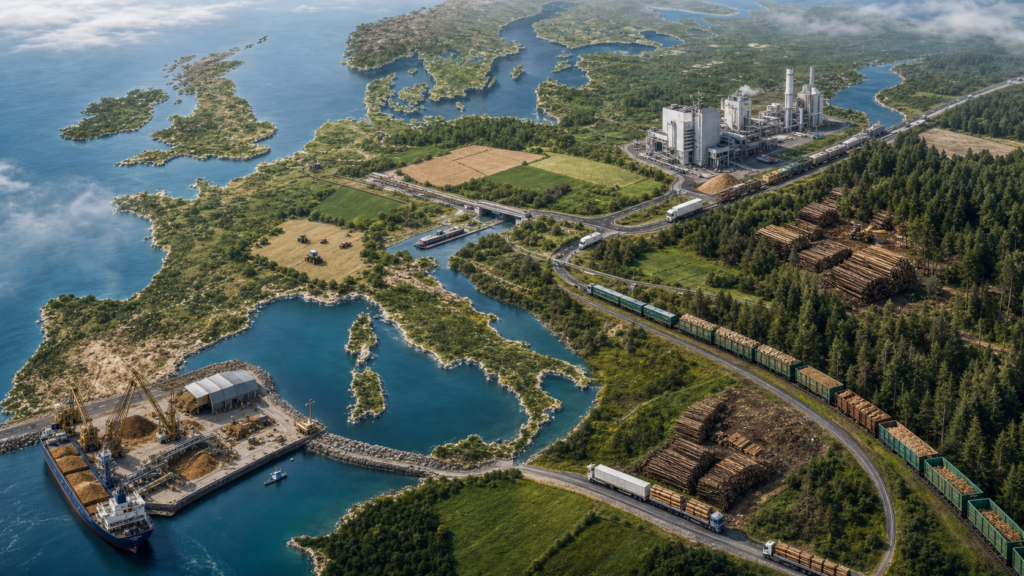
The European Commission’s 2026 workshop material on advanced biofuels and renewable fuels of non-biological origin places Europe’s fuel challenge in industrial rather than purely resource terms. The EU can identify large volumes of potentially sustainable biomass, but projects are constrained by mobilisation, certification, offtake, financing and the slow conversion of regional feedstock into bankable supply chains.
The Commission-source material refers to sustainable biomass potentially available to energy markets in 2030 in a broad range of roughly 310-836 million dry tonnes. It also discusses advanced biofuel and biomethane capacity, transport demand growth and support needs running into several billion euros per year. These figures are useful, but they are not plant-level feedstock contracts. They describe the size of the opportunity and the scale of the policy task.
Europe’s constraint is mobilisation, not only conversion technology
Advanced fuel pathways require different types of biomass: agricultural residues, forestry residues, organic wastes, manure, energy crops and industrial by-products. Each has a different ownership structure, seasonality, moisture profile, contaminant risk and competing use. A refinery or biogas plant cannot buy an EU resource estimate. It needs tonnes delivered to specification, with documented sustainability and a price mechanism robust enough to support debt.
This is why the Commission discussion of premiums, guarantees, blended finance, certification and book-and-claim systems matters. The barrier is not a single missing subsidy. It is the need to coordinate farmers, forest owners, aggregators, technology providers, lenders, fuel buyers and regulators. Without that coordination, biomass remains visible in studies but unavailable to projects.
Support instruments need to follow the risk, not the slogan
A production premium helps once a plant is operating. It does less for a farmer deciding whether to collect residues or plant a perennial crop. A feedstock premium can mobilise tonnes but will not by itself finance a first-of-a-kind conversion asset. A capital grant lowers upfront cost but may not solve offtake duration. A guarantee can reduce lender risk but depends on clear eligibility and performance triggers.
The strongest policy packages will therefore be layered. Early projects may need feedstock mobilisation support, certification infrastructure, construction risk sharing and long-term revenue visibility. That is especially true for pathways such as gasification, cellulosic ethanol, ATJ and lignocellulosic intermediates, where feedstock and conversion risk are both material.
The bankable unit is regional, not continental
Europe’s resource base is continental; biomass projects are local. A plant depends on a catchment area, road network, storage sites, farmer participation, seasonal weather and local competing uses. The same dry-tonne estimate can support very different investment conclusions depending on whether the material is straw in a dense cereal region, forest residue in mountainous terrain, manure near gas-grid access or woody crops on marginal land.
The next evidence of progress will be regional hubs with contracted feedstock, group certification, aggregation infrastructure and offtake tied to specific fuels. Europe’s advanced-fuels opportunity is real, but the missing infrastructure is institutional and commercial as much as physical. The biomass exists in many places. The investable supply chain still has to be built catchment by catchment.
Sources and further reading
- European Commission, workshop material on advanced biofuels and RFNBOs, June 2026, DOI 10.2777/7851099.
- European Commission, Development of outlook for the necessary means to build industrial capacity for drop-in advanced biofuels, 2024, DOI 10.2777/679307.
- European Commission, Mobilization of industrial capacity building for advanced biofuels, 2026, DOI 10.2777/2375274.