BEC Intelligence Radar — Feedstock Bankability from Land to Industrial Gate | 17 August 2026

BEC Intelligence Radar, 17 August 2026 — land screening, crop systems, biomass logistics and industrial feedstock delivery
Industrial feedstock bankability connects suitable land and crop performance with harvesting, logistics, contracted volume and reliable plant-gate delivery. Visual: Bioenergy Crops. Evidence sources are listed in the article.

Produced by Bioenergy Crops | BEC Intelligence Radar — new every Monday

This edition examines six developments across California, Japan, Australia, the Czech Republic, Germany and the United States. Drawing on official procurement and funding records, government programme documents and peer-reviewed research, it explains what each development changes for plantation design, feedstock mobilisation, delivered cost and industrial reliability.

Edition: 17 August 2026Evidence reviewed through 16 August at 17:00 CESTSix developed storiesApproximately 28 minutes

Executive Summary

The week produced one clearly verified new operational change and five high-value developments whose decision relevance extends beyond their original publication dates. Together they form a coherent picture of the challenge facing purpose-grown biomass and forestry supply systems: resource potential is abundant on paper, but industrial projects become financeable only when land, yield, harvesting, preprocessing, contracts and plant-gate performance are connected. This edition therefore combines current intelligence with carefully dated technical and project evidence, without presenting older research as new weekly news.

In California, the National Forest Foundation and the USDA Forest Service revised the procurement timetable for the 588-acre Thin Lizzy commercial-thinning project in Plumas National Forest. The contract requires both sawtimber operations and removal of non-sawlog biomass, but the public information still omits the recoverable tonnes, quality, destination and delivered economics required to treat that biomass as an industrial supply. In Japan, NEDO’s forthcoming “Energy Forest” call is more ambitious in its system design: it links fast-growing-tree establishment and silviculture to harvesting, replanting, chip and pellet production, transport, quality standards and market pricing. Its final late-August terms will show whether those ambitions translate into integrated demonstrations with measurable operating data.

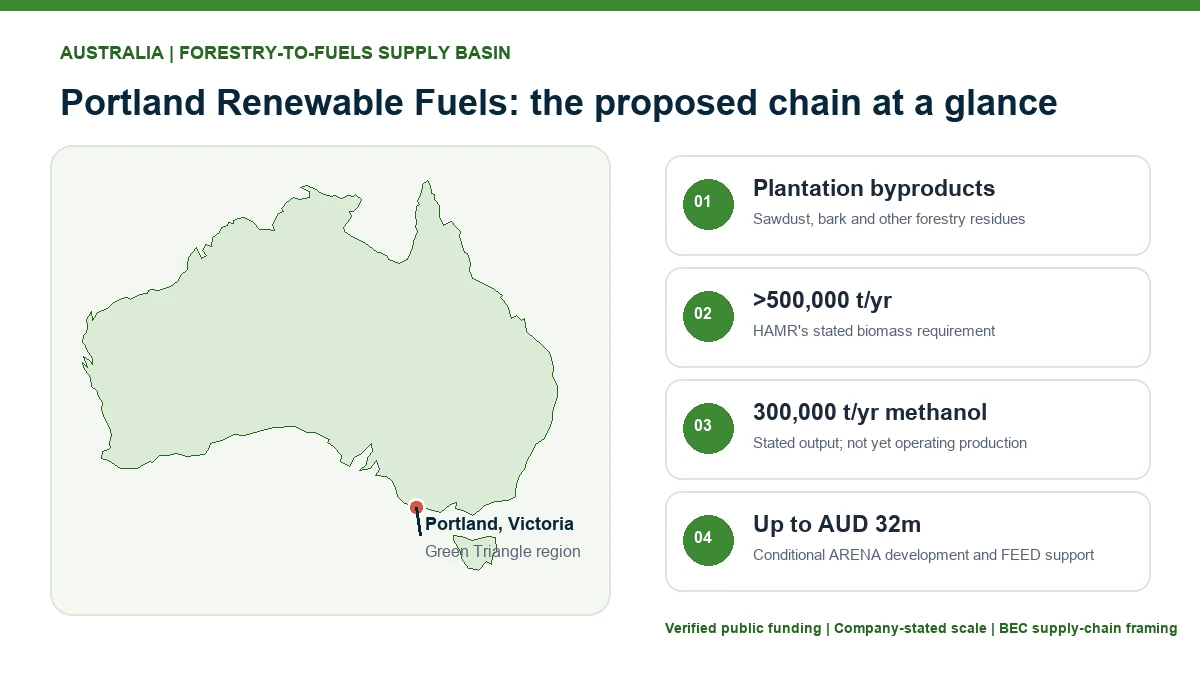
Australia provides the largest project-finance case. ARENA has confirmed up to AUD 32 million of conditional support for HAMR Energy’s development and FEED work across Victoria and South Australia. HAMR’s stated design would use more than 500,000 tonnes of forestry residues per year to produce 300,000 tonnes of low-carbon methanol, potentially feeding SAF and renewable-diesel production. The public funding is real; the feedstock coverage, plant output and emissions performance remain project claims that still need to pass co-funding, contract, permitting, engineering and final-investment-decision tests.

The three research stories explain why that diligence must extend from the land to the receiving hopper. A Czech spatial model estimates 120–125 PJ per year from perennial crops on selected fallow land, while showing how yield and support requirements vary sharply by site. A nine-year German poplar trial demonstrates that clone, density, survival, drought and rotation can reorder yield performance and alter plantation economics. Idaho National Laboratory’s miscanthus study shows that annual crop tonnage is not enough: pellet dimensions and hopper design can determine whether a biorefinery achieves stable hourly throughput. The combined implication is clear for industrial sponsors, landowners and financiers: hectares, nominal tonnes and nameplate capacity must be converted into a verified, specification-compliant and contractable delivery system before they can support investment.

The Week in Feedstocks

Six stories about the land, crop, logistics and engineering decisions behind reliable industrial biomass supply.
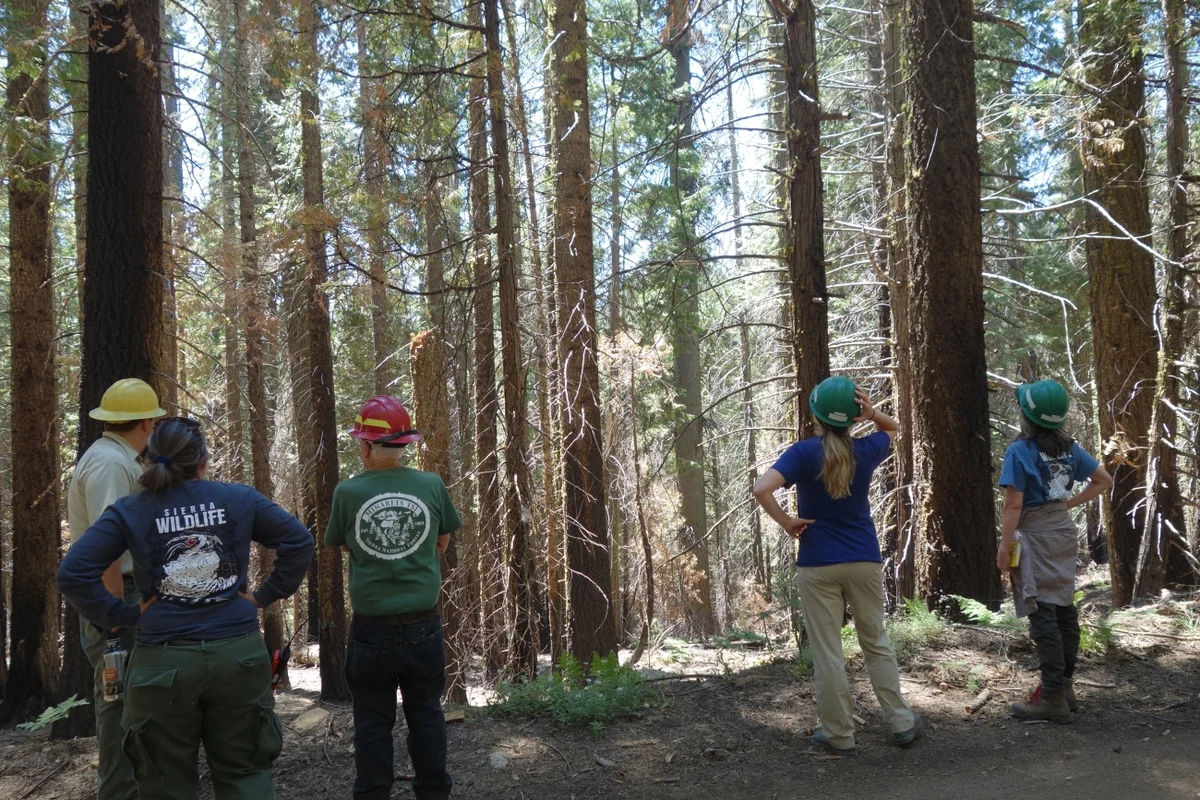
Forest specialists examine a planned thinning area in Sierra National Forest, California
California fuels-reduction context: forest specialists assess a planned thinning area in Sierra National Forest. This image does not depict the Thin Lizzy site.Photo: Stephanie Eyes / US Fish and Wildlife Service, public domain. Source and rights record.
01California, United States · forestry procurementA live forestry procurement exposes the missing biomass-volume questionA 588-acre thinning project includes non-sawlog biomass removal, but area alone does not establish recoverable tonnes, destination or delivered economics.
Verified factBEC analysisOpen point

What changed, who published it and where. The National Forest Foundation (NFF), working with the US Department of Agriculture’s Forest Service, published the procurement for the Thin Lizzy Timber Project in Plumas National Forest, California. The project covers 588 acres of commercial thinning. The selected contractor is expected to cut, skid, deck, haul and sell sawtimber that meets the specification; it must also cut and remove non-sawlog biomass and carry out road reconstruction. The edition’s captured procurement record documents a 12 August change to the bid tables and an extension of the response timetable to 19 August. That makes this an actual operating and procurement change inside the Radar window, rather than a general forestry announcement.

Why the development matters in context. Thin Lizzy is not large enough to define a regional biomass market on its own, but it is a useful real-world example of how forest treatment, merchantable wood and lower-value biomass become one mobilisation problem. The public project description identifies area and contractor duties, yet it does not quantify the standing inventory, recoverable non-sawlog tonnes, moisture or contamination limits, seasonal access, landing capacity, haul radius, intended buyer or utilisation pathway. Road reconstruction adds another variable because access work can affect both the timing and cost of removal. An obligation to remove biomass therefore does not, by itself, prove that a specification-compliant industrial feedstock can be produced or sold economically.

BEC Perspective

For developers, utilities and biomass buyers, the case illustrates the difference between treatment acreage and a contractable supply basin. A bankability assessment would translate stand data into assortments, recovery factors and moisture-adjusted tonnes; identify who controls the material after felling; test competing outlets; map roads, landings and seasonal constraints; and calculate delivered cost to one or more credible destinations. It would also establish whether the contractor bears utilisation and price risk or whether the project sponsor provides an outlet or disposal mechanism.

The commercially important question is consequently not “How many acres are being treated?” but “How many tonnes of defined quality can be delivered, over what schedule, to which plant or market, and under what allocation of volume, logistics and price risk?” Without those answers, the biomass requirement may improve forest-treatment outcomes but cannot yet be counted as dependable industrial supply. This is why even a relatively modest procurement deserves attention: it exposes the information gap that repeatedly appears in much larger forestry-to-energy proposals.

Open point and next trigger

The next decision-grade evidence would be the bid package or award record showing estimated tonnage, product specifications, utilisation destination, haul and access assumptions, contract value and the final allocation of biomass-market risk.

Primary source: National Forest Foundation — Thin Lizzy Timber Project, Plumas National Forest, California.

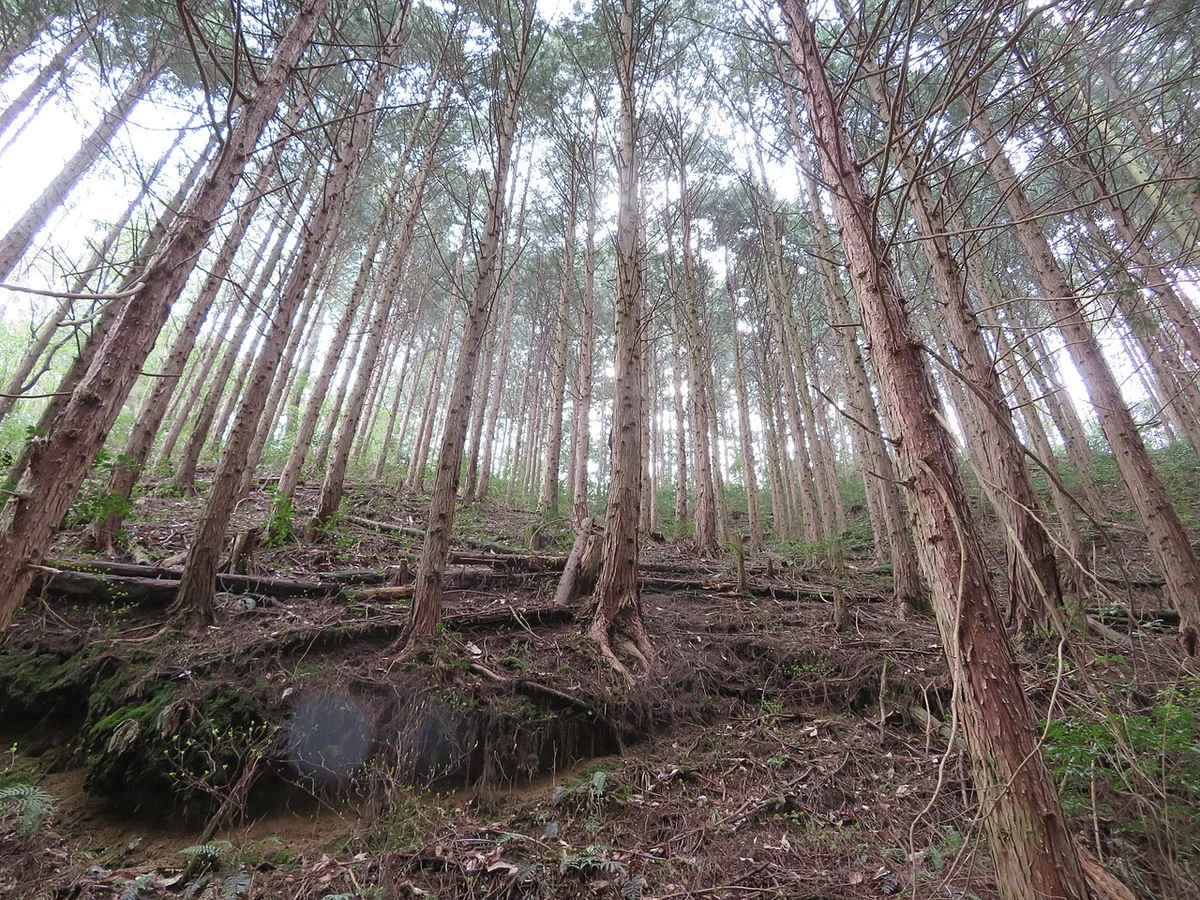
Even-aged Japanese cypress plantation on a forested slope in Japan
Japanese plantation context: an even-aged cypress stand illustrates the silvicultural and harvesting system boundary that NEDO’s Energy Forest programme is designed to test. This is not a photograph of a funded NEDO demonstration.Photo: Zbttp / Wikimedia Commons, CC BY-SA 4.0; resized for web, no substantive alteration. Source file.
02Japan · energy-forest programmeJapan’s energy-forest programme treats feedstock as a complete operating chainNEDO’s forthcoming call links planting and silviculture to harvest, replanting, chips, pellets and transport.
Verified factBEC analysisOpen point

What NEDO announced and where. Japan’s New Energy and Industrial Technology Development Organization (NEDO) published the official preview of the second 2026 call under its programme for stable and efficient woody-biomass fuel supply and use systems. The notice, issued in Japanese on 20 April, says the call is expected in late August and may support projects for up to three fiscal years. It identifies two connected fields: an “Energy Forest” demonstration for fast-growing trees and other new fuel resources, covering planting, silviculture, harvesting, extraction and replanting; and demonstrations to improve the manufacture and transport of domestic wood chips and pellets. Eligible applicants are expected to include companies and other organisations, universities and local governments, with applications to be handled through Japan’s J-Grants system.

The wider programme gives the call unusual strategic depth. NEDO’s FY2021–FY2028 programme is not framed as a simple tree-planting subsidy. It divides Japan into six climate classifications and seeks region-specific combinations of tree species, establishment, tending, harvesting and delivery methods. NEDO’s published outcomes include increasing fuel-material resources by 50,000 dry tonnes per year by FY2028 and 110,000 dry tonnes per year by FY2032, reducing the transaction price of fuel material by 30% by FY2032 through whole-system optimisation, and developing quality practices that connect characteristics such as moisture with market price. The programme also calls for demonstrations covering production and transport, both chip and pellet fuels, and the development of two quality standards. Those are programme targets, not yet results of the forthcoming awards.

BEC Perspective

The relevance for BEC’s audience is the system boundary. NEDO treats forestry establishment, regeneration, harvesting, processing, transport, quality and market transactions as one operating chain. That is closer to the way an industrial sponsor or financier must evaluate a plantation-based feedstock system: species and nursery material must match climate; survival and regrowth must be measured; harvest equipment and road access must suit the rotation; chips or pellets must meet a buyer’s specification; and transport and quality penalties must be visible in the delivered price.

The programme is therefore worth watching beyond Japan. If the final call translates those objectives into measurable cost, yield, moisture, availability and market criteria, it could provide a replicable template for public support elsewhere. The open commercial questions are the 2026 budget, grant rate and co-funding, eligible cost base, minimum demonstration scale, ownership of operating data and the extent to which awards require evidence of an actual buyer or local supply contract. Those details will determine whether the call funds isolated technology trials or integrated supply systems capable of informing investment decisions.

Open point and next trigger

The next trigger is the official late-August call package: budget, co-funding requirements, eligible costs, evaluation criteria, demonstration scale, data obligations and the balance between “Energy Forest” and chip/pellet supply-chain awards.

Primary sources: NEDO — second 2026 call preview and NEDO — programme scope, targets and climate framework.

Map of Australia locating Portland, Victoria, with the proposed HAMR forestry residues to methanol chain
Portland sits within the Green Triangle plantation region spanning western Victoria and south-east South Australia. HAMR states that its proposed chain would use more than 500,000 tonnes of forestry residues per year; the figure is not yet operating supply.Graphic: Bioenergy Crops. Boundary data: Natural Earth, public domain. Project facts: ARENA and HAMR Energy.
03Australia · project finance and forestry fuelsHAMR shows the diligence chain behind a large forestry-to-fuels supply basinConditional public funding is verified; feedstock and output scale remain company-stated until contracts, FEED and FID close the evidence gap.
Verified factCompany-stated claimBEC analysisOpen point

What the public funder confirmed. On 22 July, the Australian Renewable Energy Agency (ARENA) announced up to AUD 32 million in conditional funding for HAMR Energy to undertake development work and Front-End Engineering Design for a proposed forestry-byproducts-to-fuels chain across Victoria and South Australia. ARENA describes a route in which sawdust, bark and other byproducts from plantation owners in the Green Triangle — the forestry region spanning western Victoria and South Australia — would be converted into renewable methanol and then potentially into sustainable aviation fuel, renewable diesel or other low-carbon products. Funding is staged: AUD 12.5 million is available for the initial phase, while the remaining AUD 19.5 million depends on HAMR securing the co-funding required to begin detailed FEED.

What remains a company or project claim. HAMR describes its Portland Renewable Fuels project in Portland, Victoria, as an early-FEED facility designed to process more than 500,000 tonnes of under-utilised forestry residues per year, combine them with a 200 MW-plus electrolyser and produce 300,000 tonnes of low-carbon methanol annually. The company also says biomass agreements cover more than 100% of the requirement. ARENA estimates that the broader proposed chain could displace 140 million litres of fossil jet fuel and abate about 330,000 tonnes of CO2 per year. These figures establish the intended scale and public-development case, but they do not demonstrate that the plant is financed, permitted, built or operating, nor do they provide the contract terms, resource audit or complete lifecycle assumptions behind the stated supply and emissions performance.

BEC Perspective

The project is commercially significant because half a million tonnes per year would require a genuine regional supply basin, not opportunistic spot purchasing. Diligence must separate gross forestry byproduct generation from material that is sustainably recoverable, not already committed to panelboard, energy, mulch or other users, accessible across seasons, and suitable in moisture, ash, particle size and contamination. It must then reconcile supplier locations, storage and preprocessing, truck movements, port and plant logistics, contract duration, indexation, volume tolerances and remedies with the operating profile of the gasification and methanol system.

Conditional public support reduces development risk but does not close feedstock or project-finance risk. The decisive sequence remains co-funding, a traceable resource and contract audit, detailed FEED, environmental and planning approvals, integration of renewable power and hydrogen, product offtake and final investment decision. For financiers and industrial sponsors, the lesson is to test the supply basin with the same discipline applied to the conversion plant: ownership, quality, competing demand, downside volume, delivered cost and operational flexibility must all survive independent review before headline capacity becomes bankable throughput.

Open point and next trigger

Watch for confirmation of co-funding, detailed FEED completion, permits, auditable biomass-supply contracts and product offtake, reconciliation of the different emissions estimates, and a final investment decision.

Primary sources: ARENA — conditional funding and Green Triangle supply-chain description and HAMR Energy — Portland Renewable Fuels project claims.

BEC diagram showing how theoretical Czech biomass potential is filtered into bankable industrial delivery
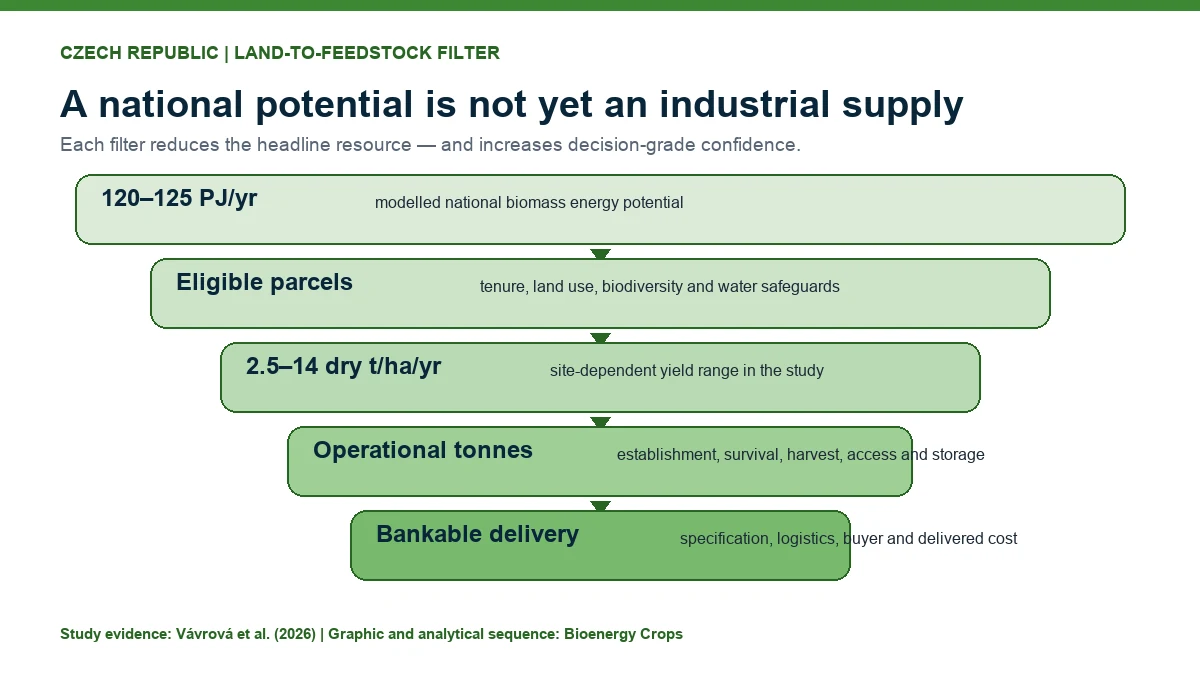
The Czech study’s 120–125 PJ per year result is a national scenario, not a contracted supply. Deployable tonnes shrink through parcel eligibility, site-specific yield, establishment, access, logistics, product specification and buyer filters.Graphic: Bioenergy Crops. Evidence: Vávrová et al. (2026); no publisher figure reproduced.
04Czech Republic · land mapping and perennial cropsFallow land becomes a feedstock opportunity only after spatial and economic filteringA Czech model links land classes, perennial-crop yield, ecosystem services and support — while showing why national potential is not deployable supply.
Verified factBEC analysisOpen point

Who produced the evidence and what it covers. Kamila Vávrová, Jan Weger, Tomáš Králík, Jaroslav Knápek and colleagues published a peer-reviewed Czech case study in Elsevier’s Energy Conversion and Management. The research, supported by the Technology Agency of the Czech Republic, develops a spatial framework for assessing whether selected land classified under the EU Common Agricultural Policy as non-productive or fallow could host perennial energy crops, including fast-growing trees and Miscanthus. The authors combine land allocation, crop-yield assumptions, ecosystem-service evidence and producer economics. The article became available in May and appears in the journal’s 1 August issue; the issue date does not make it a new development from this Radar week.

What the model reports — and what those numbers mean. Across the analysed Czech scenarios, the study estimates a national biomass energy potential of roughly 120–125 PJ per year. It applies site-dependent yields ranging from 2.5 to 14 tonnes of dry matter per hectare per year and calculates minimum production prices for short-rotation woody crops of approximately EUR 2.9–10.0/GJ at an 8% discount rate. At lower yields of 4–6 tonnes of dry matter per hectare per year, the authors estimate that support of about EUR 212 per hectare per year may be required for viability. The study also identifies potential benefits for biodiversity, carbon storage, landscape cooling and erosion control. These are modelled, literature-supported and site-dependent outcomes; they are not evidence that 120–125 PJ is presently accessible, contracted or deliverable to Czech industrial users.

BEC Perspective

The work is important because it moves beyond a single “marginal land” number and connects policy categories, spatial suitability, yield and economics. It also demonstrates why such categories must not be treated as empty or universally available. A project-level screen would still have to remove parcels with incompatible tenure, food-production value, biodiversity or water constraints; establish landowner willingness; account for parcel fragmentation and access; select crops and planting material for each site class; and build realistic establishment, mortality, harvest and replanting assumptions.

Only after that filtering can the remaining hectares be connected to an industrial destination, feedstock specification, aggregation plan and delivered-cost curve. The subsidy result is equally instructive: support needs change sharply with yield, so a uniform payment can overcompensate good sites while failing to unlock poor ones. For investors and public agencies, the useful output is therefore not the headline national potential but a progressively validated opportunity map showing land eligibility, probable yield, environmental safeguards, grower economics, logistics and buyer demand at basin scale.

Open point and next trigger

The next useful evidence would be parcel-level implementation, a policy mechanism that defines eligible land and environmental safeguards, grower adoption, field-verified yields and an updated delivered-cost analysis tied to actual industrial demand.

Primary source: Vávrová et al. — peer-reviewed Czech fallow-land and perennial-biomass study.

Newly established poplar short-rotation coppice field trial in north-eastern Germany
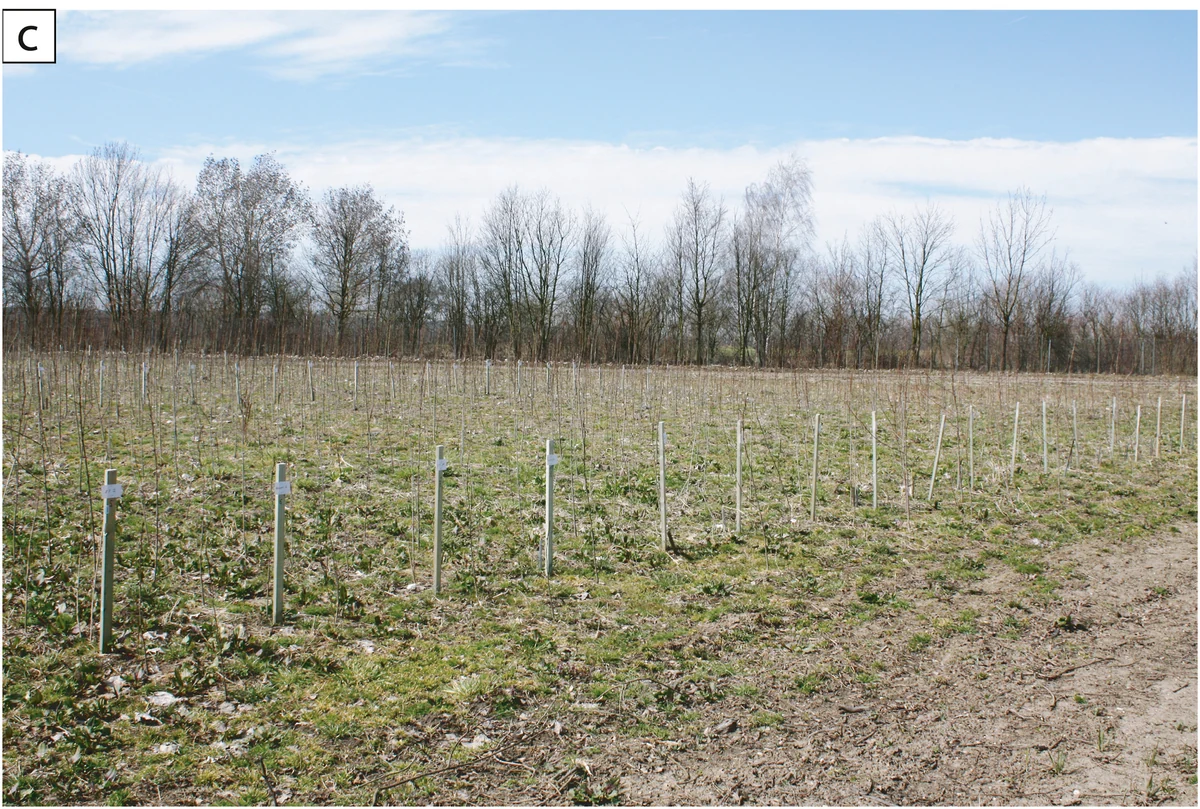
The German short-rotation coppice trial was established in 2012 on a light, sand-dominated site and followed 37 poplar varieties through three harvest rotations over nine years.Image: Landgraf, Thomas and Neupert (2026), Biomass and Bioenergy, detail from Fig. 1c, CC BY 4.0; cropped and resized for web. Article.
05Germany · poplar genetics and droughtPoplar drought evidence challenges standard high-density SRC assumptionsNine years and 37 varieties show that clone, density, water and rotation interact as financial variables.
Verified factBEC analysisOpen point

Who ran the trial and where. Dirk Landgraf and Simon Thomas of Erfurt University of Applied Sciences, together with Markus Neupert, report the results in the peer-reviewed journal Biomass and Bioenergy. The randomized short-rotation coppice trial was established in 2012 on a light, sand-dominated site under the continental climate of the Northeast German Lowlands. It compared 37 poplar varieties, including established clones and newer breeding material, over nine years. Survival was recorded after establishment and around harvests in 2015, 2018 and 2021; the researchers also measured resprouting, height, diameter at breast height and dry-matter yield. The article was released online in February and appears in an August journal volume, so it is a technical evidence file rather than current-week news.

What the nine-year record found. Performance varied widely. Seven varieties exceeded 11 Mg of dry matter per hectare per year and were judged suitable for commercial use under the trial conditions, while many produced around 8 Mg and six remained below 4 Mg. During the third rotation — a period that included exceptionally high temperatures and lower precipitation — rankings changed materially: AF19, previously a middle performer, reached 17.13 Mg of dry matter per hectare per year, while several familiar varieties declined. The authors observed that some of the strongest late-period yield gains occurred in stands with lower survival and therefore lower density, leading them to argue that dense stands may have suffered more drought competition. They favour lower planting densities, drought-tolerant material and, for comparable dry sandy sites, longer “midi-rotations” of roughly six to ten years rather than assuming that two-to-four-year cycles are always optimal.

BEC Perspective

The finance implication is larger than a clone-ranking table. Plantation models often begin with a single yield number multiplied by hectares, but this trial shows a distribution that changes with genetics, age, density, mortality and water stress. Establishment cost per surviving stool, the timing of the first commercial harvest, resprouting after cutting, drought losses and the chosen rotation all affect cash flow, annualised yield, harvesting cost and the probability of meeting an offtake schedule. A high-density design may maximise early site occupation yet increase competition for scarce water and require more planting material.

The authors’ recommendation should not be copied into another country or soil class without local validation. Lower density and a longer rotation can reduce planting cost and drought stress, but they can also delay revenue, change stem dimensions and harvesting equipment, increase standing-inventory exposure and alter product suitability. For project developers, the transferable lesson is to build clone-by-site yield curves, mortality and renewal scenarios and harvesting economics before fixing plantation density or promising annual tonnes.

Open point and next trigger

Watch for multi-site confirmation across different soils and rainfall regimes, commercial harvesting and replanting costs, nursery availability for the best-performing clones and documented adoption of the lower-density, longer-rotation approach.

Primary source: Landgraf, Thomas and Neupert — nine-year German poplar SRC trial.

Graphical abstract comparing granular and pelletised miscanthus flow through industrial hoppers
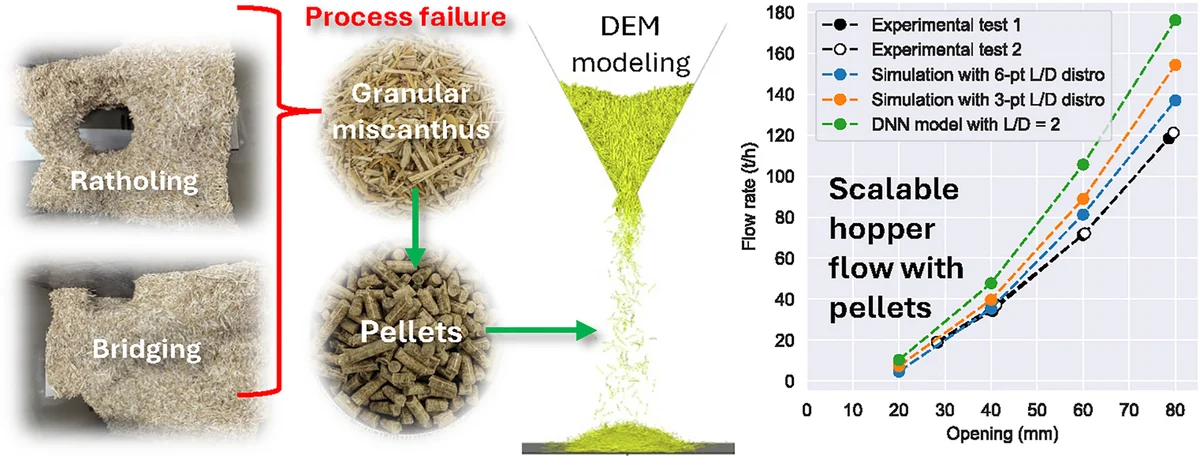
The study’s graphical abstract shows why crop tonnage and plant throughput are different questions: granular miscanthus bridged or rat-holed, while short, stiff pellets achieved more controllable hopper flow in experiments and models.Image: Xia et al. (2026), Biomass and Bioenergy, graphical abstract, CC BY 4.0; resized for web, no substantive alteration. Article.
06United States · miscanthus and industrial handlingMiscanthus feedability is part of feedstock bankabilityPellet geometry and hopper flow can determine whether a crop-based resource becomes reliable industrial throughput.
Verified factBEC analysisOpen point

Who produced the study and what was tested. Yidong Xia, Nepu Saha, Yingqian Lin and Jordan Klinger of Idaho National Laboratory published the peer-reviewed study in Biomass and Bioenergy, with support from the US Department of Energy’s Bioenergy Technologies Office. The team used Miscanthus × giganteus as a representative herbaceous energy crop. Material milled to 6 mm was processed in a pilot-scale ring-die pellet mill, and pellets were characterised for diameter, length, density and stiffness. Physical observations then informed discrete-element simulations of how pellet aspect ratio, stiffness and friction interact with wedge-hopper wall angles and outlet widths. A deep-neural-network surrogate was trained on the simulation dataset to produce a predictive design tool. The article was first published online on 4 March; its appearance in an August volume is not a fresh weekly release.

What the results show — and their limit. The study found that pellet length and hopper opening were the most influential variables. Long pellets could still jam during initial packing, while short, stiff pellets flowed much more reliably than the milled-miscanthus baseline. In the calibrated simulations, the preferred combinations produced continuous, stable discharge above an industrial design target of 2,000 metric tonnes per day, equivalent to about 83 tonnes per hour, and flow could be adjusted through outlet design. This is strong evidence that densification and geometry can reduce a known herbaceous-biomass handling problem. It is not evidence that a complete commercial biorefinery has continuously processed 2,000 tonnes per day of miscanthus, and it does not by itself establish the net energy, cost or storage performance of the pelletisation step.

BEC Perspective

The commercial significance is that annual feedstock availability and hourly plant feedability are different tests. A supply basin may deliver the contracted dry tonnes over a year and still fail the conversion plant if fibres bridge in bins, pellets break into fines, moisture changes friction or the receiving system cannot sustain the required hourly rate. Every interruption reduces plant availability and can erase margins that looked attractive in a field-gate or transport-only model. Physical form is therefore part of the feedstock specification, not merely a downstream engineering detail.

During FEED, a sponsor should test representative material from seasons and suppliers, measure densification energy and mass loss, examine storage, attrition and dust, and reconcile pellet properties with conveyors, hoppers, metering and reactor requirements. The optimal answer may be pelletisation, another form of densification or a redesigned receiving system; the study does not settle that project-specific choice. Its decision value is to show that crop, preprocessing and plant design must be developed together before nominal tonnes are converted into capacity, availability and revenue assumptions.

Open point and next trigger

The next evidence should include continuous full-scale operation, pelletisation energy and cost, storage and attrition across realistic moisture ranges, dust and safety performance, and adoption of the design method in an operating industrial feed system.

Primary sources: Xia et al. — peer-reviewed miscanthus pellet-flow study and Idaho National Laboratory publication record.

BEC Analysis — From Resource Potential to Bankable Feedstock

The six stories in this edition point to the same structural issue: most biomass projects do not fail because the world lacks biological material. They struggle because the distance between a resource estimate and a dependable industrial delivery system is underestimated. A land map may identify apparently suitable hectares; a forest treatment may require biomass removal; a plantation trial may report an attractive yield; and a conversion project may announce large capacity. None of those observations alone establishes who controls the resource, how much is recoverable, when it can be harvested, what quality reaches the plant, what it costs at the gate or who carries the downside risk.

Thin Lizzy and the Czech study illuminate opposite ends of the land-to-volume problem. The California procurement is operationally specific about contractor duties but silent on biomass quantity and destination. The Czech model is nationally ambitious and economically explicit, yet necessarily abstract at parcel level. Between those ends lies the work that converts hectares into supply: cadastral and tenure checks, environmental exclusions, stand or crop inventory, landowner participation, access, seasonal operations, recovery factors, moisture adjustment, aggregation and identification of a real industrial buyer. The practical supply curve becomes smaller and more expensive at every filter, but also more credible.

The poplar trial shows why biology cannot be reduced to a single yield coefficient. Yield is a distribution shaped by genetics, establishment success, mortality, stand density, water availability, rotation and management. It changes over time and can reorder the apparent winners between harvests. For a project sponsor, that variability affects nursery demand, planting cost, replacement rates, working capital, harvest scheduling and the probability of meeting annual delivery commitments. The correct model is not “hectares multiplied by expected yield”; it is a set of site- and age-specific yield probabilities linked to operating decisions and downside cases.

HAMR’s proposed Australian chain moves the same challenge to industrial scale. More than 500,000 tonnes per year would need to arrive not as an undifferentiated regional resource but as contracted material of known origin, quality and delivered cost. Plantation byproducts already have competing uses, and gross availability must be reduced for technical recovery, sustainability restrictions, supplier commitments, seasonality and transport. The feedstock plan must also match the plant’s operating profile and the hydrogen and methanol systems around it. Public funding can finance engineering and reduce development risk, but it cannot substitute for durable supply contracts, permits, co-funding, offtake and a final investment decision.

The miscanthus study brings the argument inside the factory fence. Plants consume feedstock hourly, while most resource assessments report annual tonnes. Bridging, variable moisture, pellet breakage, fines and hopper geometry can interrupt flow even when the annual supply contract appears adequate. Those interruptions reduce capacity utilisation and can change the economics of the entire project. Preprocessing therefore has to be assessed as a balance: densification may improve flow and transport, but it also consumes energy, adds equipment and creates storage, attrition, dust and safety requirements. The cheapest material at the field gate may not be the lowest-cost feedstock at reliable reactor throughput.

NEDO’s programme is the clearest institutional response to this fragmentation. Its proposed boundary includes the forest, the harvest, replanting, fuel production, transport, quality and transaction rules. That matters because public programmes often fund agronomy, machinery or conversion equipment separately and leave integration to a later project phase. A strong final call would require demonstration data that allow developers to compare species, climate, regeneration, cost, moisture, delivered quality and market price across the full chain. If NEDO achieves that, the learning could be more valuable than any single supported plantation.

For industrial sponsors and financiers, the emerging discipline is a staged evidence ladder. First, define eligible land or resource and its legal control. Second, establish crop- or stand-specific yield and recovery distributions. Third, design harvesting, preprocessing, storage and logistics around seasonal reality. Fourth, translate tonnes into enforceable contracts with quality, volume, indexation and remedies. Fifth, demonstrate that the receiving and conversion system can process the material continuously. Finally, connect field, logistics and plant data through monitoring and revision rules. Each stage should narrow uncertainty before the project commits the next tranche of capital.

The near-term watchpoints are therefore concrete. NEDO’s final call will reveal whether integrated energy-forest objectives are backed by meaningful budgets and operating metrics. Thin Lizzy’s award documents may disclose the missing volume and utilisation route. HAMR must progress from conditional support and scale claims to detailed FEED, auditable supply, approvals, offtake and FID. The Czech, German and US studies need transfer from controlled models and trials into commercial projects with transparent costs. The broader outlook remains positive for plantation and purpose-grown feedstocks, but the winning projects will be those that treat feedstock as engineered infrastructure rather than an input assumed to be available.

Top Five Developments

  1. California forestry mobilisation: Thin Lizzy’s bid tables and response timetable changed on 12 August, while biomass tonnage, specification and destination remain undisclosed.
  2. Japan’s integrated energy forests: NEDO’s late-August call is the nearest public decision point linking planting and regeneration to chips, pellets, transport, quality and market practice.
  3. Australian project finance: ARENA has verified conditional HAMR development funding; feedstock coverage, output and emissions performance remain to be demonstrated through FEED and contracts.
  4. Czech land and biomass economics: spatial analysis quantifies a large theoretical potential while showing that yield, support, parcel eligibility and logistics determine what can actually be developed.
  5. Plantation and plant-gate reliability: poplar and miscanthus research places drought, density, rotation, preprocessing and hopper performance inside the bankability model.

What to Watch Next

  • The final budget, grant rate, eligibility and measurement requirements in NEDO’s second 2026 woody-biomass call.
  • Thin Lizzy bid and award records showing estimated biomass tonnes, product specifications, destination and commercial terms.
  • HAMR’s co-funding, detailed FEED, permits, independently auditable supply contracts, product offtake and final investment decision.
  • Commercial adoption of lower-density, longer-rotation poplar systems under climates comparable to the German trial.
  • Full-scale evidence on miscanthus pelletisation energy, storage, attrition and sustained hourly feeding performance.

From the BEC Blog

Need to test the feedstock case behind a project?

Bioenergy Crops supports land and resource screening, crop and residue assessment, supply-basin design, delivered-cost modelling, feedstock diligence and implementation systems for bioenergy and biobased projects.

Discuss a project

Sources

Primary and authoritative sources were checked through 16 August 2026, 17:00 Europe/Madrid. Organisation-led scale or performance statements are identified as company claims; BEC’s interpretation and unresolved questions are presented separately in each story.

  1. National Forest Foundation — Thin Lizzy Timber Project, Plumas National Forest
  2. NEDO — second 2026 woody biomass supply-system call preview
  3. NEDO — stable and efficient woody-biomass supply programme
  4. ARENA — conditional HAMR development and FEED funding
  5. HAMR Energy — Portland Renewable Fuels project description
  6. Vávrová et al. — perennial biomass on Czech fallow land
  7. Landgraf, Thomas and Neupert — nine-year poplar SRC trial
  8. Xia et al. — miscanthus industrial feeding study
  9. Idaho National Laboratory — publication record and release date