
Sustainable aviation fuel is often discussed as if it were a single global commodity.
Commercial reality is more fragmented.
A fuel can meet an approved aviation specification, achieve a strong lifecycle greenhouse-gas reduction and still carry different commercial value in Europe, the United Kingdom, the United States, Brazil, India, Singapore or under CORSIA.
Feedstock eligibility, lifecycle methodology, certification, blending infrastructure, production location, environmental attributes and the structure of the offtake agreement can all determine whether a project reaches the market successfully.
For SAF developers, this creates a critical requirement: the intended market needs to be considered alongside the feedstock and conversion pathway from the beginning.
SAF must pass several commercial filters
A SAF project moves through a sequence of interconnected systems.
The conversion technology must first produce an aviation-fuel component that complies with an approved pathway. The feedstock and supply chain must then satisfy the relevant sustainability requirements. Lifecycle emissions need to be calculated and verified. The resulting fuel must qualify under the regulation or incentive scheme creating demand. Finally, it needs to be blended, certified, distributed and sold under contracts capable of supporting the project economically.
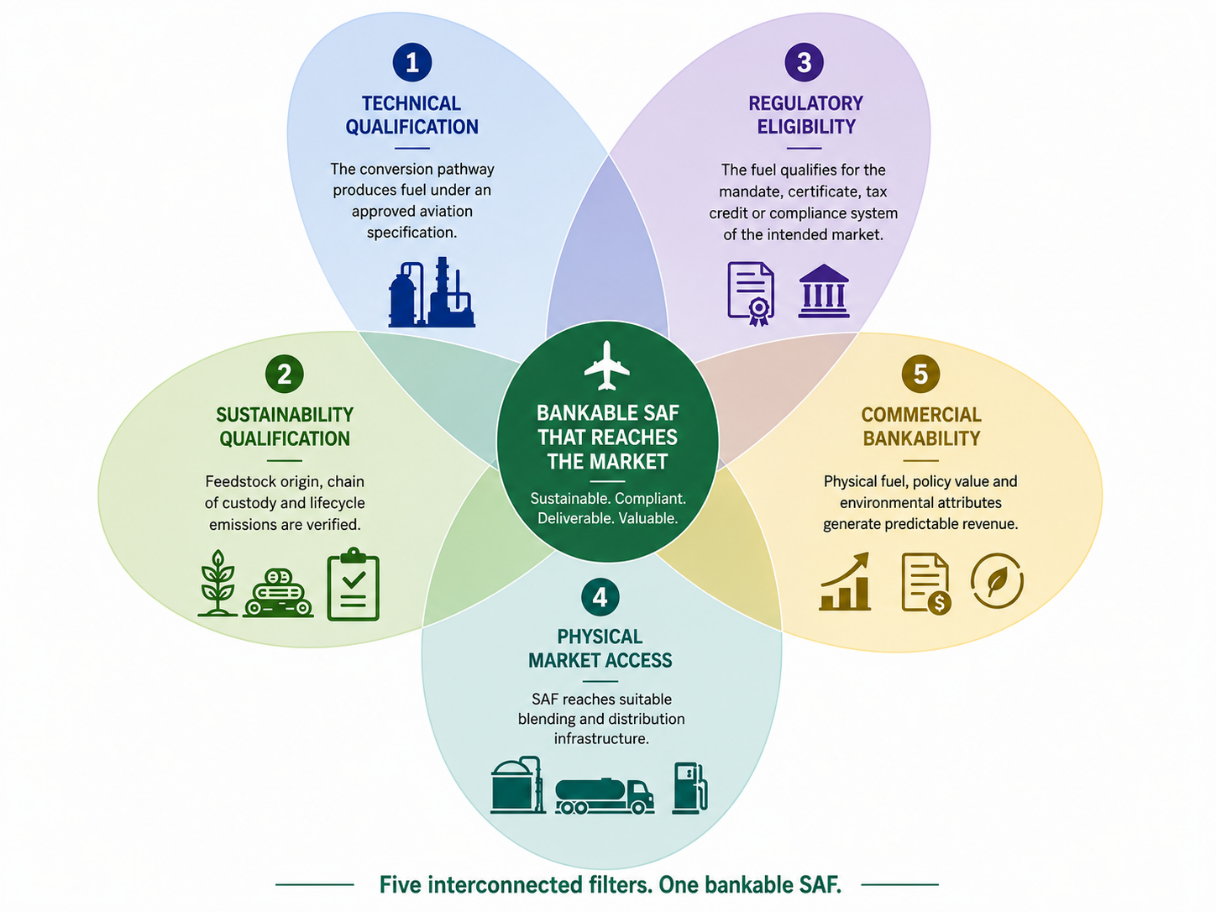
A useful way to view the process is through five filters:
- Technical qualification: the conversion pathway produces fuel under an approved aviation specification.
- Sustainability qualification: feedstock origin, chain of custody and lifecycle emissions are verified.
- Regulatory eligibility: the fuel qualifies for the mandate, certificate, tax credit or compliance system of the intended market.
- Physical market access: SAF reaches suitable blending and distribution infrastructure.
- Commercial bankability: physical fuel, policy value and environmental attributes generate predictable revenue.
Weakness in any one of these areas can materially reduce project value.
An ethanol-to-jet fuel may comply technically but receive different regulatory treatment depending on the underlying ethanol feedstock and carbon intensity. Waste-derived SAF may lose eligibility if its waste status cannot be demonstrated. A fully eligible fuel may still face delays if blending or terminal capacity is unavailable.
This extends the feedstock challenge discussed in our earlier analysis, SAF Will Not Scale Without Reliable Feedstock. Reliable feedstock is the starting point. Market eligibility and delivery determine where that feedstock can ultimately create value.
CORSIA provides a global framework, but national markets remain different
ICAO’s Carbon Offsetting and Reduction Scheme for International Aviation, or CORSIA, establishes the main international framework for recognising eligible aviation fuels.
To generate CORSIA value, SAF must be produced by operators certified under an ICAO-approved Sustainability Certification Scheme and comply with the applicable lifecycle-emissions and sustainability methodologies [1].
As of June 2026, ICAO had approved ISCC, RSB, ClassNK and Bonsucro, although their approved scopes differ. Bonsucro, for example, was approved specifically for sugarcane-related supply chains and associated Alcohol-to-Jet and SIP production [2].
Certification systems should be evaluated against the feedstock, pathway and destination market rather than selected generically.
CORSIA also differentiates primary products, co-products, by-products, wastes and residues. These classifications influence lifecycle calculations and verification requirements. High compliance values create strong incentives to correctly establish whether a material is genuinely a waste or residue.
Traceability therefore extends well upstream of the refinery.
Different policies create different SAF markets
National and regional policies increasingly influence which fuels and pathways gain commercial advantage.
European Union
ReFuelEU Aviation establishes one of the clearest long-term demand trajectories.
The SAF requirement begins at 2% in 2025 and rises to 70% by 2050. A separate synthetic-fuel requirement starts at 1.2% in 2030 and reaches 35% by 2050 [3].
This gives Power-to-Liquid and other synthetic fuels a protected share of future European demand, even while bio-based SAF remains commercially important.
United Kingdom
The UK mandate reaches 10% in 2030 and 22% in 2040.
It also deliberately restricts the long-term contribution from HEFA. HEFA can initially meet the full obligation, but its maximum contribution falls to 71% by 2030 and 35% by 2040. A separate Power-to-Liquid obligation begins in 2028 [4].
The implication is significant: growth in total UK SAF demand does not translate directly into equal growth in the addressable market for every pathway.
United States
The US market is structured differently.
There is currently no federal volumetric SAF mandate comparable with ReFuelEU Aviation. Economics instead depend heavily on carbon-intensity-based incentives, domestic production credits, the Renewable Fuel Standard and selected state programmes [5].
This creates considerable potential value, but also exposes projects to carbon modelling, tax rules, credit prices and policy duration.
Brazil
Brazil’s ProBioQAV framework uses a lifecycle-emissions-reduction approach, beginning with a 1% reduction requirement in 2027 and increasing progressively thereafter [6].
This structure gives carbon performance a central commercial role.
India
India has announced an initial pathway of 1% SAF for international flights in 2027, 2% in 2028 and 5% in 2030 [7].
The development of domestic feedstocks, conversion capacity and certification will influence how much of this demand is supplied locally.
Singapore
Singapore is developing another model.
Its SAFCo structure centralises procurement and uses a levy on departing passengers, cargo and aviation activity to finance SAF acquisition. This can aggregate demand and create more standardised procurement conditions in a major global aviation hub [8].
These policy architectures affect project location, technology selection and feedstock strategy. A SAF molecule can therefore have materially different economic value depending on where and how it is sold.
The refinery gate is only part of the route to the aircraft
Once SAF has been produced, it still needs to enter the aviation fuel distribution system.
Approved synthetic components are produced under ASTM D7566 pathways. They are then blended with conventional Jet A or Jet A-1 according to pathway-specific limits and tested.
After successful blending and certification, the fuel is redesignated as ASTM D1655-compliant aviation fuel and can enter conventional distribution infrastructure [9].
This is where existing terminals become strategically important.
NREL’s analysis of SAF blending and logistics found that established fuel terminals are generally the most practical blending locations because they already provide:
- tanks and pumps;
- metering and blending systems;
- trained personnel;
- permits and insurance;
- quality-control procedures;
- pipeline, rail, road or marine connections.
Using existing terminal infrastructure can substantially reduce the capital and operational burden of introducing SAF.
Blending at airports is considerably less attractive. It can require dedicated tanks, testing systems, additional truck movements, new insurance arrangements and further operational complexity.
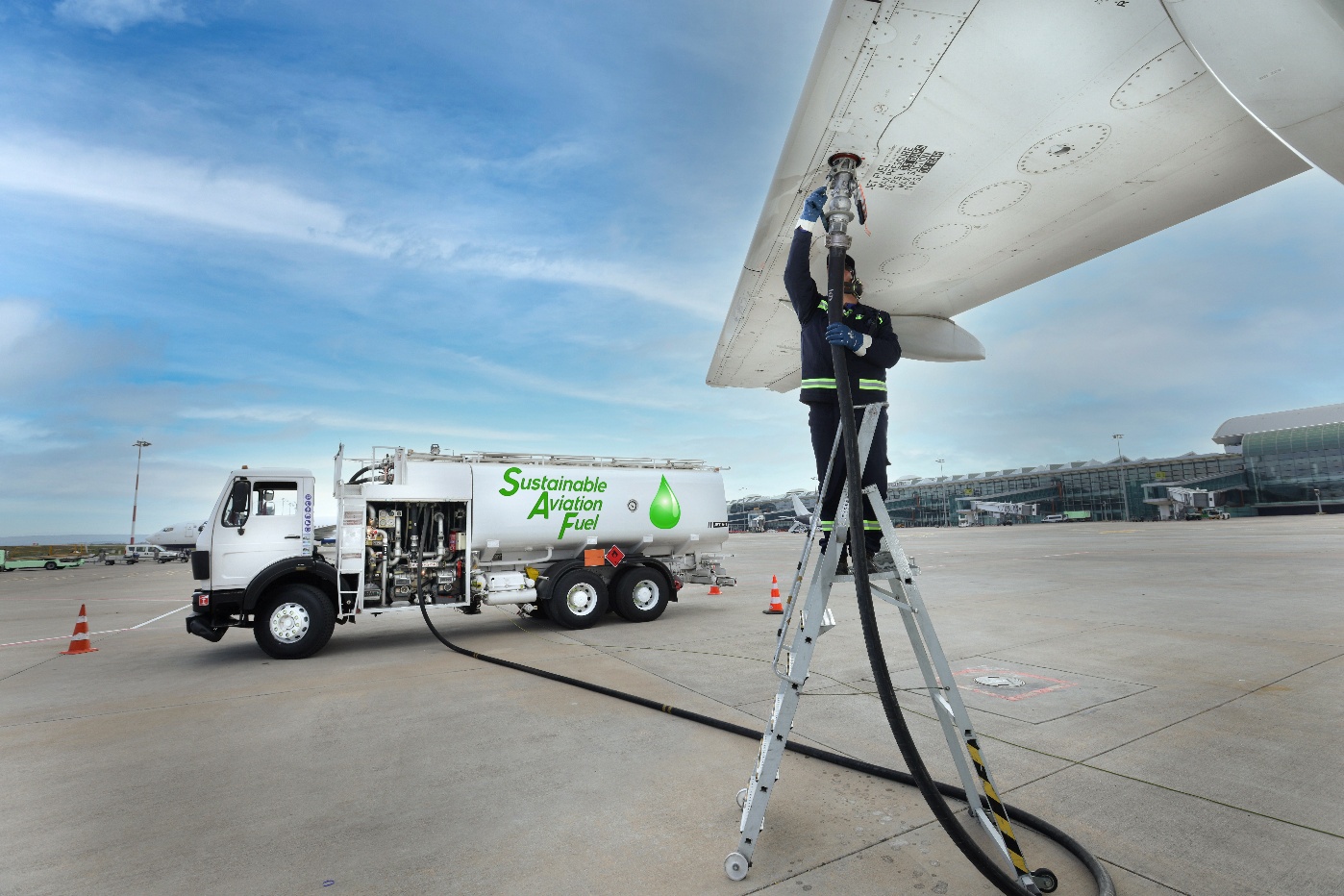
Once SAF has been blended and certified as conventional-specification aviation fuel, the downstream system becomes much simpler. Existing pipelines, trucks, airport tank farms and hydrant systems can generally handle it.
This creates an important distinction between neat SAF logistics and certified blended-fuel logistics.
Infrastructure can become a market constraint
Terminal capacity, pipelines and airport connections are finite.
Some airports already experience conventional jet-fuel infrastructure constraints. Growing SAF volumes can add pressure where dedicated storage, blending or transportation capacity is limited.
Location therefore becomes part of the business model.
A project located close to a suitable terminal, refinery, port or pipeline connection can have a significant advantage over an otherwise similar project requiring new infrastructure.
This also connects with the wider BEC concept of feedstock basins and biomass hubs. Large biofuel projects need to be understood as networks connecting resource territories, aggregation infrastructure, conversion assets and downstream markets.
The feedstock basin determines what can reach the plant. Fuel infrastructure determines what can leave it.
Book-and-claim changes how SAF reaches customers
SAF also has an unusual commercial characteristic: the physical fuel and its environmental attributes do not always have to move together.
Book-and-claim systems allow SAF to be physically introduced into the aviation fuel system where production and infrastructure make most sense, while the associated emissions-reduction attributes can be purchased by an airline or corporate customer elsewhere.
IATA launched its SAF Registry in April 2025 to support these transactions and prevent double counting [10].
This can reduce unnecessary transportation and broaden market access.
An airline operating from an airport without SAF infrastructure can financially support SAF introduced at another suitable hub and potentially claim the associated environmental benefit, subject to the relevant accounting and regulatory rules.
Credibility depends on rigorous registry systems, unique transactions, recognised lifecycle data and transparent retirement of environmental attributes.
Offtake volume does not automatically equal bankable demand
SAF purchase announcements have grown rapidly.
ICAO tracks tens of billions of litres associated with announced offtake agreements, while IATA has documented substantial airline commitments [11][12].
But the quality of those agreements varies considerably. A memorandum of understanding and a long-term take-or-pay agreement may both appear publicly as “SAF offtake”, but they provide very different levels of revenue certainty.
The feedstock–pathway–market triangle
SAF projects ultimately need alignment between three systems:
Feedstock
Sufficient, sustainable, traceable, contractable and compatible with the required lifecycle methodology.
Pathway
Technically qualified, mature enough for the intended scale and capable of converting the selected resource competitively.
Market
Able to recognise the fuel, provide blending and distribution access, and create sufficient contractual and policy value.
This creates a useful project-development sequence.
The target market influences feedstock eligibility. Feedstock characteristics influence the conversion pathway. The pathway determines fuel qualification and infrastructure requirements. Together, these factors shape the carbon value, offtake structure and financing case.
The development process therefore needs to connect the feedstock basin, conversion technology and commercial market architecture from the beginning.
Bioenergy Crops supports feedstock assessment, sustainability, lifecycle-data requirements and supply-chain design around selected SAF pathways. Canoppia Group supports project structuring, implementation, partner alignment and commercial development.
Future SAF scale will come from projects capable of integrating these systems into one solid supply chain—from the land or residue source, through conversion and certification, to the fuel terminal and ultimately the aviation market.
References
[1] International Civil Aviation Organization (ICAO), CORSIA Eligible Fuels, updated June 2026.
https://www.icao.int/CORSIA/corsia-eligible-fuels
[2] ICAO, CORSIA Approved Sustainability Certification Schemes, Fourth Edition, June 2026.
[3] European Commission, ReFuelEU Aviation.
https://transport.ec.europa.eu/transport-modes/air/environment/refueleu-aviation_en
[4] UK Department for Transport, The SAF Mandate: An Essential Guide.
[5] U.S. Internal Revenue Service, Clean Fuel Production Credit – Section 45Z.
[6] Empresa de Pesquisa Energética (EPE), Sustainable Aviation Fuels in Brazil and ProBioQAV Framework.
[7] Government of India, Government Brings SAF-Blended Aviation Fuel Under ATF Control Order, April 2026.
[8] Civil Aviation Authority of Singapore, SAFCo Central Procurement Framework.
[9] Moriarty, K. and McCormick, R., Sustainable Aviation Fuel Blending and Logistics, National Renewable Energy Laboratory, 2024.
[10] International Air Transport Association (IATA), IATA SAF Registry Goes Live, April 2025.
[11] IATA, Quarterly Air Transport Chartbook, Q1 2026.
[12] ICAO, Cleaner Energy Tracker and SAF Offtake Agreements.