
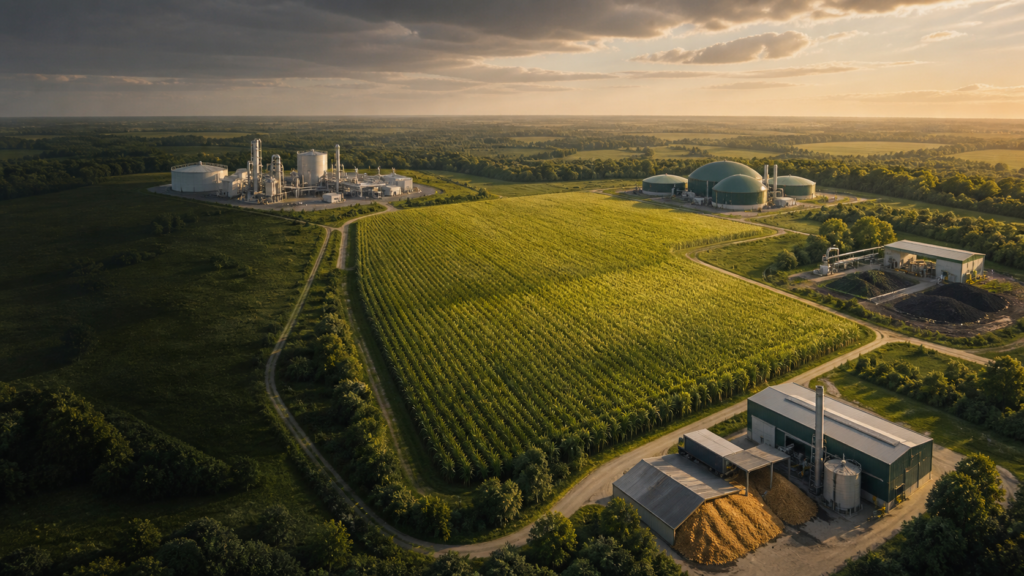
A crop becomes an industrial feedstock when its agronomy, delivered form, evidence and economics match a conversion pathway. Designing that fit early can create stronger primary markets, credible fallback uses and better investment decisions.
One hectare can produce biological carbon for several growing markets.
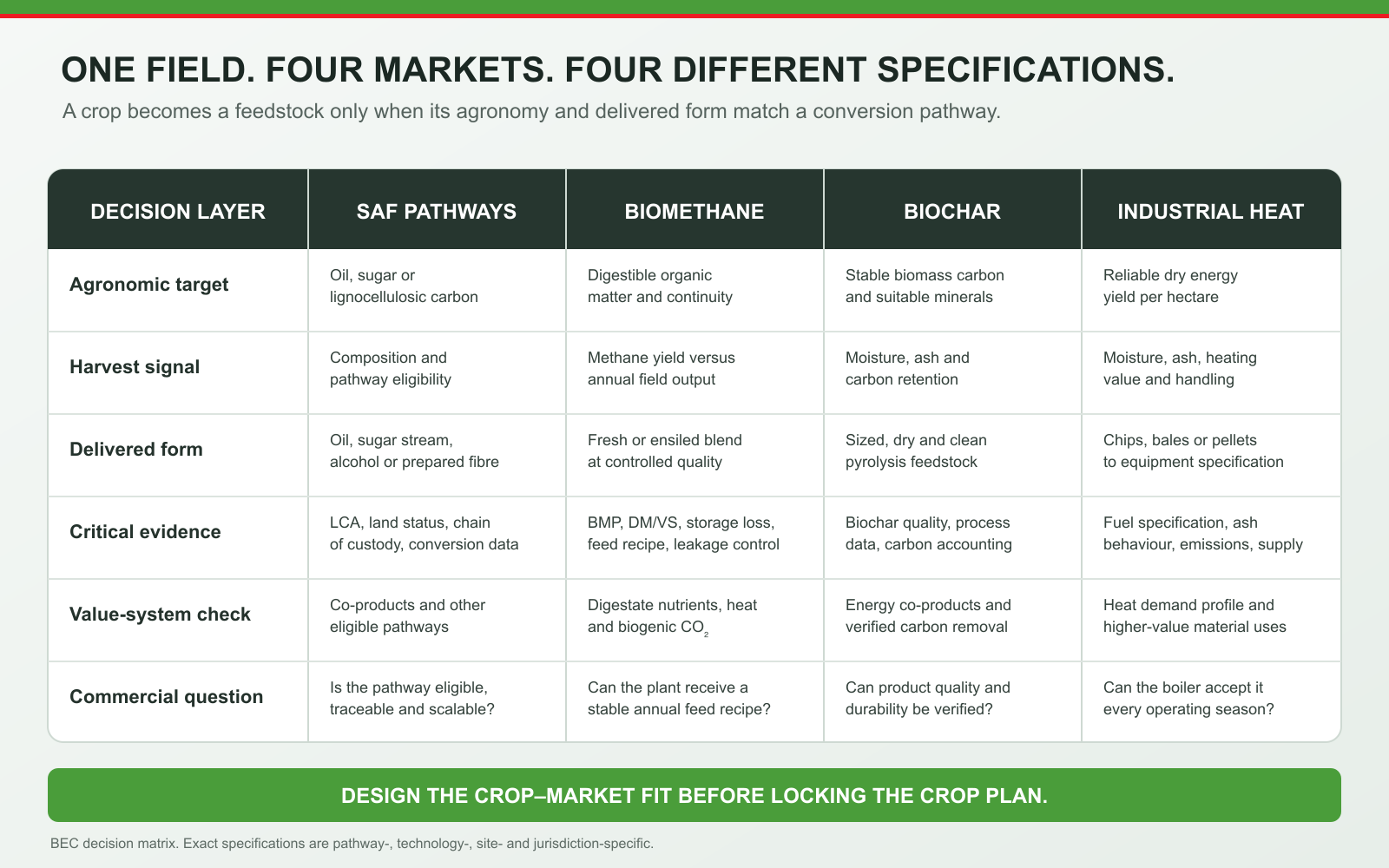
Oil, sugars and lignocellulosic material can enter sustainable aviation fuel pathways. Wet, digestible biomass can support biomethane. Clean, controlled biomass can be converted into biochar. Dry, specification-compliant material can supply industrial heat.
That range creates opportunity — and a common planning error.
The same crop name does not mean the same industrial product. A variety, harvest date and logistics system optimised for anaerobic digestion may be poorly suited to combustion. A crop grown for high dry-matter yield may require different management if its value depends on oil content, fermentable sugars, ash chemistry or carbon-removal performance.
This principle connects four sectors that are often analysed separately. It also opens a practical route for developers, farmers, investors and offtakers: begin with crop–market fit, then build the field programme, conversion evidence and supply system around the intended product.
Why crop–market fit matters now
Biological resources are being asked to do more.
The International Energy Agency identifies diversification beyond limited waste oils and edible oils as a key requirement for scaling aviation biofuels. Biomethane policies are expanding as countries seek domestic gas, waste-management and rural-development benefits. The European Union has established a voluntary certification framework and methodologies for permanent carbon removals, including biochar carbon removal. Industrial users continue to evaluate biomass and biomethane for high-temperature heat and gaseous feedstock applications.
At the same time, the European Commission’s 2025 Bioeconomy Strategy calls for more resource-efficient and circular use of biological resources, stronger sustainable biomass supply and greater value creation for primary producers. These goals increase the importance of allocating biomass intelligently, recognising alternative uses and avoiding double counting.
The opportunity is larger than choosing which market pays the highest price today. It is to develop feedstock systems that can produce the right quality, evidence and calendar for a primary market while retaining realistic secondary options.
Optionality is valuable when it is engineered. It is fragile when it exists only in a presentation.
Market 1: SAF values pathway eligibility and lifecycle evidence
SAF is not one conversion route and crops are not interchangeable inputs.
Current and developing pathways can use fats and oils, alcohols, sugars, municipal and industrial streams, and lignocellulosic biomass. Oilseed crops may supply lipid pathways such as HEFA where they meet technical and sustainability requirements. Sugar or starch crops can produce alcohol intermediates for alcohol-to-jet routes. Grasses, agricultural residues and woody biomass may enter cellulosic ethanol or thermochemical pathways such as biomass gasification followed by Fischer–Tropsch synthesis, subject to technology maturity and project configuration.
The International Civil Aviation Organization’s CORSIA framework ties lifecycle emissions to the combination of feedstock, conversion process and production region. Its system boundary includes cultivation, harvest and collection, processing, transport, conversion, fuel distribution and combustion. Land-use change and sustainability certification also matter.
For an agricultural SAF feedstock, the specification therefore has at least four dimensions:
- conversion quality: oil, sugar, carbohydrate, lignocellulosic composition, contaminants and delivered form;
- eligibility: feedstock classification and compatibility with the intended certified pathway;
- lifecycle performance: land history, inputs, energy, transport, soil effects and conversion data;
- traceability: field boundaries, chain of custody, batch identity and auditable operating records.
Two physically similar tonnes may have different commercial value because their origin, pathway or evidence differs.
This connects directly with BEC’s earlier analysis of SAF feedstock supply chains. Reliable procurement remains essential. Crop–market design goes one step earlier: it asks what should be grown, how it should be managed and which evidence must be captured so that a future tonne is eligible and useful.
Market 2: Biomethane values usable methane through the year
Anaerobic digestion values organic matter that microorganisms can convert under the plant’s operating conditions. Important variables include dry matter, volatile solids, fibre fractions, nutrient balance, inhibitors, particle size, storage condition and specific methane yield.
Fresh yield alone is a weak comparison. A crop with high water content can create transport and reactor-volume costs. A highly digestible young crop may require frequent harvesting and remove more nutrients. A mature crop may deliver more dry matter but become more fibrous. Ensiling can extend availability, while introducing requirements for chop, compaction, cover, drainage and inventory management.
The most useful agronomic target is often annual recoverable methane potential per hectare at an acceptable delivered cost, combined with feed-recipe stability. That requires field measurements and representative biochemical methane potential tests, supported by digestion trials as the project advances.
Biomethane also has co-product and environmental dimensions. Digestate nutrient use, process heat, biogenic carbon dioxide and fugitive-methane control influence both economics and lifecycle performance.
For this market, a feedstock passport should tell the plant operator what will arrive each month, how it was preserved, how variable it is and how it behaves in the selected digestion system.
Market 3: Biochar values controlled carbon and product quality
Biochar markets convert biomass into a carbon-rich solid through controlled thermochemical processing. The resulting product can serve different applications, including soil use and permanent carbon removal where the full methodology, product quality and end use qualify.
The feedstock influences char yield, fixed carbon, ash, pH, nutrients, contaminants and operating behaviour. Moisture affects drying energy. Minerals can concentrate during conversion. Soil contamination introduced at harvest can alter ash content and product quality. Particle size and bulk density influence preprocessing and reactor feeding.
The European Commission’s Carbon Removals and Carbon Farming framework now includes a certification methodology for biochar carbon removal as a permanent-removal activity. This development strengthens the case for connecting feedstock records, conversion data, product testing, eligible end use and monitoring from the beginning.
A credible biochar feedstock strategy therefore considers:
- clean and controlled biomass origin;
- moisture, ash and contaminant limits;
- stable reactor feeding and conversion conditions;
- product-quality testing;
- lifecycle emissions and energy co-products;
- carbon accounting, durability and end-use evidence.
The commercial product is not simply black material leaving a reactor. It is a tested biochar, an energy balance and — where claimed — a verified carbon-removal record.
Market 4: Industrial heat values a dependable fuel specification
Industrial heat users purchase energy delivered through equipment.
For solid biomass, moisture, ash content and composition, particle size, bulk density, heating value, contamination and consistency can affect storage, conveying, combustion, slagging, fouling, corrosion, emissions and ash handling. Boilers and gasifiers have specific tolerances. A material that burns in principle may still be commercially unsuitable for a particular system.
The US Department of Energy’s Feedstock Conversion Interface Consortium highlights how variability in moisture, ash, particle size and chemical composition can cause dry-matter loss, equipment blockage, wear and lower conversion yields. It also shows why harvest practice, soil contamination, weather and storage can change downstream behaviour.
For crops supplying industrial heat, agronomy must target reliable dry-energy production and a fuel that can meet the acceptance protocol across seasons. That may influence variety, harvest maturity, cutting height, field drying, baling or chipping, covered storage and blending.
Alternative material uses also belong in the decision. The EU’s cascading-use principle for woody biomass directs support towards uses with higher economic and environmental added value. A project should therefore understand whether the same material already supplies panels, pulp, animal bedding, soil products or other markets before assigning it to energy.
One crop can express four different specifications
Consider a perennial lignocellulosic grass as an illustrative case.
For biomethane, the development team may prioritise digestibility, manageable dry matter, ensiling behaviour and multiple harvests. For industrial heat, it may favour a later harvest, lower moisture, higher dry-matter yield and controlled ash behaviour. For biochar, clean harvesting, mineral composition, drying requirement and char quality become important. For SAF via a lignocellulosic pathway, carbohydrate composition, preprocessing, lifecycle data, feedstock eligibility and conversion maturity shape value.
These options do not imply that every crop can enter every market competitively. They reveal the variables that must be tested.
Genetics, soils, water, nutrients and harvest timing affect both yield and composition. The US Department of Energy describes biomass variability from field through conversion as a persistent challenge for biorefineries. Research on Napier and other grasses likewise shows that variety and cutting interval can change dry matter, fibre, digestibility and methane response.
The lesson is commercially useful:
Otherwise, a project may maximise the wrong attribute.
A primary market, a secondary market and a fallback route
Multi-market thinking becomes valuable when the roles are explicit.
Primary market
This market determines the core crop specification, evidence programme, contracting model and infrastructure. It should support the strongest expected margin and the clearest route to qualification.
Secondary market
This market can purchase a defined fraction, a co-product, a different harvest window or material that meets a second specification. The secondary route needs its own buyer, quality protocol, logistics and economics.
Fallback route
This reduces exposure to temporary outages, rejected batches or demand changes. It should be technically and legally feasible, but it should not be assigned the same premium economics as the primary route without evidence.
Primary market
This market determines the core crop specification, evidence programme, contracting model and infrastructure.
Secondary market
This market can purchase a defined fraction, a co-product, a different harvest window or material that meets a second specification.
Fallback route
This reduces exposure to temporary outages, rejected batches or demand changes.
The same tonne cannot be committed twice. Nor should a project assume that rejected SAF feedstock automatically becomes premium biochar feedstock, or that a wet digestion crop can be moved economically into a boiler. True optionality depends on separate specifications, tested acceptance and available capacity.
Build a feedstock passport before scale
A feedstock passport is a structured evidence set connecting the field, the delivered material and its potential markets. It can begin during screening and become more detailed through trials and deployment.
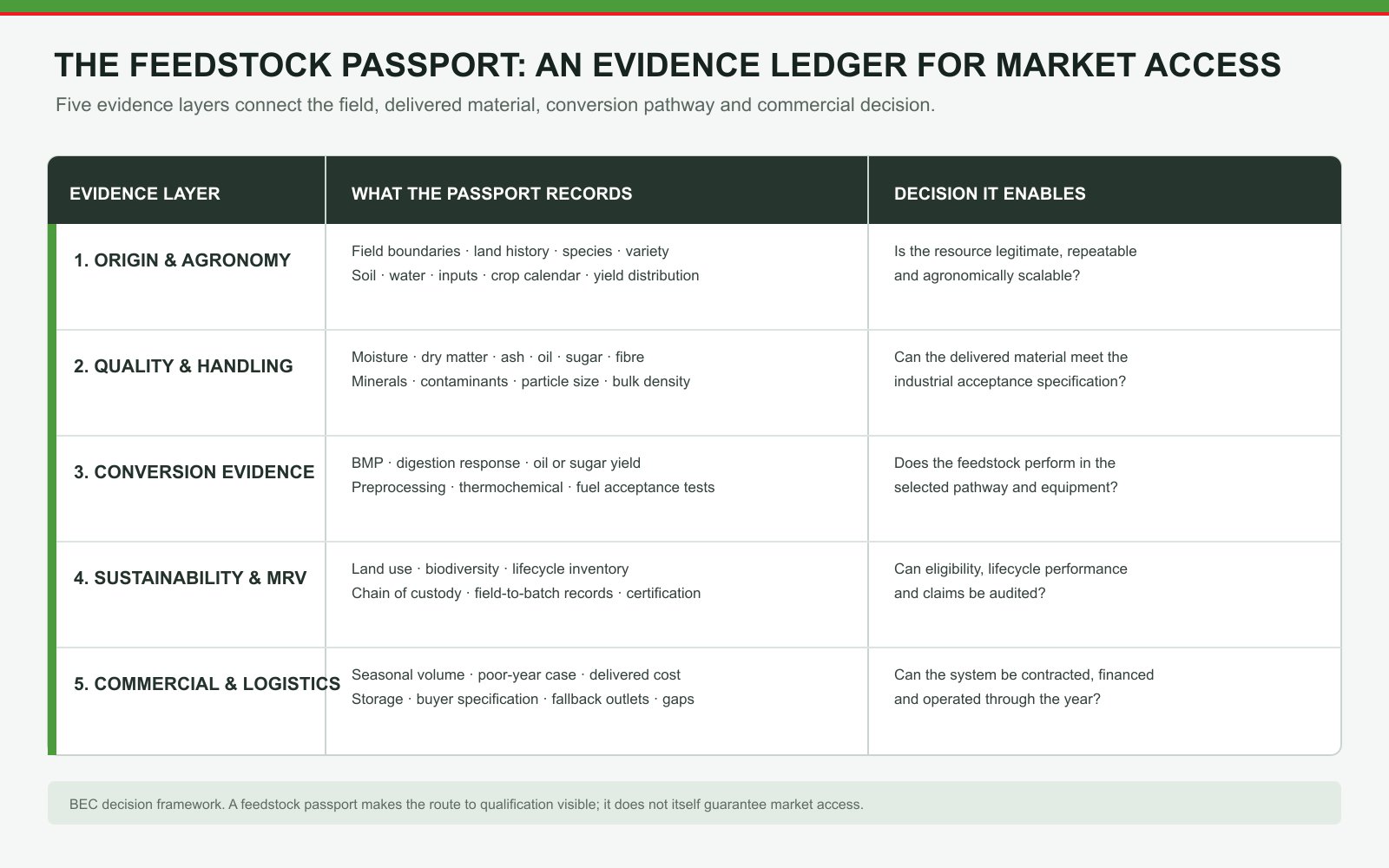
Origin and agronomy
- field boundaries, land status and prior use;
- species, variety and planting material;
- soil, climate and water context;
- inputs, field operations and crop calendar;
- yield distribution and harvest history.
Physical and chemical quality
- moisture and dry matter;
- ash and relevant minerals;
- fibre, carbohydrates, oil or other pathway-critical composition;
- contaminants and storage condition;
- particle size, bulk density and handling behaviour.
Conversion evidence
- BMP and digestion response;
- oil or sugar yield and quality;
- preprocessing and thermochemical testing;
- biochar product analysis;
- fuel acceptance and combustion or gasification trials.
Sustainability and traceability
- land-use and biodiversity screening;
- lifecycle inventory;
- chain of custody;
- field-to-batch records;
- applicable certification and MRV requirements.
Commercial and logistics data
- seasonal volumes and poor-year cases;
- collection, storage and delivered-cost curves;
- competing uses and supplier structure;
- primary, secondary and fallback outlets;
- development gates and remaining evidence gaps.
This passport does not guarantee market access. It makes the route to qualification visible and allows developers, buyers and investors to discuss the same material with the same data.
A six-step crop–market design sequence
- Define the target products and pathways. Specify the primary market, technology, geography, qualification route and operating calendar.
- Screen land and resources. Map sustainability constraints, current uses, water, soils, logistics and realistic scale.
- Select crop systems against the specification. Compare genetics, rotations, intermediate crops, perennial grasses, woody crops and residues on delivered performance.
- Run field and conversion tests together. Link harvest date and management to laboratory and pilot results.
- Design logistics, storage and traceability. Preserve quality and evidence from field to industrial gate.
- Contract the value system. Align growers, aggregators, processors, offtakers and fallback outlets around measurable specifications.
This sequence can prevent two costly errors: building a conversion concept around theoretical biomass, and establishing a crop programme before confirming how the market will value it.
The next bio-based advantage is crop–market intelligence
Biological carbon will serve more markets, not fewer. SAF, biomethane, biochar and industrial heat will continue to compete, collaborate and create co-product opportunities across regions.
The winning feedstock systems will understand what each market buys. They will design genetics, fields, harvests, storage, testing and records around those requirements. They will also know when another use creates more value or resilience.
One field can open four markets. The advantage comes from designing the right route before the crop is planted.
Bioenergy Crops supports developers, investors, industrial users and offtakers with land and crop screening, agronomy, feedstock specification, conversion-oriented trials, supply-chain and logistics design, sustainability, MRV and multi-market commercial strategy.
Sources and further reading
- ICAO, CORSIA lifecycle emissions of aviation fuels
- ICAO, CORSIA eligible fuels and feedstock classifications
- IEA, Biofuels: diversifying sustainable feedstock supplies
- IEA, Outlook for Biogas and Biomethane, 2025
- European Commission, 2025 EU Bioeconomy Strategy
- European Commission, CRCF certification methodologies
- European Commission, biomass cascading principle
- US Department of Energy, biomass variability and conversion
- Related BEC analysis: SAF feedstock supply chains