
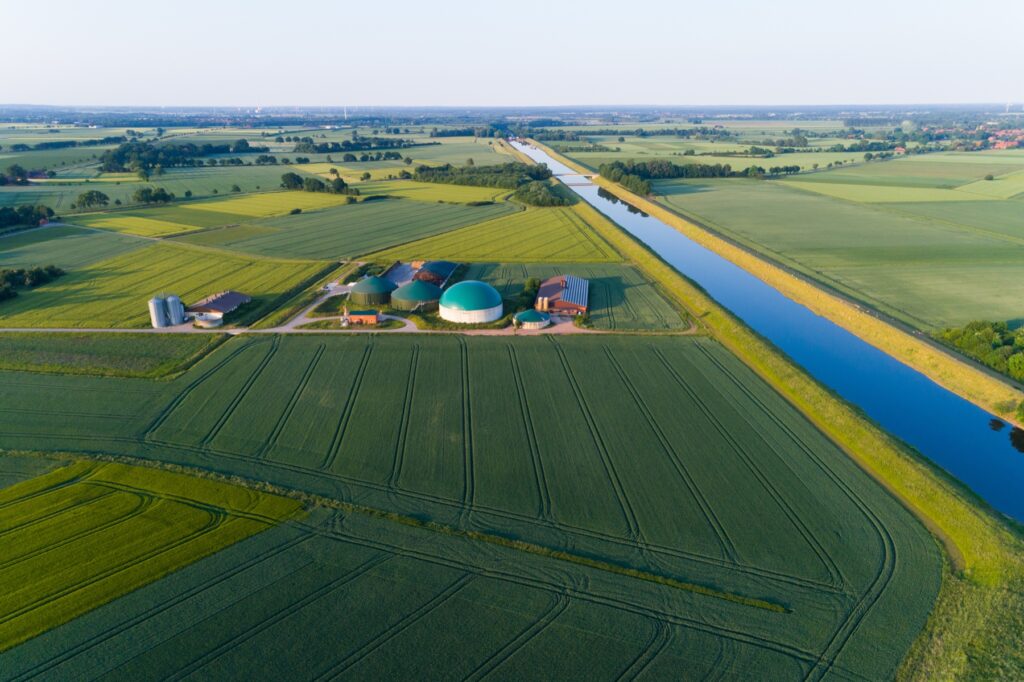
India has created a much stronger demand and investment signal for compressed biogas. The next competitive advantage will be built upstream: in fields, feedstock portfolios, storage systems, laboratories and local supply basins.
India’s compressed biogas market has entered a new phase.
On 6 August 2026, the Government of India approved GOBARdhan, the National Circular Bioenergy Scheme, with a total outlay of ₹23,731 crore and an implementation horizon from FY 2026–27 to FY 2035–36. The framework combines assured offtake, a stable administered CBG price, capital assistance, pipeline infrastructure, credit support and a dedicated ecosystem fund. It is intended to drive nearly ten-fold growth in domestic CBG production. The official announcement also points to more than 200 plants already commissioned across the country.
For developers and investors, the signal is unusually clear. The notified CBG obligation rises from 3% in FY 2026–27 to 4% in FY 2027–28 and 5% from FY 2028–29 in the CNG transport and domestic PNG segments. The scheme announces an administered price of ₹2,110/MMBTU with a minimum ten-year horizon, and capital assistance of up to ₹2 crore per tonne per day of installed CBG capacity for eligible greenfield projects.
These measures can improve revenue visibility, financing conditions and evacuation options. They also change the centre of gravity of project risk.
As the offtake framework becomes clearer, feedstock execution becomes more valuable.
A CBG facility requires a dependable daily feed recipe, while agriculture produces seasonal, variable and geographically dispersed material. Closing that gap is the field-to-gas challenge.
The equation that determines commercial gas output
The useful question is not simply how many tonnes a crop can produce or how much biomass exists within a district. A more practical early-stage relationship is:
Delivered CBG = harvestable dry matter × recovered fraction × specific methane yield × plant recovery
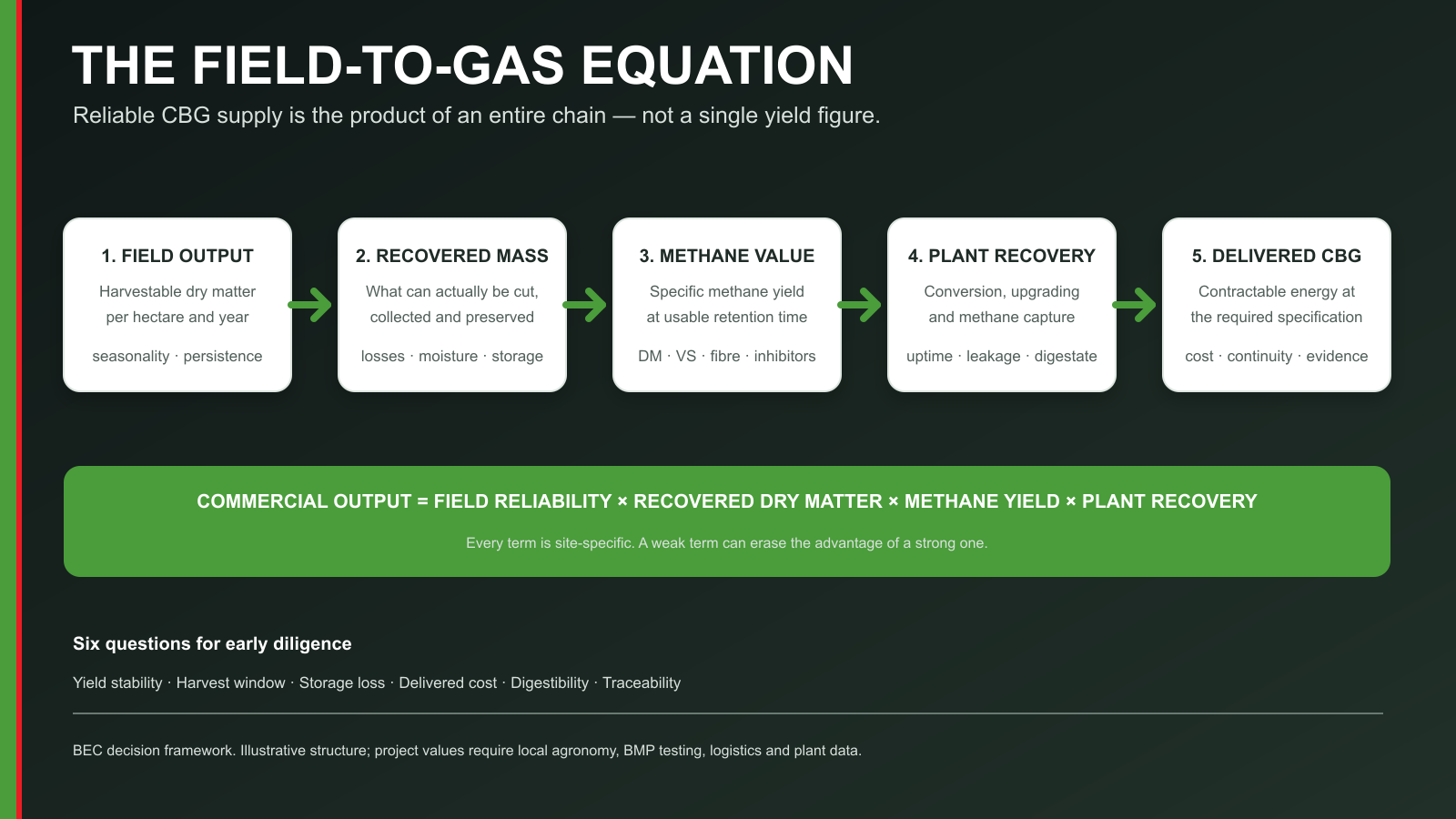
Each term is influenced by a different operating system.
- Harvestable dry matter depends on genetics, soil, water, nutrient management, climate, cutting regime and stand persistence.
- Recovered fraction reflects weather access, machinery, field losses, transport, ensiling or other storage, and dry-matter deterioration.
- Specific methane yield depends on feedstock composition, maturity, pretreatment, blending, digestion conditions and retention time.
- Plant recovery includes digester performance, upgrading efficiency, uptime and control of fugitive methane.
The commercial answer is the product of the chain. A weak term can erase the advantage of a strong one.
A high fresh-mass yield can be diluted by low dry matter. Excellent biochemical methane potential in a laboratory can lose value if the crop is expensive to irrigate, difficult to preserve or harvested during the same narrow window across a large basin. Low-cost biomass at the farm gate can become expensive after collection, storage loss and transport are included.
Crop maturity is an economic decision
Purpose-grown grasses illustrate why agronomy and conversion must be designed together.
As a grass matures, field biomass may increase, while moisture, fibre, lignin, digestibility and methane response can also change. Cutting more frequently may improve the digestibility of some materials, yet it can increase machinery movements, nutrient removal, labour requirements and the number of storage events. Longer intervals may increase dry-matter accumulation, but can produce a more fibrous substrate and change the feedstock’s behaviour in digestion.
Controlled studies on Napier grass have shown that cutting age affects total solids, lignin, carbon-to-nitrogen ratio and methane yield. Other work has demonstrated that digester configuration and organic loading rate alter the methane recovered from the same broad feedstock category. These results should not be converted into a universal harvest prescription. They show why a local project needs field trials and biochemical methane potential testing connected to the intended process.
The most useful harvest date is therefore not necessarily the date with the highest fresh tonnage or the highest laboratory methane yield per unit of volatile solids. It is the point that produces the best annual system result after considering:
- dry matter per hectare per year;
- methane yield per tonne of delivered material;
- number and timing of harvests;
- field and transport costs;
- nutrient replacement and soil effects;
- storage behaviour and losses;
- digester throughput and feed-recipe stability;
- and the resilience of the stand across seasons.
This is why variety, planting material, irrigation strategy, harvest interval and machinery choice belong in the same development model as digester size and upgrading capacity.
The feedstock basin is an operating system
India has major supplies of agricultural residues, cattle dung, press mud, municipal organic waste and other biomass. It also has strong potential for purpose-grown crops in suitable, carefully screened systems. The opportunity lies in combining these resources into reliable local portfolios.
The International Energy Agency’s 2025 global assessment evaluated more than 30 types of biogas feedstock and identified plant size, feedstock composition, quality, collection radius and local infrastructure as core economic variables. It found that emerging and developing economies hold around 80% of global sustainable biogas potential, with India prominent in cereal and sugar-crop residues.
The same analysis illustrates why distance must be modelled by material. Wet manure is expensive to move and often supports short collection radii; dense concentrations of crop residues can support a larger basin. These are global reference observations, not fixed rules for an Indian project. The real radius must be calculated from local road access, payload, moisture, seasonal availability, traffic, storage location and competing demand.
A useful feedstock-basin model separates at least five layers:
- Biological potential: material grown or generated in the territory.
- Sustainable availability: the portion that can be removed without unacceptable effects on soil, food, feed, water, biodiversity or other legitimate uses.
- Commercial accessibility: volumes whose owners are willing and able to supply.
- Technical compatibility: material that can meet the plant’s feed and handling specification.
- Contractable delivery: the tonnes, quality and calendar that can be secured at an acceptable delivered cost.
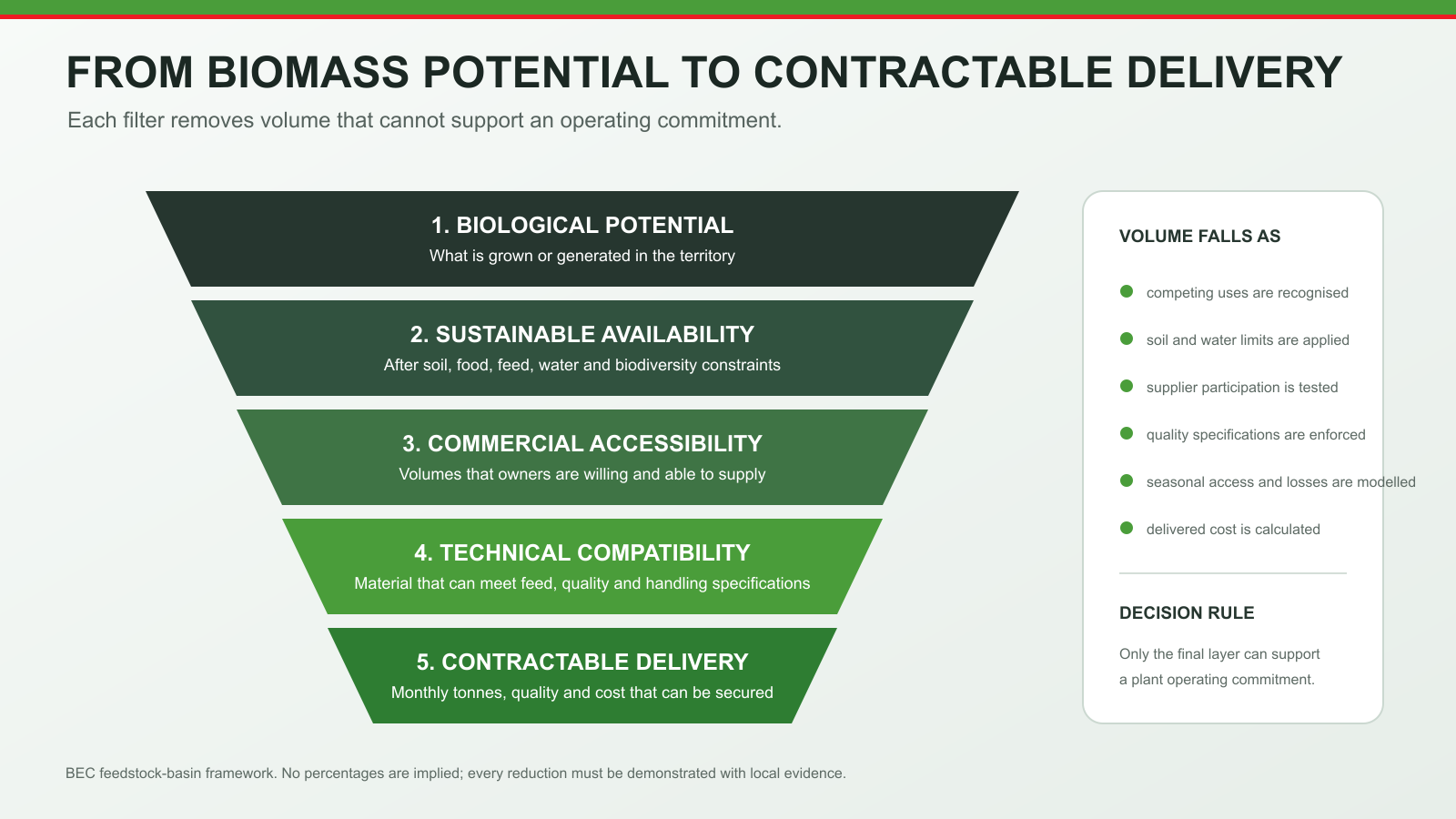
Only the fifth layer supports an operating commitment.
A robust portfolio has a base, a complement and a contingency
Single-feedstock concepts can be operationally elegant, but they concentrate agronomic, climatic and commercial exposure. A resilient project may instead define three roles.
1. Base feedstock
This provides the most dependable share of annual input. It might be a controlled crop programme, an anchored industrial residue, manure from a concentrated livestock system or another stream with strong visibility and suitable characteristics.
2. Complementary feedstocks
These improve seasonality, nutrient balance, digestibility, dry-matter content or economics. They must be assessed as part of a feed recipe, because compatibility involves biology, rheology, contaminants, handling and storage — not only methane yield.
3. Contingency supply
This protects the plant during poor harvests, supplier interruptions, storage losses or demand competition. A contingency feedstock has value only if it is technically pre-qualified, commercially reachable and permitted within the project’s sustainability and operating framework.
This portfolio should be expressed as a monthly mass balance, not only an annual total. The model needs to show crop calendars, residue-generation periods, inventories, storage drawdown, poor-season assumptions and required buffer volumes.
Storage deserves the same attention as production
CBG plants operate throughout the year; many agricultural inputs arrive during weeks or months. Storage therefore connects biological production with industrial utilisation.
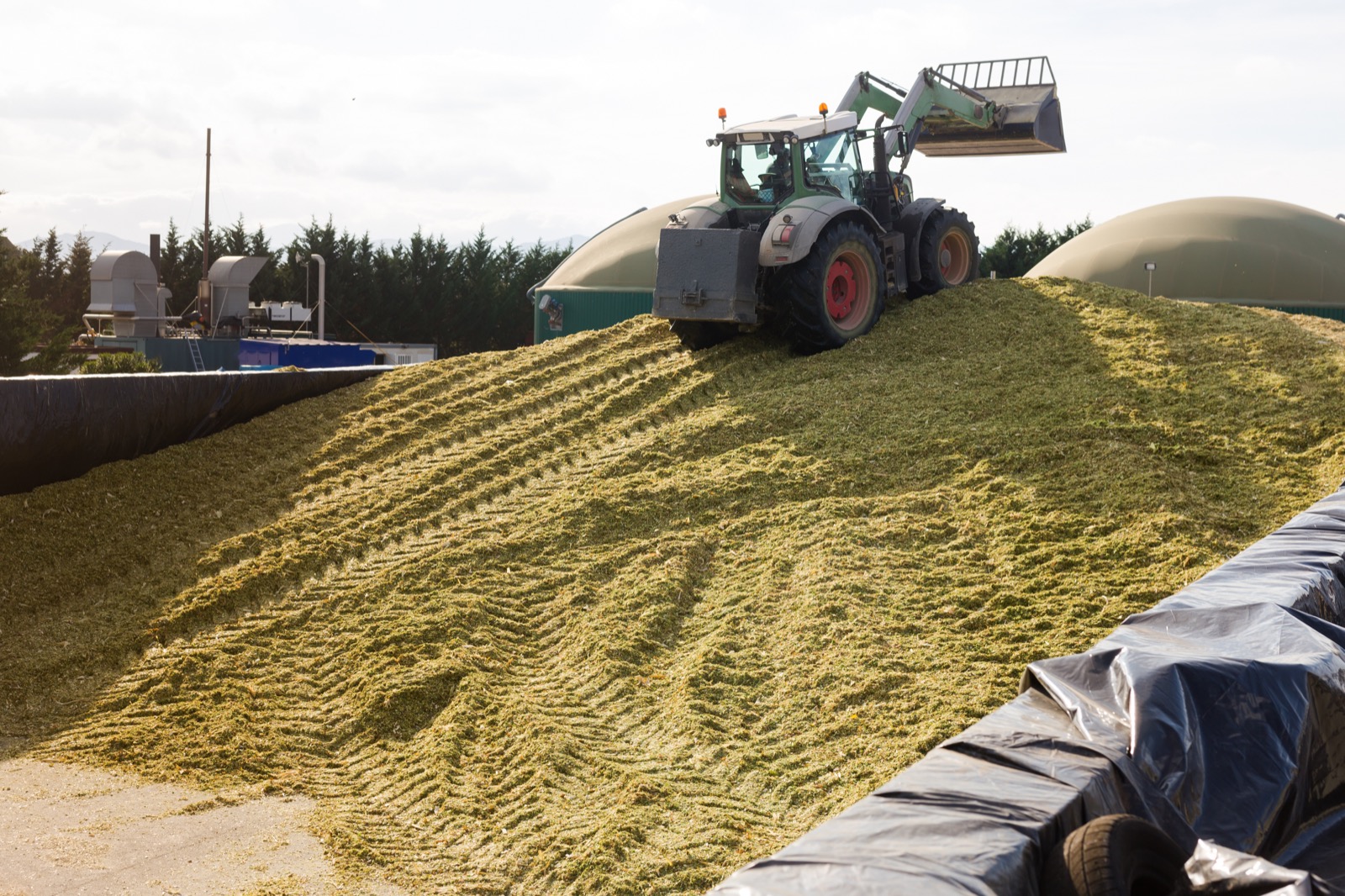
For wet crops, ensiling can preserve material and support a controlled feed stream, but performance depends on chop length, compaction, exclusion of air, dry-matter content, drainage, cover integrity and disciplined face management. For drier residues, storage design must manage moisture ingress, fire, contamination, handling and dry-matter loss. Blending decisions must preserve both biological performance and physical flow through reception and feeding equipment.
Storage also creates working-capital requirements. A project may pay growers and contractors during harvest while converting the material into gas over many subsequent months. Land, civil works, loaders, covers, drainage, fire protection, weighing, sampling and inventory control must therefore appear in the financial model.
The correct comparison is not farm-gate price versus gas revenue. It is delivered, preserved and conversion-ready feedstock cost versus recovered energy and co-product value.
Evidence should grow with the project
An early CBG concept often begins with a resource map and indicative yield assumptions. As investment advances, those assumptions should be replaced by a progressively stronger evidence stack.
Agronomic evidence
- mapped land and current use;
- soil and water constraints;
- locally relevant varieties and planting material;
- establishment performance;
- multi-cut yield distribution, not only best-plot yield;
- nutrient, irrigation and field-operation requirements;
- persistence, pest and extreme-weather response.
Feedstock and process evidence
- dry matter and volatile solids;
- fibre fractions, ash, nutrients and contaminants;
- biochemical methane potential with representative samples;
- response to harvest age, storage and blending;
- feeding, mixing and retention-time implications;
- digestate characteristics and nutrient-management plan.
Supply-chain evidence
- grower and supplier structure;
- machinery and contractor capacity;
- road and seasonal-access mapping;
- payload and cycle-time studies;
- storage design and measured loss assumptions;
- delivered-cost curves and sensitivity cases;
- chain of custody and field-level traceability.
Investors should be able to trace each important assumption to a source, sample, trial, contract or explicit uncertainty range. Offtakers should understand the connection between feedstock continuity and gas-delivery reliability. Developers should know which evidence must be completed before capacity, capital and contracting decisions become difficult to reverse.
Environmental performance includes methane control and nutrient use
Biomethane can deliver major benefits when it displaces fossil gas and captures organic materials that would otherwise release methane. Those benefits depend on operating discipline.
The IEA notes that measured leakage estimates for agricultural biogas plants can vary materially, and highlights covered digestate storage, good pressure management, treatment of upgrading off-gases and leak-detection-and-repair programmes as practical controls. Digestate can return nutrients and organic matter to agriculture, but its composition, hygiene, transport radius, application timing and local nutrient balance require an operating plan.
For purpose-grown crops, lifecycle performance also depends on land history, fertiliser and irrigation inputs, machinery energy, soil-carbon effects and transport. MRV should be designed with the crop system, rather than added after procurement begins.
The result is a more complete field-to-gas equation:
Reliable gas + verified emissions performance + responsible nutrient cycling
A 90-day diligence programme
Before a developer fixes the feedstock concept or a financier accepts the base case, a focused 90-day programme can answer six high-value questions:
- Which feedstocks can supply each month under normal and poor-year conditions?
- What is the delivered cost per tonne of dry matter and per unit of methane potential?
- Which crop, harvest and storage variables drive the largest downside?
- What local trials and BMP tests are still required?
- Which suppliers, growers, machines and storage assets must be developed before commissioning?
- Which field and plant data will support sustainability claims, traceability and operating control?
The deliverable is not a single resource number. It is a decision map: base supply, complementary supply, contingency volumes, evidence gaps, development gates and the actions needed to convert a promising territory into a reliable feedstock basin.
India’s next CBG advantage will be built in the field
GOBARdhan provides a stronger national platform for demand, price visibility, infrastructure and finance. The projects that convert that platform into dependable output will connect policy with agronomy, contracting, laboratories, storage and daily operations.
India’s CBG opportunity is therefore larger than a plant-construction programme. It is an opportunity to build thousands of local circular systems in which farmers, aggregators, industrial operators, gas networks and nutrient users work from the same evidence base.
The next unit of CBG capacity begins long before the digester. It begins with a field-to-gas design that can perform through every season.
Bioenergy Crops supports developers, investors, EPC partners and industrial offtakers with feedstock-basin mapping, crop and agronomy programmes, biomass characterisation, logistics and storage design, procurement strategy, sustainability, MRV and project-stage due diligence.
Sources and further reading
- Government of India, GOBARdhan National Circular Bioenergy Scheme, 6 August 2026
- IEA, Outlook for Biogas and Biomethane: feedstock potential and cost, 2025
- IEA, Key issues affecting biogas and biomethane projects, 2025
- IEA Bioenergy Task 37, Reduction of methane emissions from biogas systems, 2025
- Effects of cutting age on Napier grass characteristics and methane yield
- Effects of reactor configuration and loading on methane production from Napier grass
- Related BEC analysis: CBG plants and feedstock risk