
Produced by Bioenergy Crops · BEC Intelligence Radar · New every Monday

Shanghai’s 8,016-tonne biomethanol operation is the week’s clearest proof of physical delivery. Around it, Gansu moves an integrated biomass-and-hydrogen concept into EPC procurement; Project Lion tests whether cane trash can support material SAF output; Indonesia attaches 15-year demand to palm-mill biomethane; and Guatemala begins the terminal-to-retail conversion to E10.
The seven developments sit at different maturity levels. Some record operating evidence, while others create contracts, procurement or market-implementation gates. The common test is whether biological resources can become specification-compliant, traceable and repeatable supply.
CHINA · MARINE FUELS · PHYSICAL DELIVERY
Shanghai turns an 8,016-tonne biomethanol shipment into a supply-chain test
Where: Taonan, Jilin → Dalian → Shanghai, China
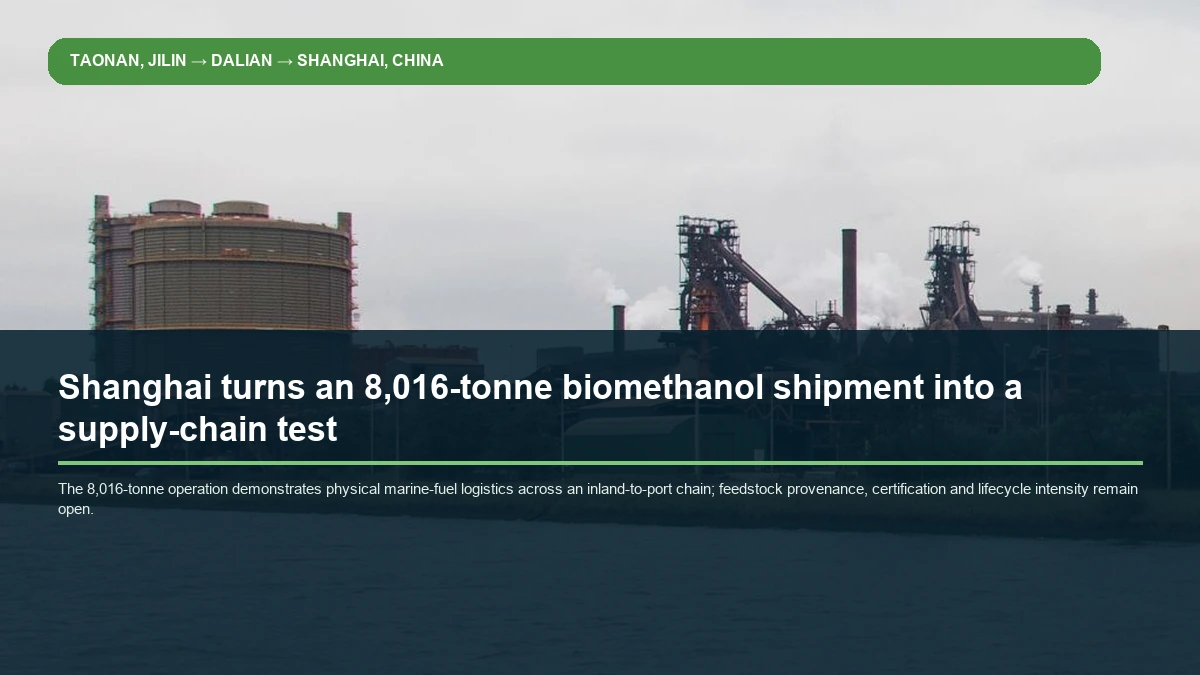
An inland-to-port fuel corridor reaches the vessel
Shanghai International Port Group reported that 8,016 tonnes of biomethanol were bunkered over 15–16 August. Most of the batch originated at Shanghai Electric's Taonan project in Jilin province, travelled by road to Dalian, continued by sea to Shanghai storage and was then transferred to the receiving container vessel. The operation therefore covered production origin, two transport modes, intermediate storage, port coordination and ship-to-ship delivery—not simply a fuel order on paper.
The volume is more than twice the 3,643 tonnes supplied in Shanghai's previous record operation in March. A separate July operation delivered 2,824 tonnes from a local Shanghai production chain. Read together, the three events show a port moving from individual trials toward several sourcing routes: a locally integrated food-waste and biogas route, and a longer northern corridor based on crop residues and renewable power.
Shanghai authorities say the city had supplied about 51,000 tonnes of green methanol by the end of June 2026 and is targeting one million tonnes of green methanol and biofuel supply capacity by 2030. They also acknowledge that available bunkering vessels were already heavily utilised and that green-methanol supply and price remain limiting factors. The August record is therefore a relevant operating milestone inside an ecosystem that is still supply-constrained.
The bottleneck is moving from port handling to certified molecules
The shipping market has spent several years ordering methanol-capable vessels faster than low-emission fuel supply has matured. Shanghai can now demonstrate that a large batch can cross a multi-node logistics chain and reach a vessel on schedule. What the operation does not disclose is equally important: the exact feedstock mix, mass-balance method, certification scope, lifecycle greenhouse-gas intensity, transfer price and contractual allocation of quality risk.
The local and northern supply routes should not be treated as interchangeable. Food waste, biogas and crop straw can produce materially different lifecycle results, eligibility outcomes and cost structures. A chain-of-custody claim must remain attached to the physical or mass-balanced molecule through production, storage, transport and bunkering; a green label at the port cannot repair weak upstream evidence.
Taonan's second phase—reported at 200,000 tonnes per year of methanol plus 10,000 tonnes per year of SAF—would expand the corridor, but planned capacity is not delivered fuel. Repeat batches, verified intensity and durable customer contracts are the evidence that will decide whether this becomes a procurement market rather than a sequence of showcase operations.
Our analysis +
The strongest signal is operational repetition. March demonstrated a 3,643-tonne international bunkering; July added a local Shanghai supply chain; August more than doubled the record with a northern production-and-logistics corridor. That sequence reduces uncertainty about terminal and vessel-side execution. It does not yet reduce uncertainty to the same degree upstream, where feedstock, certification, conversion efficiency and price determine whether the fuel is genuinely scalable.
For biomass suppliers, the change is significant because Shanghai is effectively becoming a demand hub for biological carbon produced far outside the port region. The Taonan–Dalian–Shanghai route links agricultural residues in northeast China with marine buyers on the coast. That can widen the commercial catchment for straw, but it also adds road haulage, port handling, marine transport and storage losses. The delivered economics must absorb every one of those steps.
The 8,016-tonne batch should not be confused with stable annual availability. A port can execute a record cargo while suppliers still struggle to finance feedstock inventories or maintain uniform fuel quality across vintages. The relevant performance indicators are shipment frequency, rejected or delayed batches, storage turnover, certified carbon intensity and the proportion sold under multi-year contracts rather than spot arrangements.
China's advantage is the ability to combine industrial coordination, port infrastructure and large residue basins. Its difficulty is that crop residues are heterogeneous, seasonal and contested by soil, livestock and local-energy uses. Straw procurement systems must control moisture, ash, chlorine, alkali metals and contamination before the gasification or synthesis plant sees the material. A marine-fuel customer ultimately buys a specification, not a theoretical residue resource.
The cost gap remains central. Shanghai reporting indicates that Taonan biomethanol may cost roughly twice conventional methanol at this stage. Regulation and customer decarbonisation commitments can support an initial premium, but they do not eliminate exposure to power prices, hydrogen cost, feedstock logistics and certification. Scale will matter only if it lowers the delivered premium without weakening provenance.
The next decision-grade disclosure would connect one bunkered tonne to its feedstock category, production pathway, recognised certificate, well-to-wake intensity and commercial terms. That is where port leadership becomes fuel-market bankability. Until then, Shanghai has proved that the chain can move a large batch; it has not yet proved that certified supply can match the future fleet continuously and competitively.
Sources
CHINA · EPC TENDER · DEMONSTRATION SCALE
Gansu puts biomass gasification and green hydrogen into one EPC package
Where: Xifeng Industrial Park · Qingyang · Gansu, China
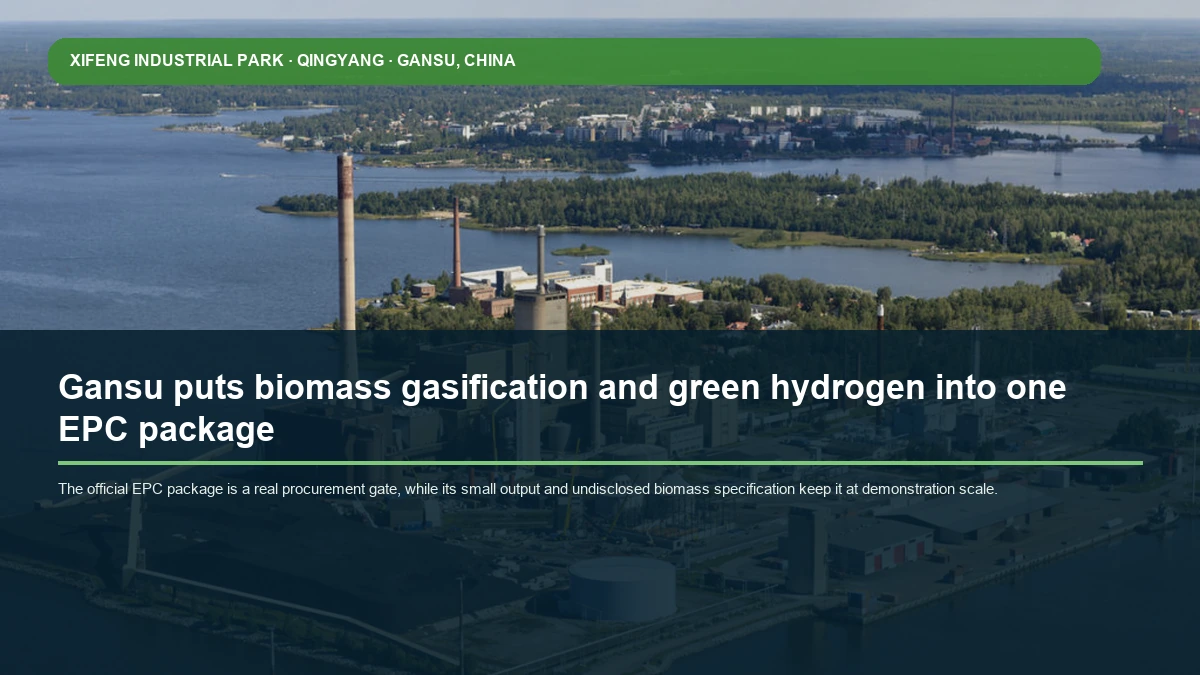
A dated tender turns a technology concept into procurement
China Energy opened an EPC tender for an integrated green-fuels demonstration in the southern part of Xifeng Industrial Park, Qingyang, Gansu. The official package states an investment of RMB196.1 million, a site of roughly 60 mu, bids due on 10 September and a 120-day implementation period.
The design combines biomass gasification, gas cleaning, green-hydrogen integration and synthesis. Nominal output is 2,000 tonnes per year of green methanol and 60 tonnes per year of green jet fuel. Those volumes are small relative to commercial fuel projects; the procurement is better understood as an integration and operability test than as a meaningful near-term source of transport fuel.
Earlier China Energy procurement records show that the project was initiated in April 2024 and received an investment decision approval in September 2024. The current change is therefore not first interest in the concept but movement into a defined EPC competition with dates, scope and bidder obligations.
The project can test carbon utilisation—but not yet fuel competitiveness
Adding renewable hydrogen to biomass-derived synthesis gas can increase the proportion of biogenic carbon converted into liquid product rather than rejected as carbon dioxide. It can also provide product flexibility between methanol and aviation-fuel intermediates. The benefit comes with more interfaces: electrolyser availability, hydrogen compression, gas cleanup, synthesis control, utilities and commissioning must operate as one system.
The disclosed capital intensity and tiny output confirm the demonstration character. A successful run could validate process integration, control logic and product quality. It would not establish commercial cost at scale because demonstration plants carry disproportionate engineering, redundancy and learning costs.
The tender materials visible publicly do not provide the biomass envelope needed for a supply case: species or residue class, annual dry tonnes, moisture, ash chemistry, particle size, contaminants, seasonal storage and catchment radius. Without that information, the feedstock system remains the project's largest unpriced interface.
Our analysis +
This tender matters because it moves advanced biofuels from an aspirational diagram into an accountable delivery package. An EPC contractor will have to define boundaries, accept a schedule and commission an integrated plant. That creates evidence about what equipment and controls are actually required when biological carbon and variable renewable hydrogen meet a fuel specification.
The 120-day period is notably aggressive for a package spanning gasification, gas conditioning, hydrogen and synthesis. It may reflect a narrowly defined demonstration scope, prefabricated modules or a schedule that excludes some enabling works. The award documents and final interface matrix will be more informative than the headline completion period.
From a feedstock perspective, the missing specification is not a secondary detail. Gasifier availability depends on stable moisture, size distribution, ash behaviour and contamination control. Gansu's agricultural context may offer residues, but resource maps cannot tell an EPC contractor how often slagging, fouling or feeding interruptions will occur. Procurement contracts must translate local biomass into enforceable acceptance limits.
Green hydrogen can improve carbon utilisation, yet it also exposes the plant to power and electrolyser economics. If hydrogen is intermittent or expensive, synthesis utilisation falls or intermediate storage becomes necessary. The demonstration should therefore report hours at stable load, hydrogen consumption per tonne, syngas composition and carbon conversion—not only annual nameplate production.
The small jet-fuel output deserves particular caution. Sixty tonnes per year can support process learning and qualification work, but it is not evidence of an aviation-fuel business. Product certification, upgrading yields and off-spec management will determine whether the route can progress beyond experimental batches.
The key gates are now observable: bid award, disclosed feedstock envelope, mechanical completion, sustained run time, product-quality data and a credible scale-up basis. If those arrive, Gansu could help de-risk an integrated biomass-plus-hydrogen pathway. If only construction completion is reported, the most important operating questions will remain open.
Sources
AUSTRALIA · SAF · CONDITIONAL ENGINEERING
Project Lion gives North Queensland cane trash a 125,000-tonne SAF ambition
Where: Burdekin Region · North Queensland, Australia
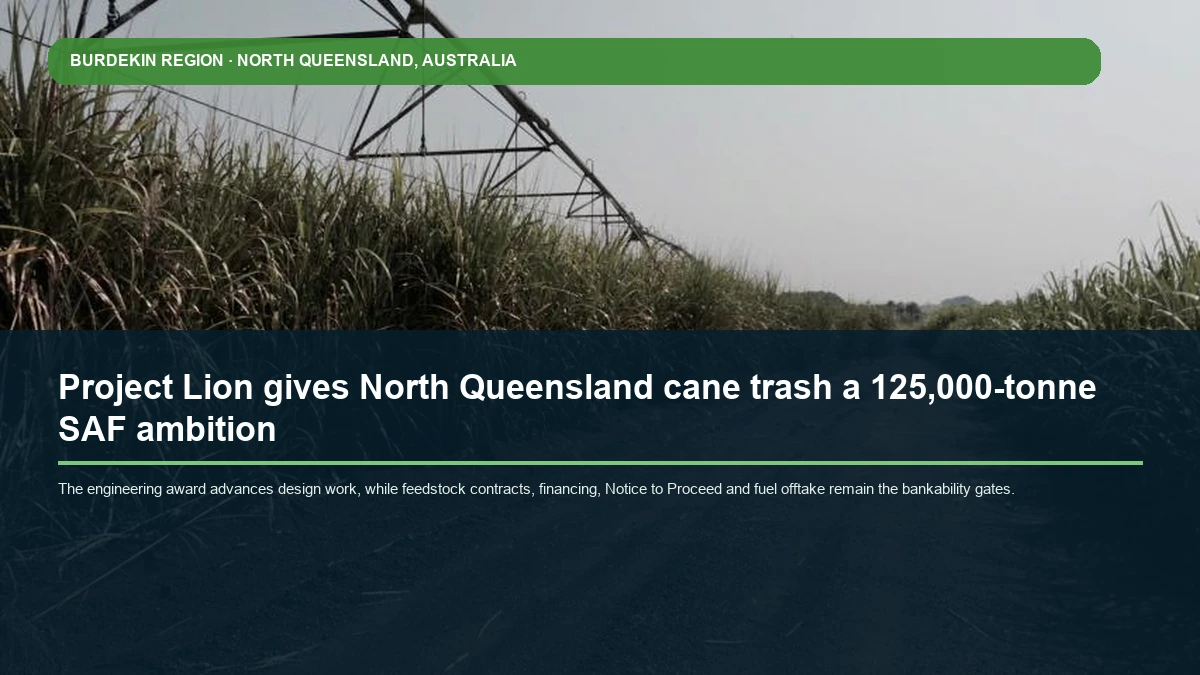
Engineering begins, while the investment decision remains conditional
MAIRE said NEXTCHEM and MyRechemical were awarded licensing, process-design and engineering services for SKY Renewables' Project Lion in the Burdekin region of North Queensland. The concept would use sugarcane tops and trash to produce synthesis gas through NX Circular gasification and, at full scale, up to 125,000 tonnes of sustainable aviation fuel per year.
The release establishes a named location, feedstock category, conversion route, technology provider and design capacity. It does not establish financing, construction, contracted residue supply, fuel qualification or operating output. MAIRE states that most of the work remains conditional on a Notice to Proceed.
Burdekin is one of Australia's most concentrated sugarcane regions, making the project geographically plausible. Concentration reduces distance between fields but does not make tops and trash automatically recoverable. Harvest method, rainfall, soil-cover requirements, nutrient removal, grower participation, baling windows and wet-season storage will determine the practical supply basin.
The plant scale turns residue recovery into the central engineering question
Cane tops and trash are dispersed across fields and generated during a defined harvest season. A gasification plant needs steady, specification-compliant feed throughout the year. The project must therefore connect field collection, densification, covered storage, fire management, contamination control and delivery scheduling to the conversion plant's hourly demand.
Leaving residue on the field can protect soil and recycle nutrients; collecting too much can impose agronomic costs that do not appear in a theoretical residue estimate. A bankable resource assessment must calculate sustainably removable dry matter by soil, slope, harvest system and grower—not apply one recovery factor to the whole region.
Australia's interest in domestic SAF provides strategic demand, but policy ambition does not replace project economics. The fuel must satisfy aviation specifications and sustainability rules while competing for capital with other pathways and imported product.
Our analysis +
The engineering award is a meaningful maturity step because it forces the project to translate a regional residue idea into mass and energy balances. It is still upstream of the decisive commercial gates. The distinction matters: engineering can validate a design basis, while Notice to Proceed, finance and binding supply and offtake agreements determine whether that basis becomes an asset.
At 125,000 tonnes of SAF per year, feedstock is not an ancillary procurement line. Even without publishing a conversion assumption, the plant would require a substantial, repeated annual flow of dry residues. Seasonal cane harvesting means storage must bridge months of low or no collection, increasing working capital, dry-matter loss, fire risk and quality-control requirements.
Grower economics will decide the recoverable fraction. Contractors must be paid for modified harvesting, raking or baling, loading, transport and possibly nutrient replacement. Those costs vary by field and season. A uniform gate price can overpay easy tonnes while failing to attract difficult ones; a supply strategy needs zoned costs and clear sustainability exclusions.
Gasification can accept a broader feedstock range than some biochemical routes, but it is not indifferent to feedstock. Soil contamination, ash fusion, alkali content and moisture affect feeding, gas cleanup and availability. Project Lion's design value will improve materially when it publishes its acceptance envelope and demonstrates how field operations will meet it.
The regional case is strategically attractive because it could create a higher-value outlet for agricultural residues and anchor SAF production near an established cane industry. It could also compete with existing residue uses or future soil-carbon strategies. The correct baseline is not 'waste equals free'; it is the economic and agronomic value of leaving or using each residue elsewhere.
The next evidence should be specific: Notice to Proceed, participating growers, recoverable dry tonnes, storage design, delivered-cost curve, financing, fuel qualification plan and binding demand. Until those components align, 125,000 tonnes is an engineering ambition. If they do align, the project would become one of the clearest tests of whether seasonal field residues can support continuous aviation-fuel production at material scale.
Sources
INDONESIA · BIOMETHANE · LONG-TERM DEMAND
A 15-year gas agreement gives Indonesia's palm-mill biomethane programme a demand anchor
Where: North Sumatra · Sei Mangkei Corridor, Indonesia
Eight mills move from programme ambition toward contracted sales
reNIKOLA and Pertagas Niaga signed a 15-year compressed biomethane gas sales agreement covering eight PTPN IV PalmCo mills, according to a joint statement carried by Bernama and The Star. The companies describe output above 830,000 MMBtu per year, approximately US$40 million of investment and a dedicated injection station near the Sei Mangkei Special Economic Zone in North Sumatra.
PTPN IV had earlier announced a broader programme of 16 CBG plants using effluent from 17 palm-oil mills, with the first initiative in Simalungun and groundbreaking projected for early 2027. The eight-mill sales agreement appears to be a bankability step within that wider programme rather than proof that all proposed plants are financed or operating.
The companies estimate annual emissions savings of roughly 320,000 tonnes of CO2 equivalent. That figure remains a company projection until operating methane capture, upgrading energy, leakage, displaced fuel and environmental attributes are measured under a disclosed accounting boundary.
Point-source residues reduce collection risk but raise programme-execution risk
Palm-oil mill effluent is generated at industrial sites, so the feedstock is more concentrated and measurable than dispersed crop residues. Digesters can capture methane that would otherwise escape and upgrade it to a transportable gas. The project still depends on mill throughput, effluent characteristics, digester performance, gas cleanup and a common sales specification.
Using eight mills diversifies dependence on one asset, but it creates repeated interfaces. Each site needs metering, maintenance, operating discipline and a route to the injection point. A weak mill can reduce cluster supply even when the aggregated annual estimate looks strong.
The 15-year tenor can support project finance only if the contract contains bankable volume, price, quality and remedy provisions. Those terms, along with take-or-pay protection and ownership of certificates or carbon attributes, were not disclosed publicly.
Our analysis +
The agreement changes the maturity of the programme because it links prospective production to a named long-term buyer. That is stronger than a memorandum or a plant announcement. It remains weaker than financial close and metered delivery, particularly because the programme covers multiple sites and an injection interface that must be commissioned as one commercial system.
The biological resource has an important advantage: POME flow follows mill operations and can be measured at the source. Supply forecasts can therefore be tied to fresh-fruit-bunch throughput and actual wastewater characteristics. The disadvantage is correlation—regional crop conditions or mill shutdowns can reduce several sites simultaneously.
Gas quality will be decisive. Moisture, hydrogen sulphide, carbon dioxide and trace contaminants must be controlled before sale or injection. A cluster needs consistent specifications across different upgrading units, and the contract must state who bears the cost of off-spec gas, curtailment and interconnection downtime.
The climate case can be strong when uncontrolled methane is genuinely avoided, but leakage can erode it quickly. Credible performance should include measured methane capture, upgrading losses, flare events, auxiliary energy and the counterfactual treatment of effluent. Palm-sector sustainability and land-use controversies also require clear separation between waste-gas recovery at existing mills and any claim that could incentivise plantation expansion.
Sei Mangkei can provide an industrial demand centre and aggregation point, improving the route to market. Yet central injection may add compression and transport costs from individual mills. The optimal design depends on distance, pipeline access, trucking configuration and the load profile of buyers.
The next gates are financial close, a named mill-by-mill rollout, injection-station commissioning, metered gas quality and disclosed realised output. If those arrive, the contract could demonstrate how a dispersed portfolio of industrial biological residues becomes a standardised gas product. Until then, the agreement is a strong demand anchor attached to a complex delivery programme.
Sources
CANADA · FORESTRY · SUPPLY-BASIN TEST
Ontario tests whether fragmented private woodlots can supply new biomass markets
Where: Private Woodlots · Ontario, Canada
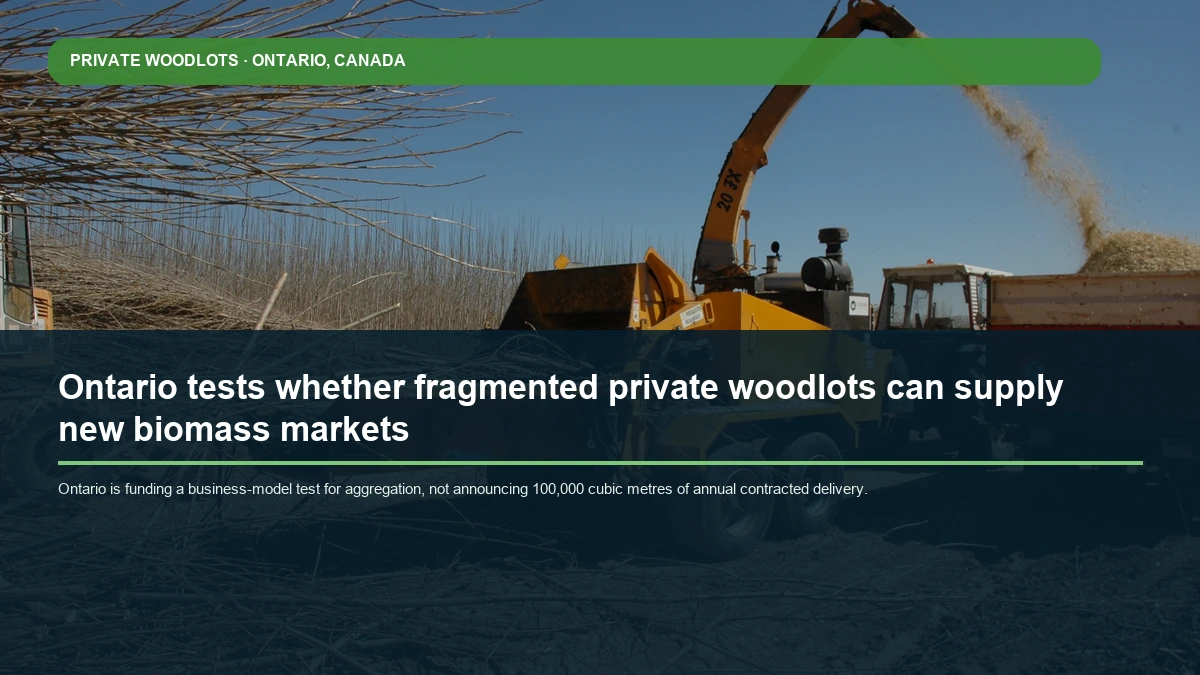
C$865,000 funds aggregation, inventory and market development
Ontario committed C$865,000 to the Ontario Woodlot Association: C$790,000 for a five-year business-model initiative led with WSP and C$75,000 for education and workshops. The programme aims to mobilise up to 100,000 cubic metres of forest biomass over five years, create three jobs and build three regional networks.
The work includes equipment, private-forest remote-sensing inventory and market development for products such as biochar, compost and mulch. The 100,000-cubic-metre figure is a potential programme total, not an already contracted annual flow. The association represents about 3,000 members through 21 chapters.
The initiative builds on a C$91,000 cooperative pilot launched in 2023. Ontario says its Forest Biomass Program has committed more than C$65 million to 66 projects since 2023, attracting more than C$250 million in external funding and supporting more than 110 jobs.
Resource inventory is only the first step toward deliverable tonnes
Private woodlots are fragmented across owners with different objectives, access and willingness to harvest. Remote sensing can improve knowledge of standing material, but buyers need product grade, moisture, delivery windows, chain of custody and reliable annual volumes.
The programme arrives while Ontario is seeking new forest-product markets and resilience against trade pressure. Lower-grade material can support biochar or other biomass uses, but the supply hierarchy must preserve sawlog and other higher-value outlets where available.
Forest roads, seasonal restrictions, contractor availability and haul distance can turn a mapped resource into an uneconomic one. The programme's real test is whether it can lower transaction costs enough for small owners and industrial buyers to contract repeatedly.
Our analysis +
This is a supply-chain experiment, not a capacity announcement. Its value lies in testing the organisational layer that biomass projects often underestimate: landowner enrolment, common specifications, harvest scheduling, contractor coordination and market matching.
The 100,000-cubic-metre ceiling should be decomposed by product class and region. Fresh volume alone does not reveal dry tonnes, energy content or conversion suitability. Moisture, species mix, bark, contamination and particle size determine which markets can pay for the material.
Aggregation can create bargaining power and reduce procurement cost, but it can also add administration. The cooperative model must demonstrate that the fee and coordination structure leaves an acceptable netback for owners while giving buyers a lower risk of short delivery.
Remote sensing will be useful for inventory and planning, yet it cannot replace field verification or contracts. Economic availability depends on road access, terrain, harvest permission, contractor mobilisation and the opportunity cost of leaving material for ecological or future silvicultural value.
Biochar, compost and mulch offer different quality and price pathways. A strong programme will cascade material toward the highest appropriate use rather than force all low-grade wood into one energy market. That diversification can reduce buyer concentration, but it complicates sorting and logistics.
The evidence to watch is practical: enrolled hectares and owners, actual harvested cubic metres, dry-matter and quality data, delivered-cost curves, repeat buyers, regeneration outcomes and the share of volume sold into higher-value products. If those indicators improve over five years, Ontario will have demonstrated an aggregation model that can travel beyond the province.
Sources
NAMIBIA · CARBON REMOVAL · OFFTAKE EXECUTION
A 50,000-tCO2 Namibian offtake puts biomass storage under a delivery test
Where: Otjiwarongo · Otjozondjupa Region, Namibia
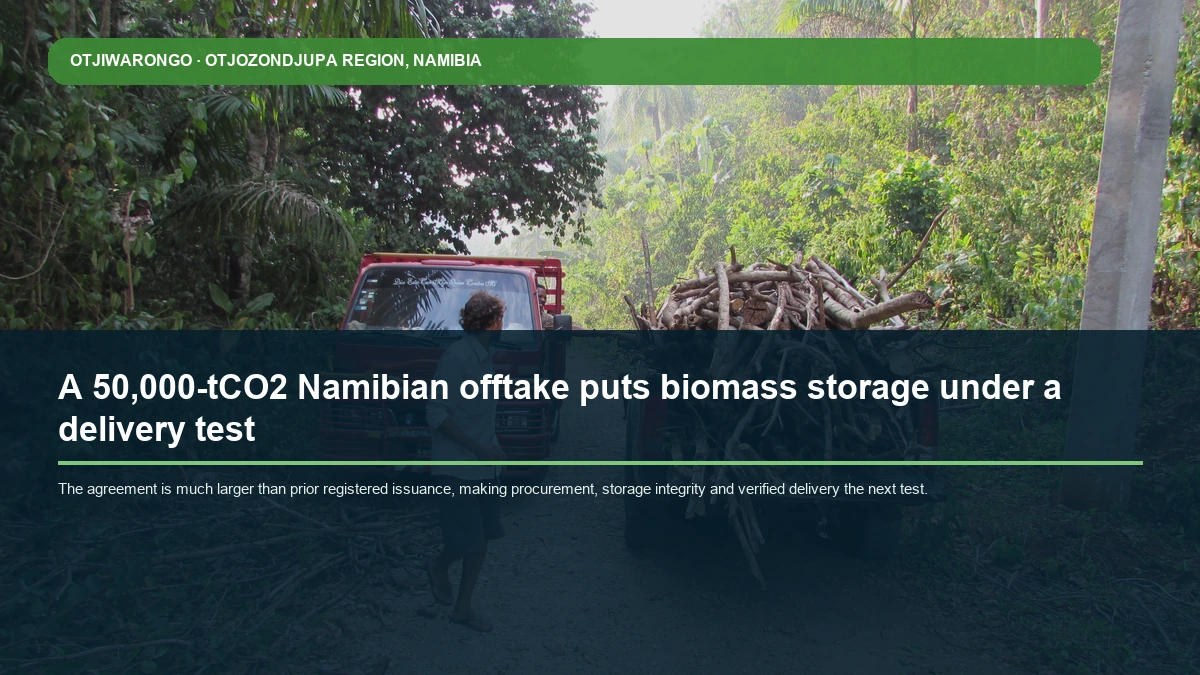
The contracted volume is far larger than the project's prior issuance
Senken and Carbonsate announced a multi-year agreement for 50,000 tonnes of carbon-dioxide removal from biomass storage in Namibia, covering 2026–2028 vintages with deliveries expected to begin in 2026. The project is located around Otjiwarongo and uses encroacher bush placed in engineered underground chambers.
The release describes the commitment as Europe's largest biomass-storage deal and says the project has operated since early 2025. Those rankings are company claims. Public registry information cited for comparison shows only hundreds of prior issued credits, so the new agreement represents a substantial scale-up in procurement, storage and monitoring.
Senken states that the project is registered with Puro and is also being evaluated under Isometric. Contract price, buyer identity and detailed delivery remedies were not disclosed. The agreement creates demand visibility; it does not itself verify future removals.
Bush control, carbon accounting and restoration must remain one system
Namibian bush encroachment can reduce grazing and alter ecosystem function, but not every woody removal is automatically restorative. Site selection, species, harvest intensity, land tenure, biodiversity and follow-up management determine whether biomass sourcing produces durable land benefits.
Biomass storage aims to prevent biological carbon from returning rapidly to the atmosphere by placing dry material in conditions designed to limit decomposition. Credibility depends on moisture control, chamber engineering, measurement, monitoring, leakage and reversal provisions.
The move from a small issuance history to a 50,000-tonne commitment changes the operating challenge. Sourcing and construction must expand without relaxing eligibility or overestimating carbon content.
Our analysis +
The offtake is commercially relevant because forward demand can finance chambers, equipment and procurement before credits are delivered. It also transfers attention from methodology design to execution. Buyers will ultimately receive value only if contracted vintages are measured, verified and issued.
Otjiwarongo provides a more precise geographical frame than a country-level announcement. That matters because haul distance, bush density, land use and alternative biomass markets vary across Namibia. A procurement map and land-management plan are needed to show that claimed removals are additional and operationally reachable.
Feedstock eligibility is the central boundary. Encroacher bush may have low immediate value in some locations, but it can also be used for fuel, charcoal or land management. The counterfactual must explain what would have happened without the project and avoid crediting biomass that would already have been durably stored or commercially removed.
Scaling MRV is as important as scaling harvest. Each batch needs mass, moisture and carbon-content evidence; each chamber needs construction and monitoring records. A portfolio can fail if rapid procurement creates weak documentation even when the physical storage performs well.
The undisclosed price prevents a direct economic assessment. Indicative market ranges are not transaction prices, and project economics will depend on harvest productivity, haulage, drying, excavation, monitoring and verification. Delivery schedules and make-good obligations will determine how much risk the developer retains.
The next proof points are first contracted issuance, chamber-level monitoring, independently verified procurement boundaries, restoration outcomes and disclosed delivery performance. If the project can scale those elements together, it will demonstrate that biomass storage can move beyond small batches. If issuance lags procurement, the contract will have exposed rather than solved the scaling risk.
Sources
GUATEMALA · E10 · STAGED IMPLEMENTATION
Guatemala's E10 mandate reaches terminals as retail conversion begins
Where: Guatemala · Terminal-To-Retail National Transition
The legal start becomes a physical fuel-distribution event
On 22 August, Emisoras Unidas reported that E10 distribution had entered into force for regular gasoline in Guatemala, citing the Ministry of Energy and Mines. The national fuel-retail association said blended product had begun leaving storage terminals. The report also noted the unloading of 3,000 metric tonnes of ethanol from the United States.
The transition will not appear at every pump simultaneously. Service stations must consume existing inventory, clean and verify tanks where required, ensure compatible materials, train staff and purchase new blended product according to their normal schedules. Terminal dispatch therefore marks the start of a staged national conversion, not instant universal availability.
The Ministry's 2026 blend agreement sets 10% ethanol and identifies a projected supply deficit of 50,054,362 gallons, with no supply contracts executed at the time of the official assessment. It allocates 60% of the requirement to 'advanced ethanol' and 40% to alcohol carburante under the applicable framework. The first imported cargo is consistent with a programme that begins with a substantial documented supply gap.
Implementation creates demand before Guatemala has proved domestic supply
Guatemala has a sugar industry capable of producing molasses and cane-based ethanol, but a mandate does not automatically create contracted domestic volume. Producers, importers, terminals and retailers need pricing, quality, licensing and delivery arrangements that work through the full year.
The regulatory framework includes mass balance, greenhouse-gas methodology, storage, transport, quality and registry requirements. Those provisions are important because ethanol origin and sustainability attributes can be lost or double-counted if documentary control is weaker than physical blending.
The original regulation anticipated an earlier 2026 start, so the August implementation reflects the difficulty of aligning supply, terminal readiness and retail conversion. The relevant test now moves from legal design to monthly operating data.
Our analysis +
The fresh signal is physical dispatch. Earlier regulations and future dates created policy expectations; the 22 August event shows blended fuel entering the distribution system. That is the point at which theoretical E10 demand begins to affect inventories, imports, terminal operations and station procedures.
The official projected deficit is the most important commercial fact. It indicates that the mandate initially creates more demand than documented domestic supply can cover. The U.S. cargo provides immediate material, but it also exposes Guatemala to international ethanol prices, freight and foreign-exchange conditions.
Domestic sugar ethanol could capture part of the market, yet production potential is not the same as committed fuel supply. Producers need contracts, specification compliance, certification where required and economics that compete with imports. Seasonality and storage must bridge the cane campaign and year-round gasoline demand.
Retail conversion will be gradual and operationally uneven. Tank water, material compatibility and inventory mixing can create quality problems during transition. Public confidence will depend on transparent quality testing and clear communication, particularly if vehicle-performance concerns become politicised.
The policy has an energy-security dimension because it can diversify the gasoline pool and create a domestic agricultural market. Its durability will depend on visible consumer outcomes, stable pricing and credible environmental accounting. If the mandate is perceived only as a costly import requirement, political support may weaken.
The next evidence should include monthly ethanol volumes by origin, terminal dispatch, station coverage, blend-quality results, pump-price effects and executed supply contracts. Those data will show whether E10 is developing into a domestic biofuel value chain or remaining primarily a regulatory blending and import operation.
Sources
What to watch next
Near-term evidence will be concrete: repeat certified bunkerings in Shanghai; a Gansu award and biomass specification; Project Lion’s Notice to Proceed and grower supply plan; mill-by-mill Indonesian commissioning; issued Namibian removals; measured Ontario deliveries; and Guatemalan volumes by origin and station coverage.
The strongest opportunities sit where feedstock eligibility, recoverable dry tonnes, logistics, contracts and verification can be designed together. A large resource number is the start of diligence, not its conclusion.
From biomass resource to bankable supply
Bioenergy Crops supports feedstock strategy, supply-basin assessment, agronomy, logistics, contracting and project diligence for industrial biomass and biobased developments.