
BEC RADAR INTELLIGENCE
5 October 2026
Plant-based materials, industrial heat and the cost of reaching production
A first batch of a plant-based plastics ingredient in the Netherlands, construction of a wood-fuelled heating plant in Germany and new engineering work for aircraft fuel in the United States show different points in the bioeconomy’s investment cycle. Canada’s Bécancour equipment order adds a procurement milestone, while Anaergia’s asset disposals show how operating performance can reshape a portfolio.
The common commercial issue is the time between committing resources and receiving dependable revenue. For growers, equipment suppliers and industrial buyers, that interval determines the terms on which a new outlet becomes worth supporting.
Delfzijl, Netherlands · Aalst, Belgium
Avantium makes its first bioplastics ingredient in the Netherlands as funding remains decisive
The Delfzijl plant has produced its first batch from plant sugars; commercial deliveries depend on further operating tests and financing.
Avantium announced its first batch of a plant-based plastics ingredient at Delfzijl, Netherlands, on 28 September. The ingredient, furandicarboxylic acid, or FDCA, is used to make PEF, a polyester intended for packaging and other applications. Continuous operation and customer testing remain ahead.
Financial statements published that week connect planned funding with the operating ramp: lender amendments and waivers depend on conditions including an equity raise of at least EUR 55 million gross. The company retains a material uncertainty over its ability to continue as a going concern.
BEC sees the equity closing as part of the operating timetable: it would fund production and activate conditional lender relief. Buyers planning packaging trials therefore have two related milestones to follow, financing completion and successive batches accepted for their applications.
Our analysis
The agricultural connection is unusually specific. Tereos documented a supply agreement for wheat-derived fructose syrup from Aalst, Belgium. Procurement therefore runs through an existing cereal-processing industry, with its own sugar specifications and markets. The feedstock delivered to the plant is a processed syrup, with conversion and quality control occurring earlier in the chain.
A packaging buyer needs to test how the new material behaves in its own conversion process and intended application. An acceptable first sample can justify that work. Repeat orders require subsequent batches to meet the same specification, so the link between commissioning and customer acceptance carries commercial value.
The planned equity raise has two linked functions. It would provide cash for the operating ramp and, once the stated conditions and receipt of net proceeds are satisfied, activate lender amendments and waivers. Proposed regional convertible funding is also conditional on the raise. Completion would therefore change both available resources and the financing framework supporting production.
The customer agreements carry their own conditions. Avantium’s interim statements describe technical, regulatory and timing requirements, including rights for some customers to suspend or terminate if conditions remain unmet. Packaging buyers’ first tests, regular accepted deliveries and committed future volumes therefore sit at different points in the demand forecast.
For crop processors assessing new industrial outlets, this case shows why a prospective materials market develops in stages. The most useful demand signal will be a financed production schedule connected to repeat accepted sales. That evidence would strengthen the case for committing additional syrup volumes.
Sources
First batch, 28 September; Financial disclosure and interim statements, 30 September; Tereos supply agreement, 2021; Shareholder authorisation
Chemnitz, Germany
HoSt starts building a wood-fuelled heating plant in Germany
Construction in Chemnitz follows financial close and a long-term heat agreement, bringing the planned fuel supply into focus.
HoSt reported the start of construction in Chemnitz, Germany, on 28 September after financial close. The project has a 20-year heat agreement with utility eins and targets operation in the fourth quarter of 2027. The company expects it to supply part of the city’s district-heating demand.
HoSt plans to obtain most fuel within roughly 250 kilometres, using untreated woody material including forestry and landscape-management residues. That disclosed supply plan combines material from several activities, each with its own collection schedule, moisture and preparation requirements.
BEC sees the twenty-year heat commitment as a reason to test the durability of that purchasing area. Changes in competing demand, contractor availability and transport costs can reach the operator long before the customer contract expires, making price-sharing terms consequential for fuel suppliers.
Our analysis
A sourcing radius defines a search area. Its commercial usefulness depends on the routes that trucks can use, the suppliers available along them and the cost of preparing each fuel category. Material close to the plant can carry substantial handling costs when it is dispersed or irregularly available.
The planned mix combines resources with different collection patterns. Forest residues depend on forestry activity and contractor access; landscape material follows another operating calendar. Storage and blending can help coordinate these flows, while their cost belongs in the fuel budget.
The duration of the heat agreement makes fuel-price exposure consequential. Contract indexation, purchasing terms and contingency supplies determine how an increase in delivered wood costs is shared between the operator and its customer. Those detailed terms remain undisclosed.
The stated residue mix makes moisture, contamination limits and seasonal storage commercially significant. Suppliers can price those requirements once the operator specifies acceptable fuel categories and delivery conditions. The twenty-year heat horizon increases the value of procurement terms that allow costs to adjust as forestry activity and competing demand change.
BEC’s conclusion is that construction strengthens the credibility of the future heat demand. For prospective suppliers, the next commercially useful detail is the procurement specification and delivery programme. It would show which local resources can become accepted fuel on the required schedule.
Sources
Wallula, Washington, United States
SkyNRG appoints engineers for a proposed aircraft-fuel plant in the United States
The engineering contracts support a proposed renewable-gas-to-aircraft-fuel plant in Washington; a final investment decision remains ahead.
SkyNRG announced engineering appointments for Project Wigeon in Washington state, United States, on 28 September. Technip Energies, Sasol and Topsoe will support work on the proposed renewable-gas-to-aviation-fuel facility. The project targets production in 2031, with its final investment decision ahead.
The proposed plant has a design target of approximately 143,000 tonnes of aviation fuel a year. The engineering stage will define the conversion of renewable gas into liquid fuel and the associated utility requirements; this target describes a future plant, with construction and financing still ahead.
BEC sees the purchasing model for renewable gas as the commercially decisive bridge between Wigeon and its biological resources. Competing uses for that gas, certification rules and ownership of its environmental attributes can change what the proposed aircraft-fuel plant can afford to pay suppliers.
Our analysis
Renewable gas can connect dispersed biological resources with a central fuel plant. That connection depends on the actual sourcing and transport arrangements, including how physical deliveries and environmental claims are accounted for. The public appointment announcement gives limited detail on those contracts.
Engineering can quantify the gas, electricity and other inputs required for a given output. Those balances become commercially useful when suppliers can price the required quantity and quality on compatible terms. A design supported by a short-term gas quotation leaves a different exposure from a longer purchasing agreement.
For developers capturing gas from manure or wastewater, a future aviation-fuel buyer could represent an additional outlet. Its value depends on the price paid, eligible gas characteristics, certification obligations and delivery start. Those terms affect the revenue available to cover gas recovery, cleaning and pipeline injection.
SkyNRG identifies gas recovered from US landfills, wastewater treatment facilities and animal manure as Wigeon’s intended resource base, with delivery through existing natural-gas pipelines. For suppliers, the relevant investment question is whether gas-cleaning capacity, pipeline access and traceable environmental attributes can be contracted for the plant’s intended start date.
The appointed technology companies bring relevant delivery experience, while their participation represents a commercial role in the project. The investment case will become clearer as engineering results connect to binding input and output agreements. Those agreements would give renewable-gas suppliers a firmer basis for expansion decisions.
Sources
SkyNRG engineering appointments, 28 September; Project Wigeon
Bécancour, Quebec, Canada · Marolles, France
Haffner wins a Canadian order to turn biomass into renewable gas
The signed Bécancour order covers stocked equipment and engineering; local manufacturing and integration precede the planned 2028 start.
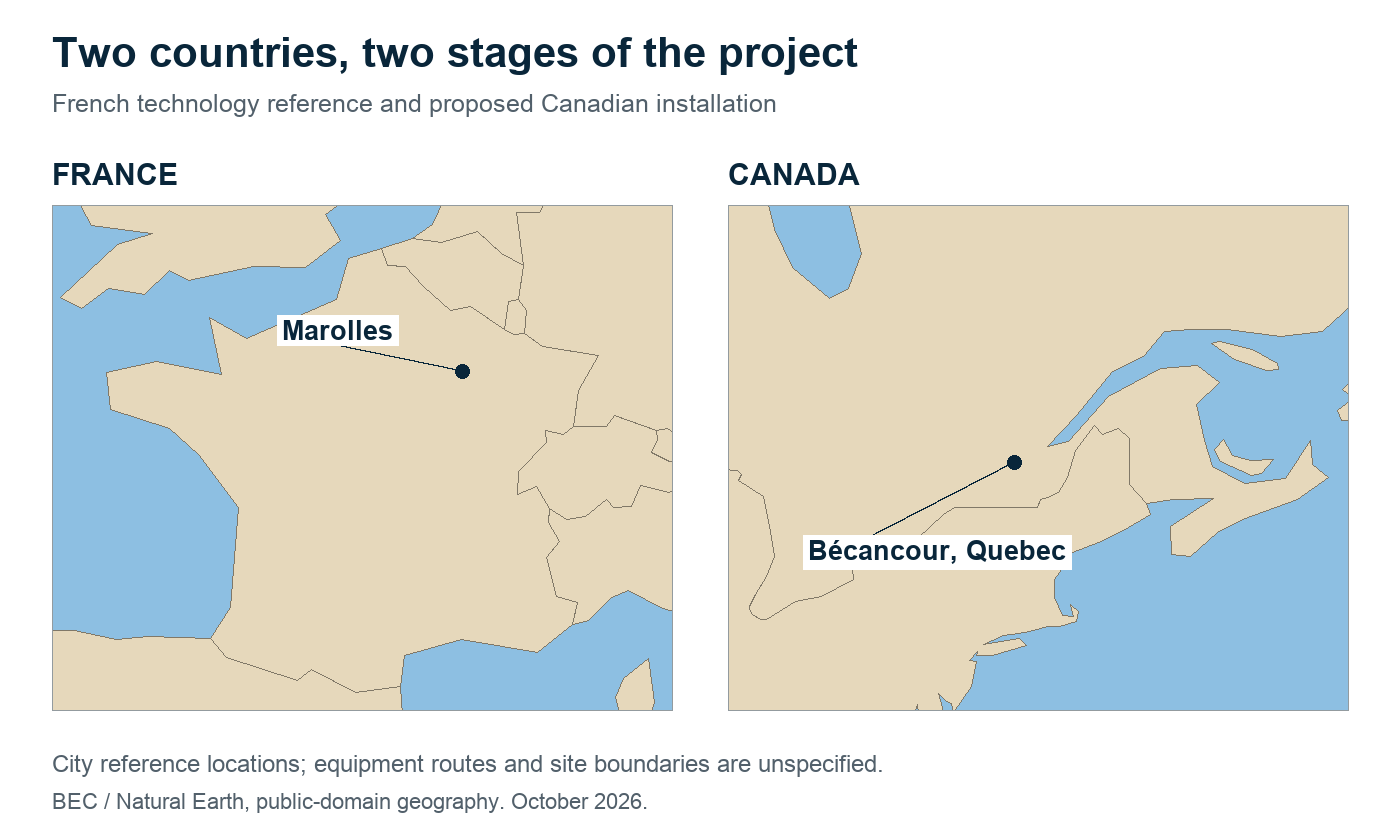
Haffner Energy disclosed a EUR 3.2 million firm equipment and engineering order from INCAD on 28 September for a proposed energy hub in Bécancour, Quebec, Canada. The contract was signed on 25 September. Its disclosed scope covers six stocked equipment items and associated engineering.
The proposed unit targets 400 normal cubic metres an hour of renewable natural gas from residual biomass, with commissioning planned for the second quarter of 2028. Remaining equipment is to be manufactured in Canada under licence, creating a separate local delivery programme.
BEC sees a timing difference with direct implications for investors: the equipment supplier expects most of the order price around export delivery, well ahead of Canadian commissioning. The developer retains the subsequent cost and delivery exposure of completing the local plant and establishing its biomass supply.
Our analysis
Equipment availability can shorten one procurement step. The overall construction schedule also depends on site preparation, local standards, utilities and the interfaces between imported and locally supplied components. Their sequencing determines when an available unit can begin useful work.
Feedstock preparation belongs within those interfaces. The form and moisture of incoming biomass influence storage, handling and the amount of usable energy entering conversion. A cost comparison should connect the delivered specification to the gas output that a customer can accept.
The payment sequence brings this distinction into focus. A EUR 480,000 deposit is due by 12 October; Haffner expects cumulative receipts of 75% of the order value within thirty days of free-on-board delivery. Export delivery is targeted for late 2026, subject to logistics, while Canadian commissioning is planned for 2028. Haffner can therefore recover value from stocked equipment well before the Canadian site begins earning operating revenue.
For a residual-biomass supplier, the equipment order makes the fuel specification and delivery timetable commercially important. Investment in collection, drying or storage depends on the receiving plant’s acceptance limits and a purchasing commitment aligned with commissioning.
The Bécancour project’s significance will strengthen as the equipment order connects to Canadian construction and operating arrangements. Accepted equipment delivery, site integration and a workable biomass contract would provide progressively firmer evidence of future demand.
Sources
Charlotte, North Carolina, and Johnston, Rhode Island, United States
Anaergia agrees to sell two US bioenergy assets as operating results fall short
The agreement covers assets in Charlotte and Johnston; private-company shares form part of the consideration.
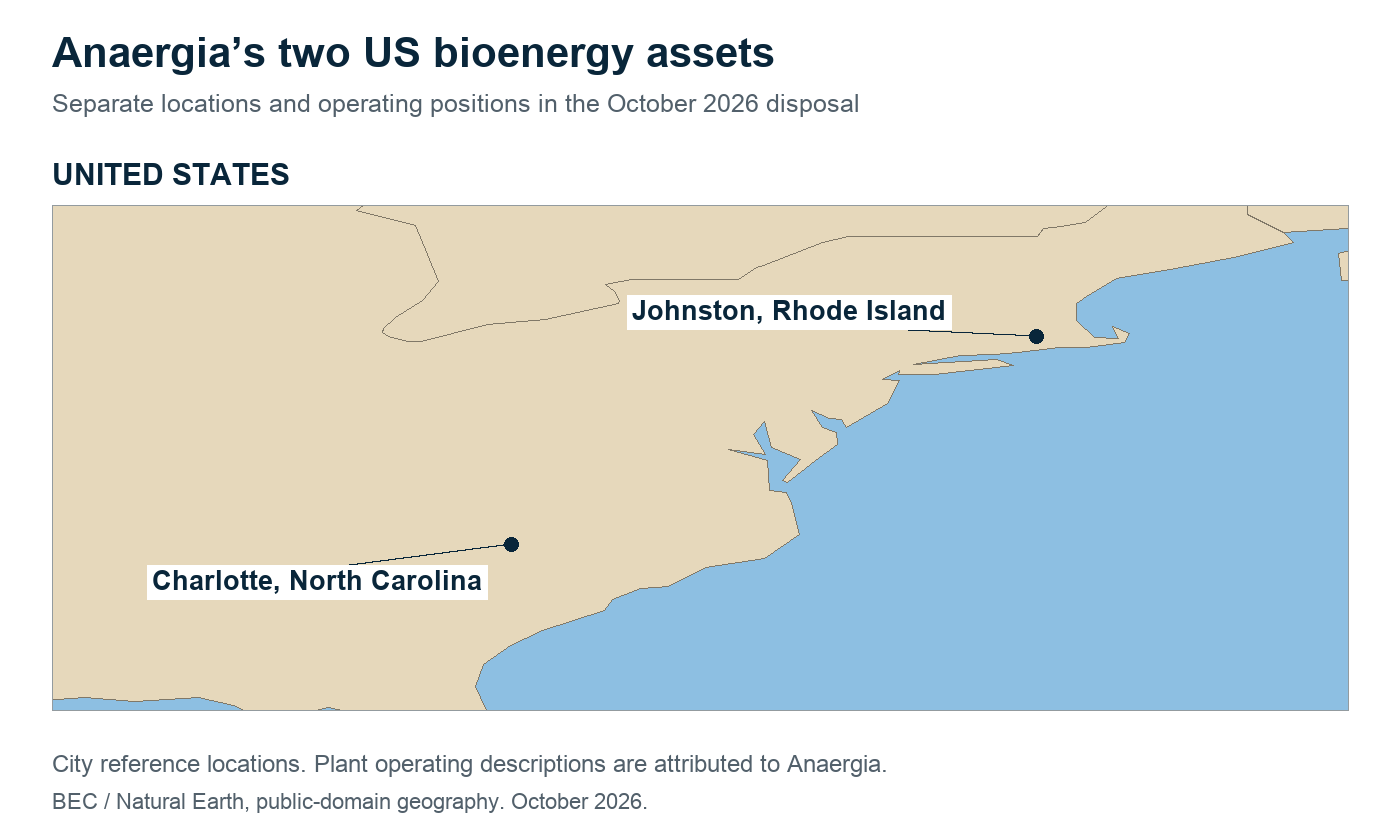
Anaergia disclosed an agreement to divest bioenergy assets in Charlotte, North Carolina, and Johnston, Rhode Island, United States, on 1 October. The company described Charlotte as inactive and the Rhode Island facility as operating below expected capacity.
Anaergia expects approximately CAD 20 million of project-level debt to leave its balance sheet and reports consideration of about CAD 9 million in private-company equity. These amounts represent different financial effects: debt reduction and a shareholding with its own valuation and liquidity risks.
BEC’s reading is that a cleaner reported earnings profile and the eventual value realised from the consideration follow different paths. The economic recovery depends partly on the performance and liquidity of the retained equity interest.
Our analysis
For investors evaluating organic-waste infrastructure, plant utilisation is a central operating variable. Lower throughput can leave fixed costs spread across less output, while any associated change in waste intake or product revenue affects the return. The announcement provides insufficient detail to assign a specific cause to these facilities’ performance.
A transfer of ownership can create an opportunity to change that operating position. Its value depends on the plant condition, supply relationships, staffing and customer arrangements inherited by the buyer, together with the capital required to improve them.
Equity consideration ties part of the seller’s result to the buyer’s future value. Sale restrictions and limited liquidity influence when that value could become cash. A comparison with a cash disposal should therefore use the actual transaction structure.
The case also matters to agricultural and waste suppliers choosing long-term counterparties. Continuity of intake, payment and product outlets can be affected by an operator’s financial and operational condition. An asset’s nominal capacity gives suppliers limited information about that continuity.
BEC would give greatest weight to operating evidence under the new ownership and the realised accounting and cash effects. Those results would clarify the extent to which the transaction improves both the industrial assets and the seller’s financial position.
Sources
Anaergia announcement via Business Wire, 1 October; Rhode Island acquisition baseline, 2021
California, United States
California approves forest-residue power support, with funding still to follow
The US state has approved an electricity incentive framework; qualifying fuel origins and future budget decisions will determine its reach.
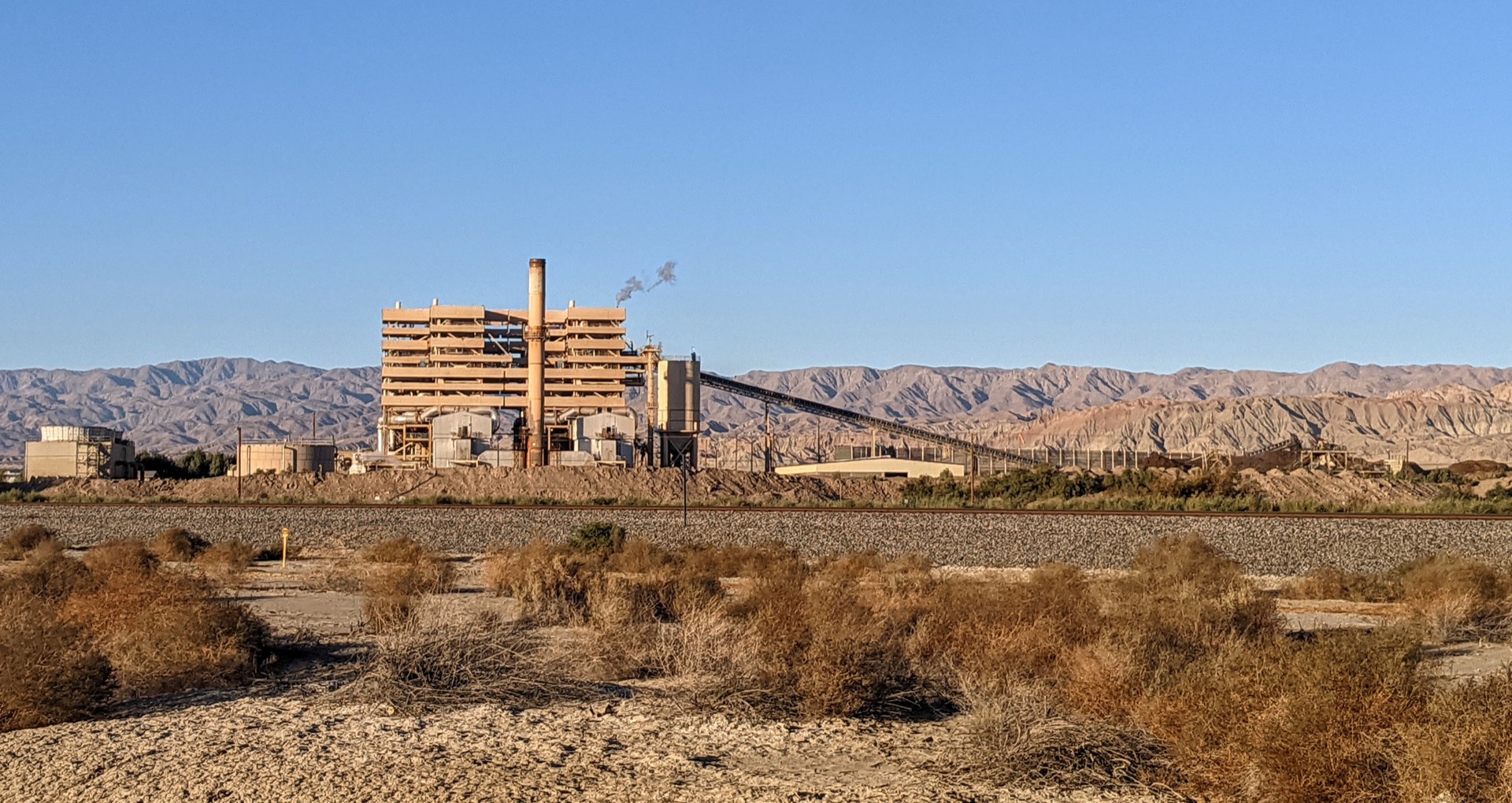
California, United States, signed its FOREST Act into law on 30 September 2026. The measure establishes a framework for payments to eligible electricity producers using forest residues, subject to legislative appropriation. On the same day, the governor vetoed a separate bill for biomass innovation parks. Together, the decisions give forest-residue electricity a specific statutory route while leaving broader industrial development dependent on other arrangements.
The enacted law links support to electricity generated from January 2027 and requires at least 60% of the qualifying plant’s fuel to come from designated high-hazard zones. Purpose-grown crops are explicitly excluded from its definition of forest biomass waste. Plant location or emissions characteristics, certification and reporting also matter. Funding, payment rates and accepted applications remain the evidence needed to translate the framework into an operating revenue stream.
BEC’s conclusion is that the relevant commercial resource is a documented, accessible stream of eligible forest residues. A large biomass inventory can overstate that resource when its origin, removal permissions or delivered cost differ from the programme’s conditions. New plantation proposals would need a separate purchasing and funding case.
Our analysis
For a developer, the source-area test changes the order of work. Mapping qualifying forest treatments and identifying who controls the resulting material come before a dependable supply estimate. Contractor access, road restrictions and the timing of treatment works then determine how much can reach the plant. A contract needs to connect those origins with accepted delivery records throughout operation.
Payment timing also deserves attention. Harvesting, chipping and haulage create expenditure before a generator receives its electricity revenue or any incentive. The ability to carry that interval affects whether contractors can participate, particularly when the plant requires seasonal stocks. Future support rates will therefore matter alongside the rules used to verify material and process payment.
Net Zero California, a sponsor of the vetoed parks bill, argues that forest industries face linked constraints in supply, demand and early operating models. Its account helps explain the intended industrial strategy and comes from an organisation directly involved in promoting it. The confirmed legislative outcomes leave project developers with different routes for electricity and other wood uses; the economics of each route require their own evidence.
The law also links reimbursement to a net reduction in short-lived climate pollutants. That makes the reference case and plant-level emissions evidence commercially relevant. Developers need to establish how their actual fuel and operating arrangements meet the applicable assessment, alongside the contractual and geographic conditions.
For landowners considering cultivated wood, this distinction is decisive. A policy designed to pay for specified forest-residue management establishes its own boundary around eligible material. Replication should start from the receiving industry’s actual specifications and purchasing terms. Appropriated funding, published incentive terms and agreements for qualifying deliveries would provide the next substantive advance.
Sources
Enacted FOREST Act; Governor’s signed and vetoed bills, 30 September; Net Zero California’s response, 1 October.
Persistent Developments
Germany: long land commitments shape the economics of cultivated wood
The EnergyCrops poplar model reported in 2026 brings land access, establishment and specialist harvesting into one industrial supply proposition. The published account describes 20-year land contracts and a first harvest after four years. Its continuing significance lies in how those commitments interact: land costs start before saleable wood becomes available, while the customer needs a predictable delivery programme across successive harvests.
A supply basin built from several planting years can distribute future harvests over time. Its economics depend on actual establishment success, growth, harvesting productivity, storage losses and haulage. Grower participation also depends on the income available from the land’s other uses. The decision for a heat buyer is whether the purchasing terms can sustain that production system at a competitive delivered cost. Site-level operating records and a clear allocation of establishment and price risks would make replication more credible.
Source: EnergyCrops operating model reported by Profi.
China: recovering bamboo forests require separate carbon and harvest accounts
A September 2026 study in Zhejiang, China, compares twelve 20-by-20-metre plots across managed bamboo and stands abandoned for 10, 20 or 30 years. Its reported increase of up to 161% in standing biomass concerns vegetation accumulated on the land; net annual productivity did not differ significantly among the four groups in the reported comparison. Industrial procurement needs a separate assessment of the material that can be harvested repeatedly while retaining the intended ecological outcome.
The distinction becomes consequential when a restoration project offers both carbon benefits and biomass sales. Harvest intensity changes the stock remaining on site, while removal of material can change nutrient replacement and management requirements. A credible commercial model needs a harvesting regime supported by field evidence and an explicit baseline for its carbon claims. The study’s space-for-time comparison also leaves site differences relevant to interpretation. Its practical contribution is to sharpen the questions a restoration-linked supply programme must answer; a transferable annual industrial yield remains to be established.
Source: Qing and colleagues, Journal of Plant Ecology, 2026.
Paraguay: Paracel’s forest-carbon registration adds a second timetable to plantation economics
Paracel’s forest-carbon project in Concepción, Paraguay, was registered with Verra on 16 September 2026. The company reported approval of its first 191,809 credits, while its carbon-market partner Trafigura described more than 190,000 verified removals. Those are attributable statements about a September milestone. The registry view checked on 3 October confirmed registration and displayed zero issued units. Reconciling that display with the company’s approval announcement requires the final monitoring and issuance records.
The continuing industrial significance lies in combining plantation revenues that mature on different schedules. Timber sales depend on growth, harvesting and the receiving industry. Carbon proceeds depend on the eligible project area, measured removals, deductions, issuance and a sale. Each stream has its own costs and conditions, so a whole-estate planting figure cannot serve as the creditable area or forecast cash receipts.
For investors assessing comparable plantation programmes, carbon finance could help bridge establishment expenditure where the contract actually provides early funding. Its value must be reconciled with the rotation, harvest regime and long-term obligations attached to the carbon claim. Paracel’s reported port works at Paso Horqueta add a separate logistics milestone. The next decisive evidence is the connection between issued units and realised funding, alongside the industrial project’s own financing and delivery schedule.
Sources: Paracel’s September announcement; Verra project 3196; Trafigura’s role.
BEC Perspective
California adds an important boundary to the supply discussion: public support for forest-residue power has specific source requirements, including an exclusion for purpose-grown crops. The eligibility of the material and the buyer’s payment terms both shape the value of a prospective outlet.
A long purchasing commitment can support new cultivation when payments cover the grower’s establishment period and the industrial buyer can absorb the harvest. Germany’s EnergyCrops model provides that cultivated-wood context. Chemnitz raises a distinct question about long-term residue procurement; Bécancour concerns residual biomass, while Wigeon depends on renewable-gas contracting. Avantium shows how an established agricultural supply chain still needs sufficient financing to reach accepted industrial sales.
The useful investment comparison connects each cash commitment to the evidence expected before the next one. That sequence can expose a supply opportunity early while preserving the distinction between a prospective market and a dependable customer.
Outlook
Avantium’s financing and operating progress will influence how confidently packaging buyers can plan material trials and subsequent orders. At Chemnitz, procurement terms will determine which suppliers can serve the future heating load. Bécancour’s near-term contractual timetable offers an earlier test of delivery progress, while Wigeon’s engineering will define the requirements of a longer development horizon.
For landowners and crop developers, those different timetables imply different commitments. Establishing perennial supply is most credible when a named buyer’s requirements and financial capacity support the years between planting and harvest.
Explore BEC’s services or contact Bioenergy Crops to discuss the land, crop and supply conditions of an industrial project.
Image credits and licences
Hybrid poplar plantation in Germany, photographed in 2016. Janffm007 / Wikimedia Commons, CC BY-SA 4.0 · Licence and reuse terms · Cropped and set within the BEC cover design; photographic content unchanged.

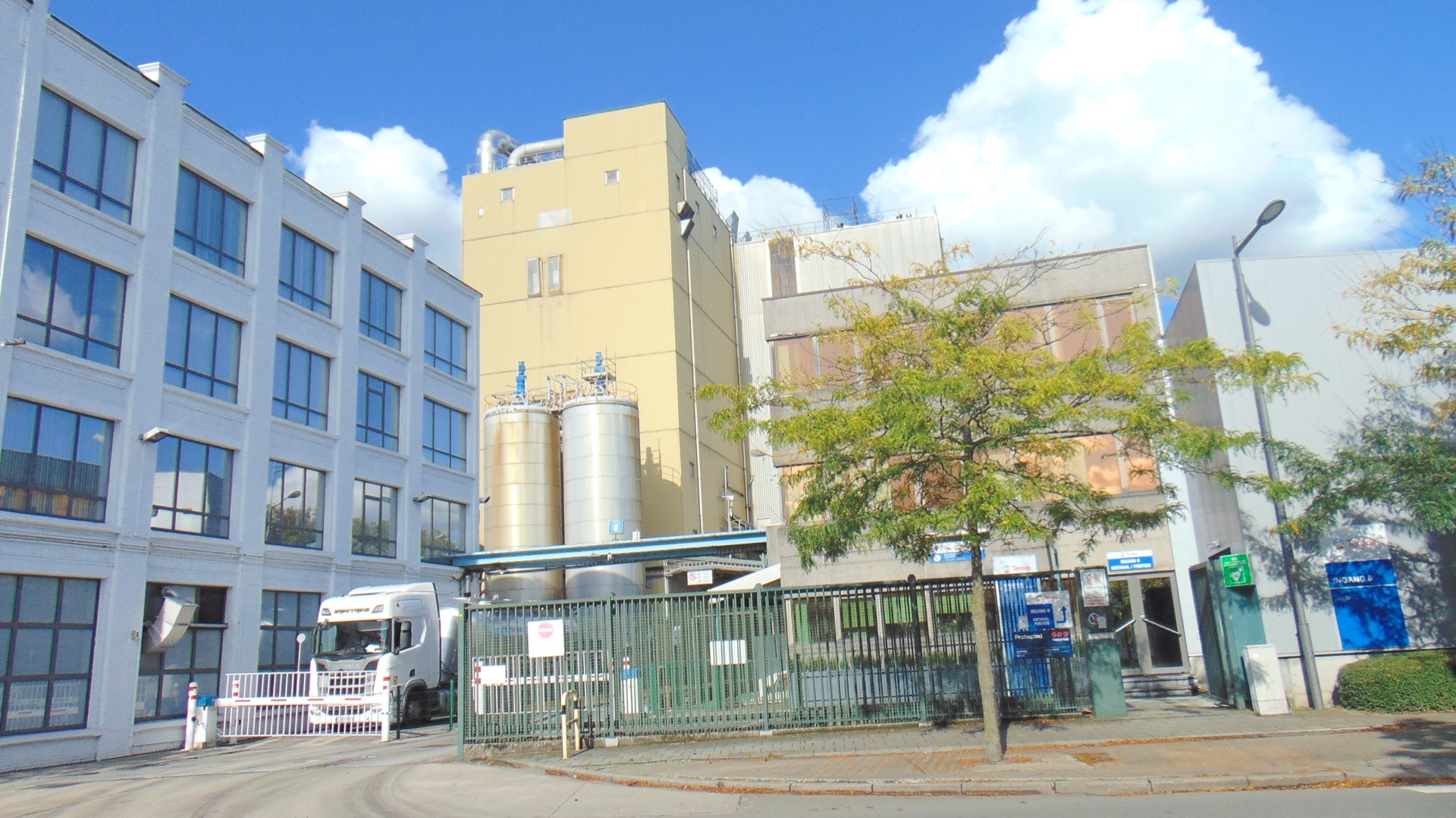
Tereos’s wheat-processing plant in Aalst, Belgium, September 2024. Its supply agreement with Avantium specifies wheat-derived syrup from this site for the Dutch company’s plant-based plastics. Jaronax / Wikimedia Commons, CC BY-SA 4.0 · Licence and reuse terms

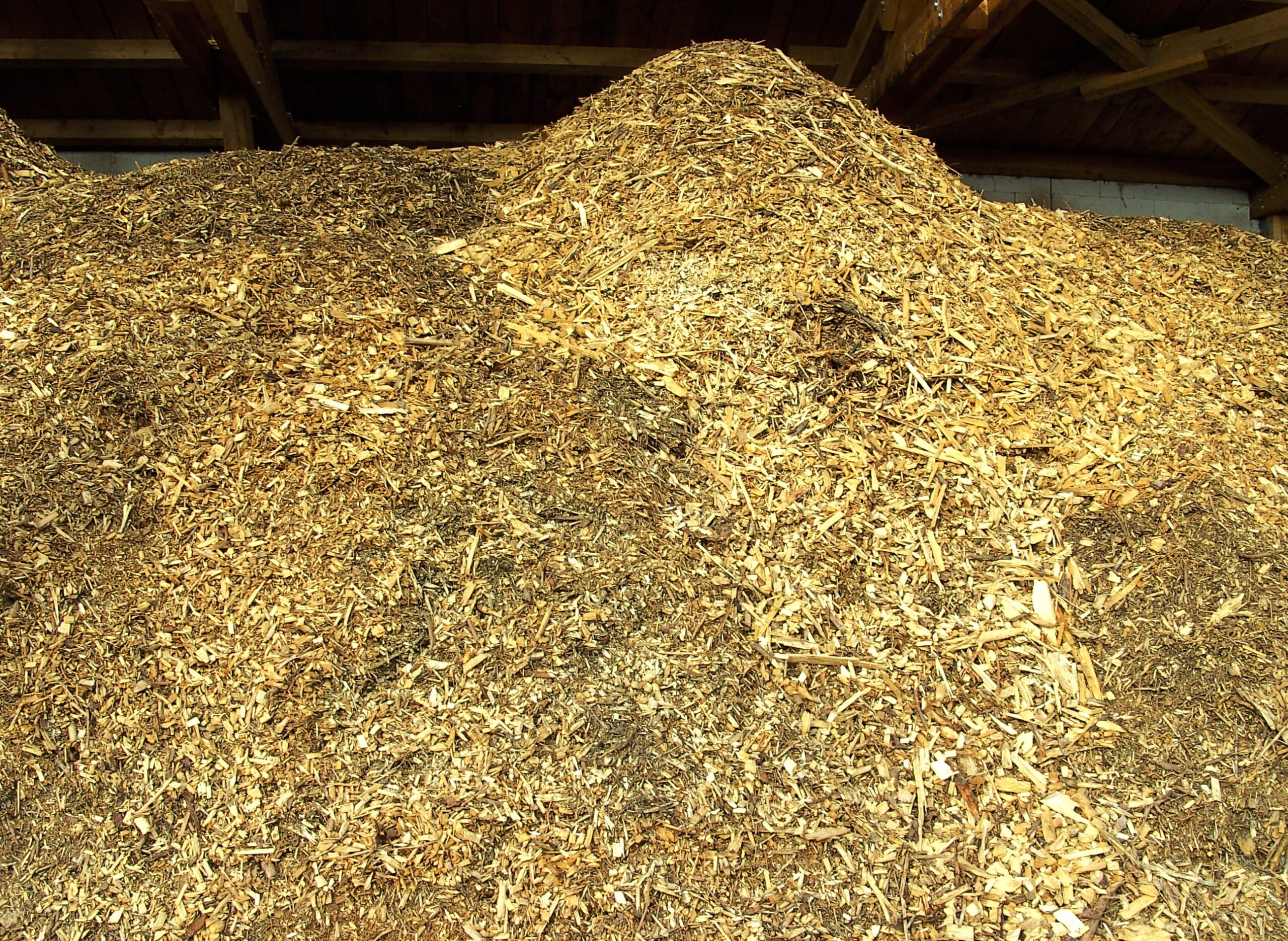
Wood chips in covered storage, photographed in 2010. HoSt’s new heating plant in Chemnitz, Germany, plans to burn untreated wood from forestry and landscape management. High Contrast / Wikimedia Commons, CC BY 3.0 DE · Licence and reuse terms

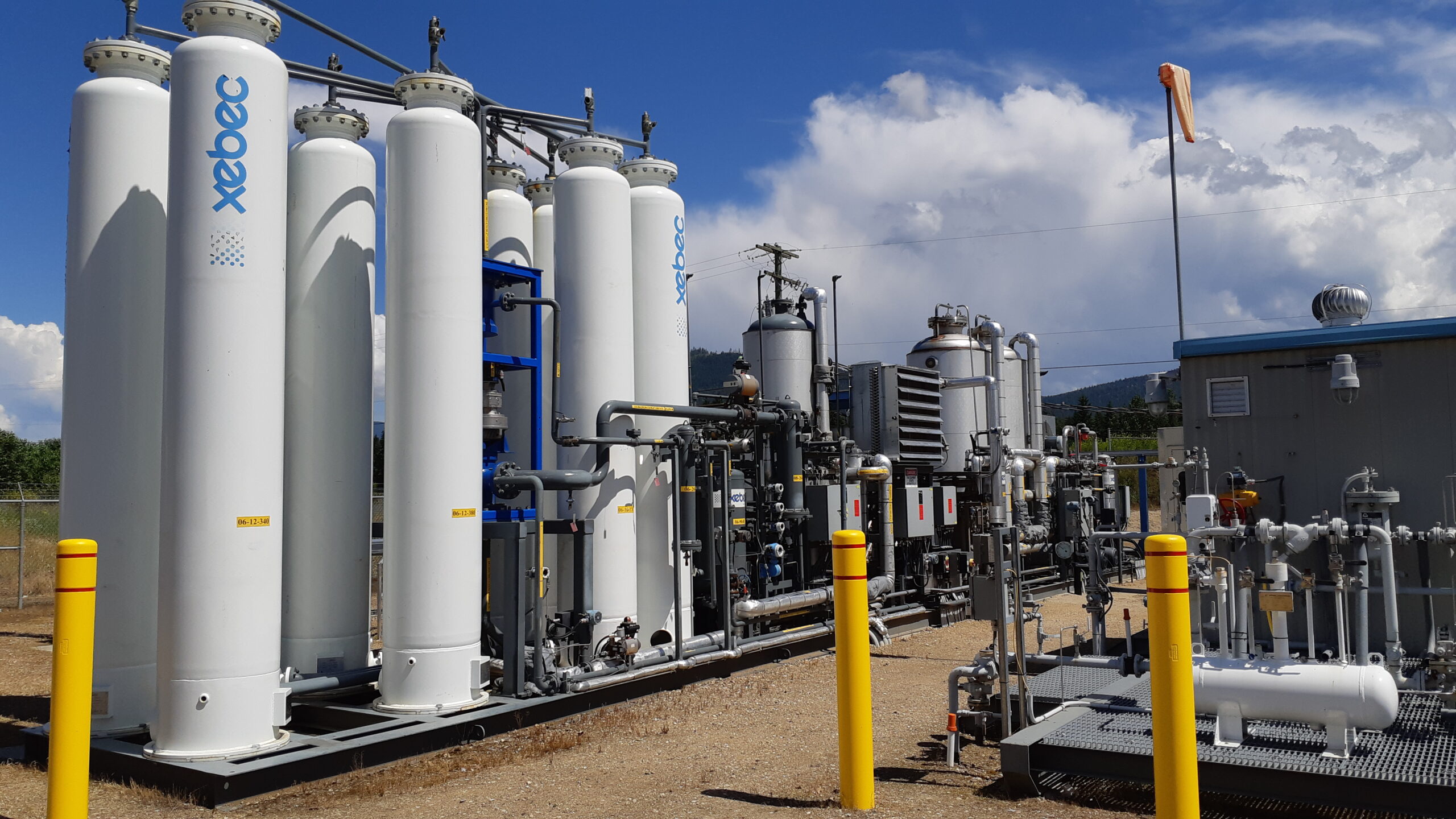
Biogas-upgrading equipment in Canada, 2019. Project Wigeon in Washington, United States, is designed to use renewable natural gas recovered from landfills, wastewater and animal manure. RedactedSagan / Wikimedia Commons, CC BY-SA 4.0 · Licence and reuse terms

Haffner’s technology reference is in Marolles, France; the proposed plant is in Bécancour, Canada. The order combines equipment supplied from France with manufacturing under licence in Canada. BEC / Natural Earth, public-domain geography
The two US assets in Anaergia’s proposed sale: Charlotte, North Carolina, and Johnston, Rhode Island. The company describes Charlotte as inactive and Johnston as operating below expected capacity. BEC / Natural Earth, public-domain geography
Desert View biomass power station in Mecca, California, United States, November 2020. The state’s new framework links electricity incentives to the origin of forest-residue fuel. Dicklyon / Wikimedia Commons, CC BY-SA 4.0 · Licence and reuse terms
