
BEC RADAR INTELLIGENCE
28 September 2026
From growing biomass to supplying industry
Indonesia is organising agricultural areas for ethanol, while Opal is assessing how local organic resources could supply an existing industrial kiln. In Canada and Romania, construction milestones are moving biocarbon and renewable-fuel projects closer to their operating tests. Verbio's annual results provide a view of the next stage: how production, market conditions and plant reliability combine in realised financial performance.
These cases place different demands on the same resource proposition. Land needs to support a workable crop calendar. Feedstock needs to reach the plant with consistent properties and a competitive delivered cost. The converted product needs a customer whose requirements can be met repeatedly. Industrial investment gains credibility as those connections become explicit.
Industrial buyers and project investors can use these developments to assess where supply commitments are becoming credible and where field performance, plant integration or commercial terms remain decisive.
Indonesia
Indonesia announces plans with 44 districts to grow crops for ethanol
The ministry announces regional coordination for sugarcane, cassava and maize. Proposed planting areas remain to be confirmed.
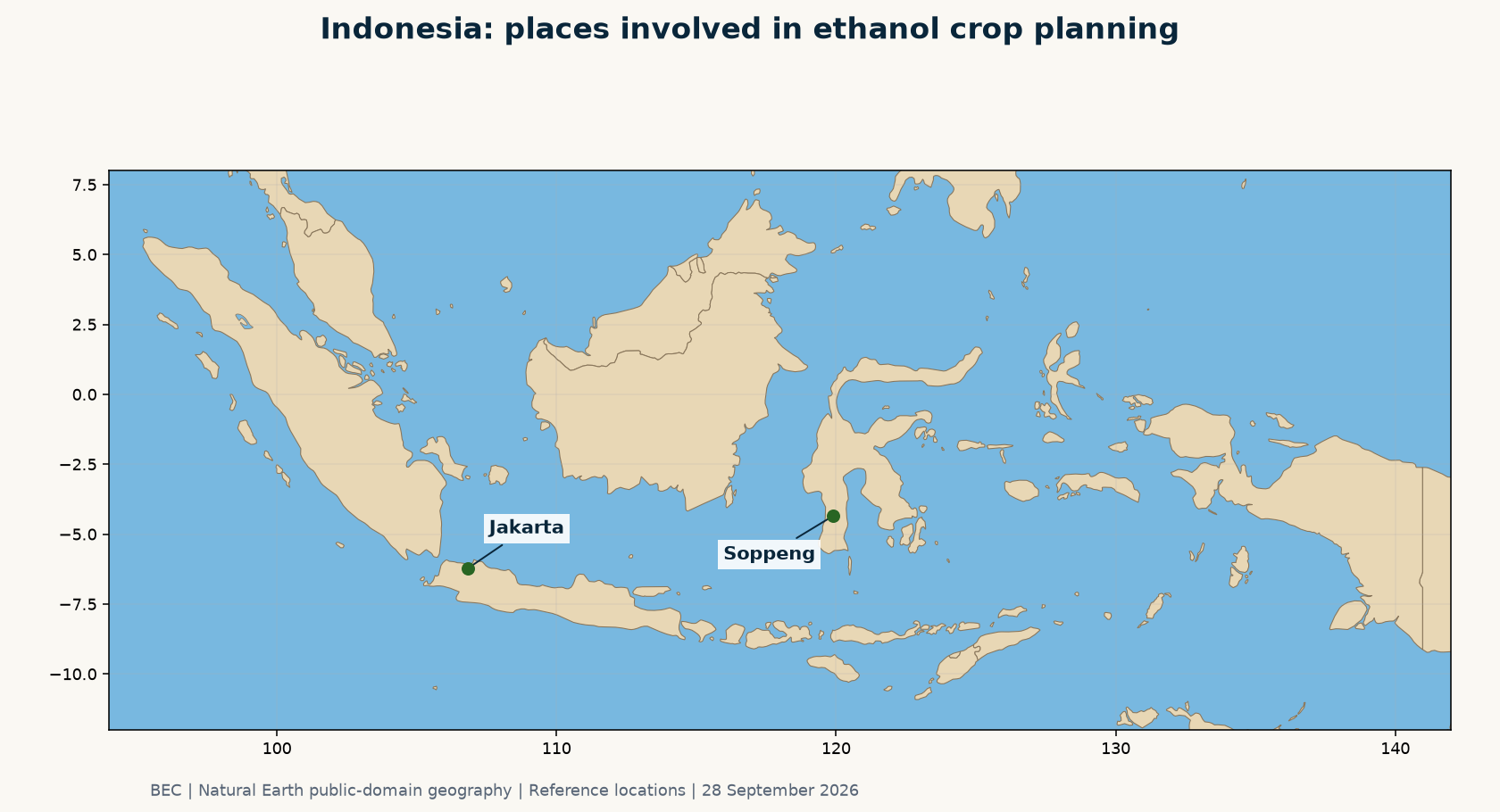
Indonesia's agriculture ministry convened 44 regents on 21 September to prepare production areas for sugarcane, cassava and maize. The programme describes an ambition of one to two million hectares, with regional governments expected to identify suitable land and production readiness.
The announcement advances regional coordination following earlier national planning. The area is a target, with secured parcels, industrial investment and commercial harvest volumes still to be established. Proposed community participation and funding arrangements will need to become workable local agreements.
BEC sees the most consequential decision upstream: which parcels and crop systems can supply a defined industrial buyer at a credible cost. District-level suitability and delivery evidence will determine how much of the national ambition can support an investable first phase.
Our analysis
Land screening should connect legal access with agronomic suitability and practical collection. A single area total can conceal differences in soils, water, slope and existing use that change the economics of cultivation. Parcel size and access also influence the machinery that can work economically and the cost of assembling each delivery.
Crop choice then determines the industrial calendar. Sugarcane, cassava and maize require different establishment, harvest and handling arrangements. The appropriate comparison includes the value of the existing agricultural alternative and the cost of delivering material in the condition the plant needs.
Community participation affects the durability of supply. Grower agreements need payment and risk allocation that support establishment and seasonal inputs, alongside specifications that participating farms can meet. Establishment finance and the timing of crop payments also determine which growers can participate through the first commercial harvest.
A phased programme could use field results and actual collection costs to refine plant scale. That would make early agricultural evidence useful to both growers and financiers, particularly where mapped potential differs from economically accessible supply.
Named districts, verified rights and a defined processing buyer would materially strengthen the case. Their combination would turn a policy ambition into a sequence of agricultural and industrial commitments with an identifiable delivery schedule. A phased investment decision could then connect the first plant commitment to agricultural performance in the areas expected to supply it.
Sources
Ontario, Canada
CHAR reports progress on Canadian plant turning wood into fuel for steelmaking
Final major piping is in place at Thorold, Ontario. The company now targets October 2026 for the start of commercial production.
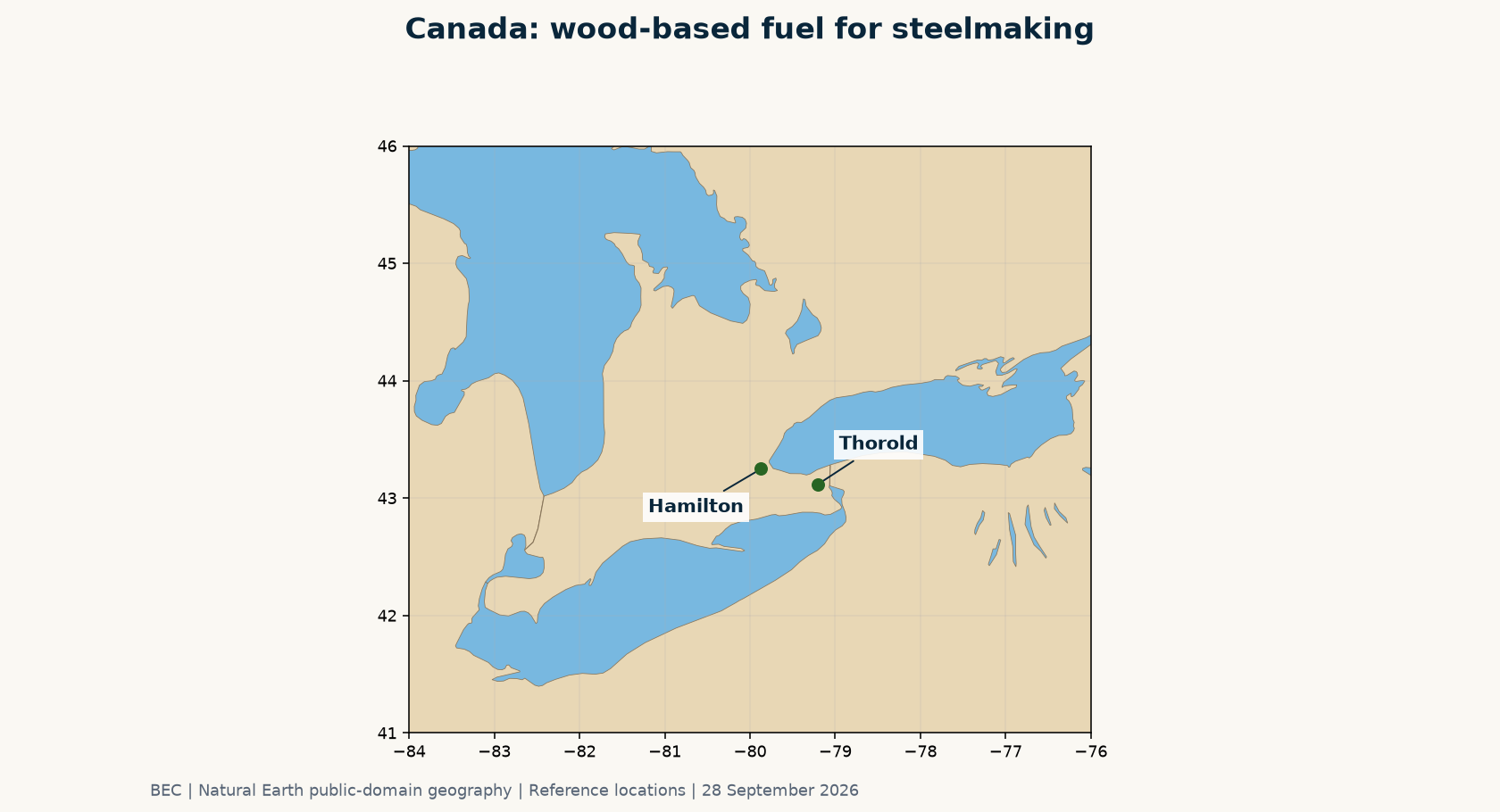
CHAR Technologies' 23 September update identifies the final major pyrogas piping installation at Thorold, Ontario, Canada, ahead of integrated commissioning. Phase 1 is designed for up to 5,000 tonnes of biocarbon annually, serving industrial uses including steelmaking.
The latest target places commercial ramp-up through October 2026. The company's 5 August announcement had targeted operation by the end of September. The comparison shows a later timetable alongside a specific construction advance; the causes and financial effects remain undisclosed.
For BEC, the decisive commercial evidence will be repeated production that meets customer requirements. Equipment installation narrows construction uncertainty, while sustained accepted deliveries will establish the value of the complete wood-to-biocarbon system for both the producer and its industrial customers.
Our analysis
Receiving biomass, commissioning a kiln and operating an integrated production line are distinct milestones. The remaining connections matter because individual components must function together under actual material and operating conditions. The critical interface is the behaviour of the combined line under the feedstocks and throughput intended for commercial production.
Feedstock quality is part of that test. Moisture, preparation and source variability can influence handling and conversion costs. A useful operating record connects a defined input range to repeatable product properties. Supplier specifications should therefore reflect the preparation and storage conditions under which repeatable product quality is achieved.
Industrial offtake provides a route to market, with delivery economics shaped by customer specifications, acceptance and pricing. CHAR names ArcelorMittal Dofasco under an earlier agreement; realised shipments and detailed commercial terms remain important evidence. The treatment of rejected material and interrupted deliveries can affect both inventory requirements and the return from a supply agreement.
The timetable change warrants attention without assigning an unsupported cause. October results could strengthen confidence through stable throughput and customer acceptance. Additional integration work would have different implications for working capital and sales timing. The elapsed commissioning period can also change the interval between procurement expenditure and receipts from accepted product sales.
The subsequent RNG phase carries its own construction and performance requirements. Phase 1 operating evidence would provide a stronger basis for evaluating that expansion and for assessing which parts of the model can transfer to another supply area.
Sources
Victoria, Australia
Opal confirms positive biogas study for its Australian paper mill
Opal confirms a positive study result for biogas to supply the mill’s kiln; investment approval and supply agreements remain pending.
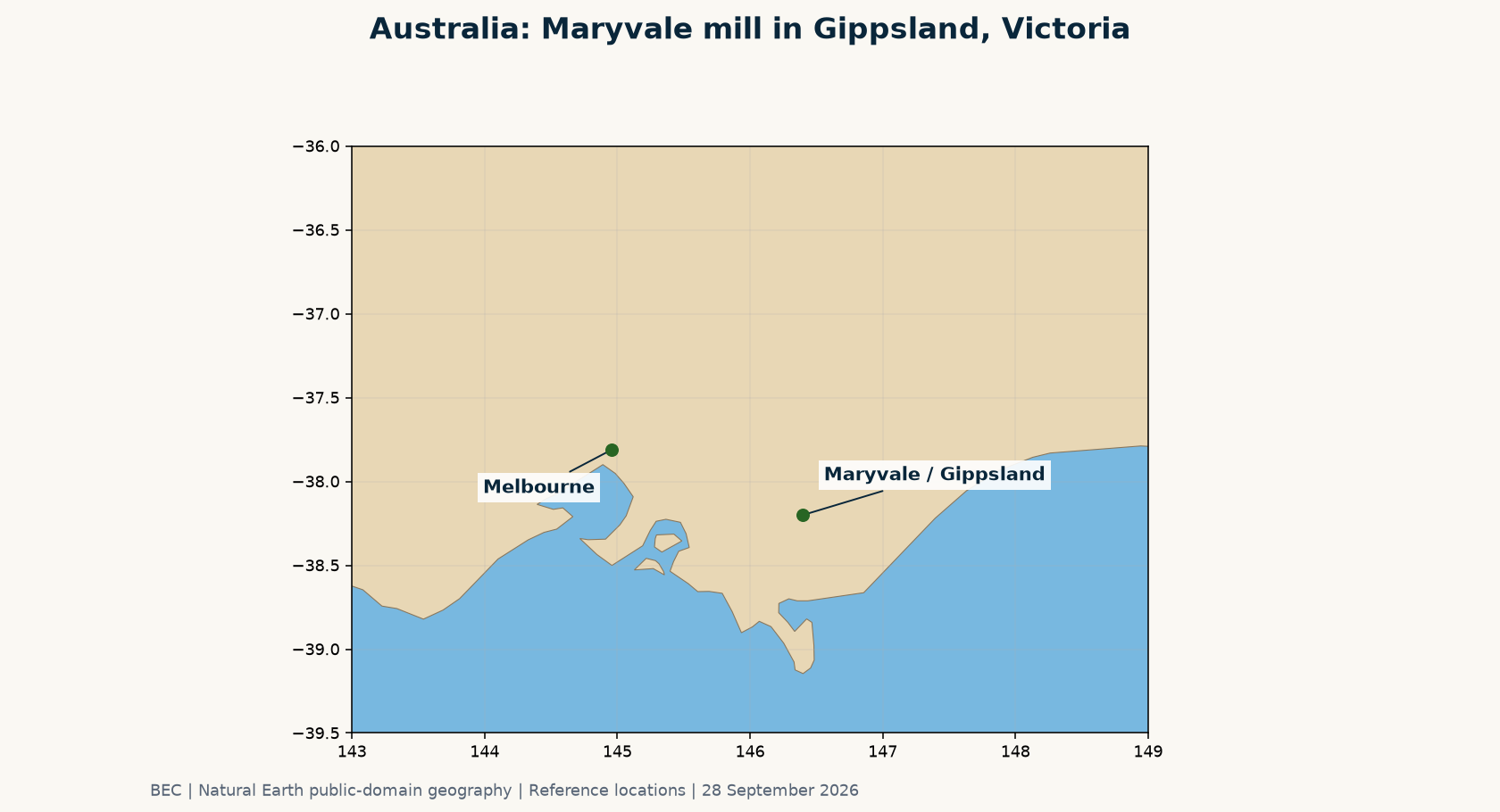
Opal's 23 September announcement confirms a favourable feasibility outcome for a proposed biogas facility at its Maryvale paper mill in Gippsland, Australia, developed with Delorean. The gas would serve the mill's rotary lime kiln.
Engineering, approvals and supply arrangements precede the investment decision. The contemplated resource mix includes organic residues and potentially paper-manufacturing byproducts. Opal's published concept graphic also identifies agricultural waste and energy crops as possible inputs, with species, planted area and procurement terms still open.
BEC's interpretation is that the kiln provides a useful demand anchor for evaluating the surrounding resource base. The project becomes more convincing as engineering and supply studies establish a feedstock mix capable of meeting that demand reliably and economically.
Our analysis
A named industrial user helps define gas quality, delivery profile and interruption arrangements. Those requirements should inform digestion capacity, treatment, buffering and integration with the existing mill. The mill and digester operator would also need agreed arrangements for periods when biological output and kiln demand diverge.
The energy-crop option deserves a local agricultural assessment. Its inclusion in a concept establishes a contemplated pathway; commercial relevance depends on land suitability, yield, harvest, conservation and delivered methane production. Harvest timing and conservation losses influence how much gas-producing material reaches the digester during the required operating season.
Perennial and intermediate systems may merit comparison where regional conditions support them. The appropriate assessment includes water and rotation effects, grower returns and the timing of supply alongside the proposed plant's biological requirements. Crop performance should be evaluated against the existing agricultural alternative and the costs of establishing a dependable annual delivery pattern.
Other organic inputs require equally specific agreements on contamination, preparation and rejected loads. Digestate storage and outlets form part of the resource balance and can materially affect transport and land requirements. Those arrangements influence the true cost of inputs that may appear inexpensive when valued only at their point of origin.
Engineering supported by resource sampling and credible supply agreements would allow a firmer investment comparison. Replication at another Opal site would benefit from operating knowledge while retaining its own local feedstock and industrial integration case.
Sources
Romania
OMV Petrom reports construction progress at its Romanian biofuel unit
The Petrobrazi unit is designed to produce 250,000 tonnes a year of sustainable aviation fuel and renewable diesel, with start-up targeted for 2028.
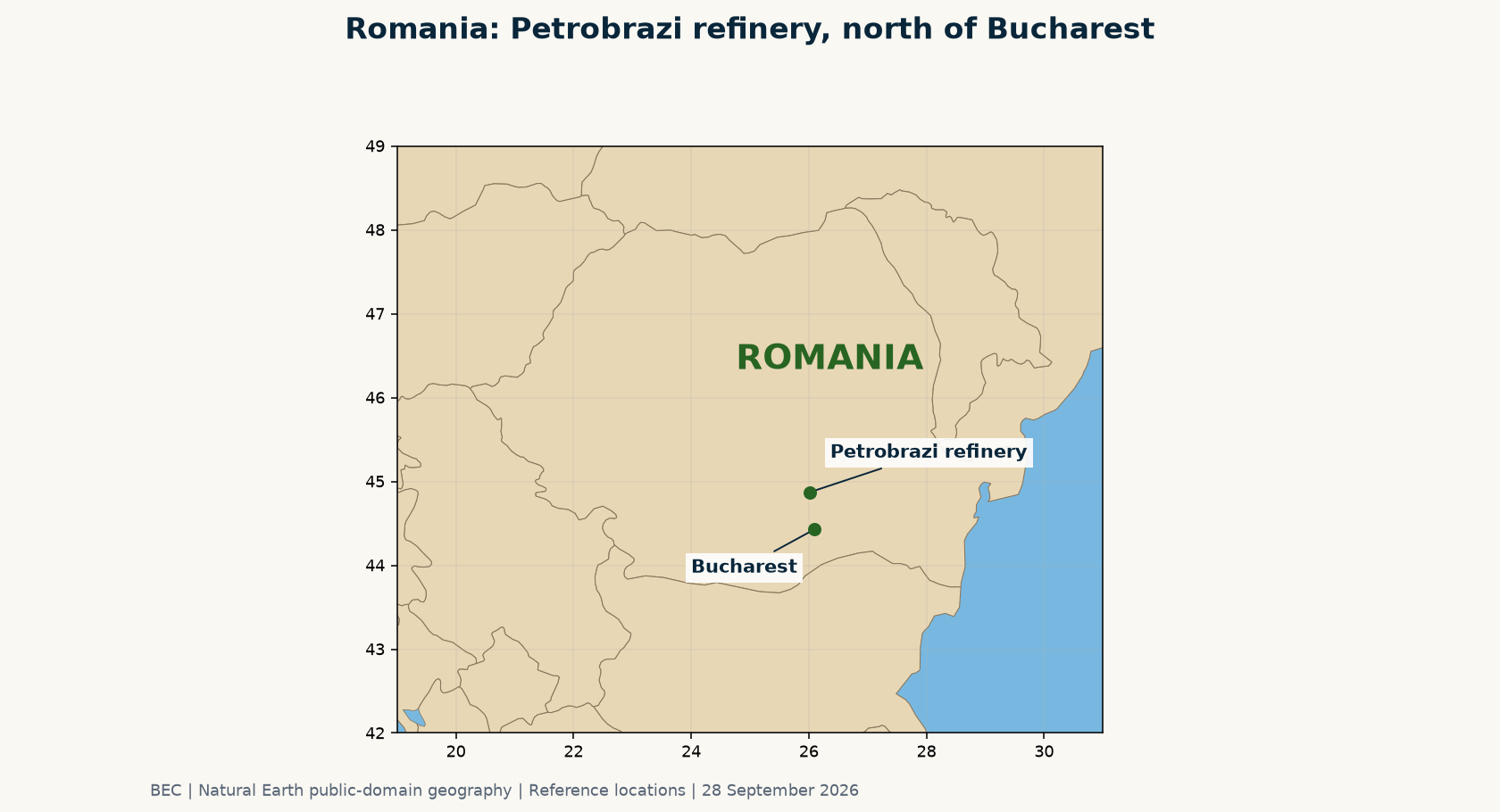
OMV Petrom reported on 21 September that foundations and key equipment were in place for Petrobrazi refinery's unit for sustainable aviation fuel (SAF) and renewable diesel (HVO). The Romanian project targets commissioning in 2028, with combined design capacity of 250,000 tonnes per year.
The EUR 560 million fuel unit forms part of a wider programme that includes EUR 190 million for hydrogen. A June filing disclosed a five-year contract with OMV Downstream for up to 360,000 tonnes of products in total, including at least 200,000 tonnes of SAF, and stated that over 80% of feedstock was secured for eight years.
BEC sees a project progressing on both physical and commercial fronts. The value of those commitments depends on the detailed product mix, feedstock qualification and timing of delivery as the new equipment is integrated with the refinery.
Our analysis
The sales quantity is cumulative. Spread evenly across five years, its maximum would average 72,000 tonnes annually, approximately 29% of stated combined capacity. This is an illustrative comparison; the actual annual delivery profile remains undisclosed.
That partial placement leaves commercial flexibility and further market exposure. The contract links related companies and uses a market-indexed pricing formula, making the terms and product allocation relevant to the revenue outlook. Delivery timing and the distribution between fuel products would make that commercial position easier to compare with the construction programme.
Feedstock flexibility can broaden purchasing options. Its value depends on material quality, pretreatment, traceability and the fuel categories that each input can support. A secured-volume percentage gives only part of that procurement picture. A procurement portfolio also needs compatibility between its quality range, pretreatment capability and the intended product specifications.
Installed columns and reactors still require connections and an extensive testing programme. Hydrogen, utilities and product handling need compatible availability before construction progress becomes reliable commercial output. The commercial schedule depends on these systems becoming available together and supporting fuel that meets customer acceptance requirements.
For prospective agricultural suppliers, the useful market begins with an eligible feedstock specification and purchasing terms. Future renewable-fuel demand can support crop development when those requirements align with a viable local production system. For a potential grower or processor, those purchasing conditions determine whether an apparent demand opportunity supports a viable production commitment.
Sources
Germany and United States
Verbio reports higher renewable gas production and positive cash flow
Annual results show higher biomethane production, while projects in Germany and the United States face different start-up and market conditions.
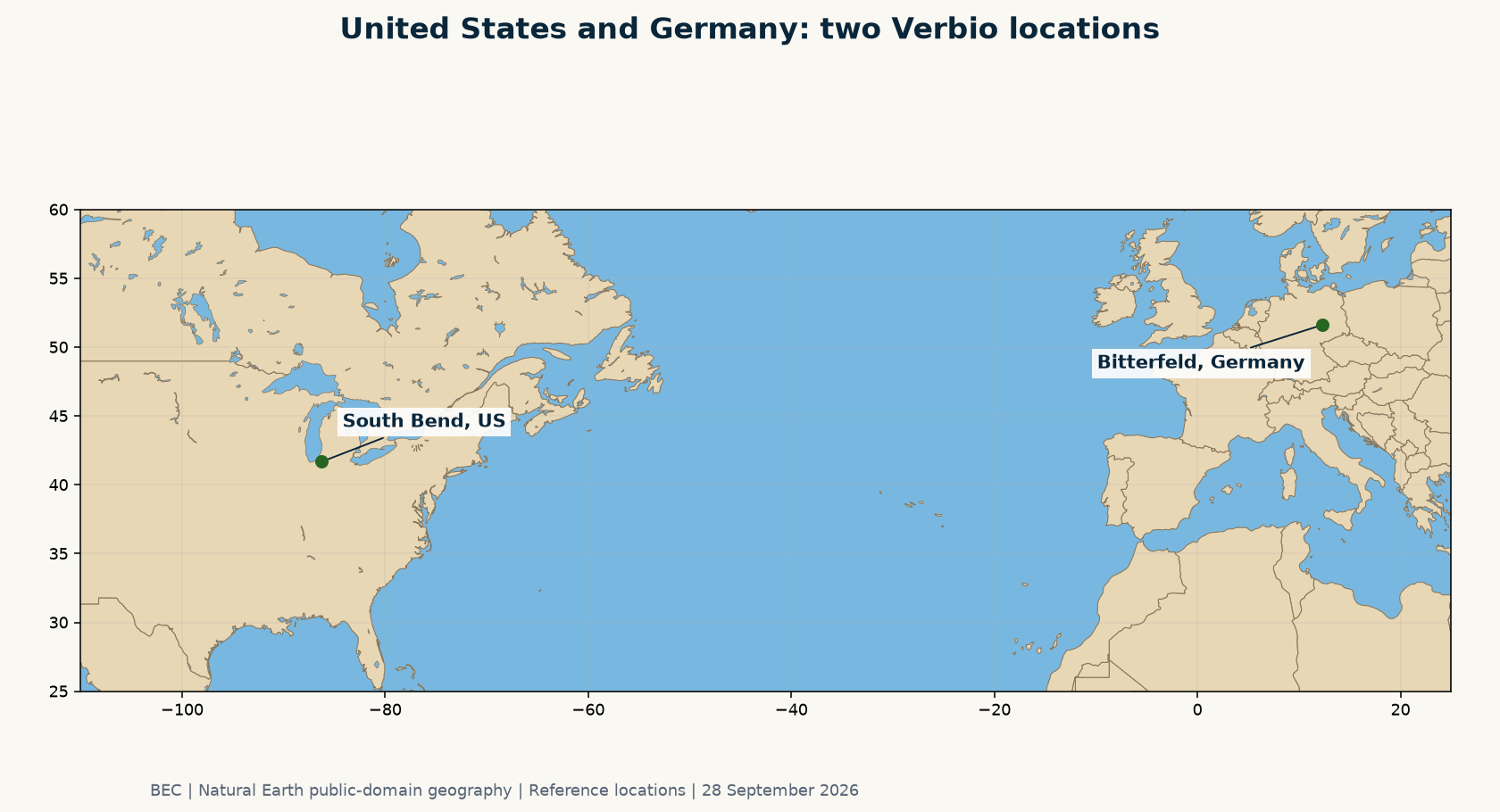
Verbio's 24 September annual disclosures report approximately 1,410 GWh of biomethane (renewable gas) production in 2025/26, compared with 1,190 GWh a year earlier. The detailed corporate announcement reports positive free cash flow and lower net debt.
The company attributes the financial recovery to a combination of utilisation, fuel-market spreads, greenhouse-gas quota conditions and other earnings effects. It also describes continuing work at South Bend and commissioning of the Bitterfeld biobased-chemicals facility.
BEC's reading is that the results strengthen the evidence for industrial progress while requiring care in extrapolation. A durable supply and investment case depends on identifying the contribution of physical operating gains separately from favourable market conditions.
Our analysis
Higher utilisation can distribute fixed costs across more product. Better selling prices or environmental-attribute values affect margins through another mechanism. A forward assessment needs both, with a clear sensitivity to input and output markets.
Integrated biorefineries can recover value through several products sharing resources and equipment. Feedstock qualification should therefore consider the whole output portfolio, including coproduct quality and market acceptance. A change in incoming material may affect both principal output and coproduct value, altering the price the plant can sustainably offer suppliers.
Verbio's detailed release also describes an earlier biological disruption in European fermentation and subsequent recovery. Operating availability influences procurement schedules, storage and delivery obligations as well as production totals. Procurement agreements and storage capacity should reflect that operating variability over the periods in which material must be delivered.
South Bend's staged development connects expansion to an existing site. Its eventual contribution depends on successful process integration, local supply and gas-market access. Bitterfeld introduces a different product and customer qualification process. Each investment consequently needs its own view of process availability, supply conditions and the timing of customer qualification.
For industrial decision-makers, the next useful evidence is repeatable performance across operating and market conditions. That would clarify the basis for further capacity, longer supply commitments and the allocation of capital between fuels and additional biomass-derived products.
Sources
Persistent Developments
Japan and Indonesia develop tree crops for future energy supplies
Japan's 2026 energy-forest programme and Indonesia's PoMa Hub illustrate two complementary parts of a longer agricultural investment cycle. NEDO's August call supports technologies that reduce establishment and harvesting costs for fast-growing trees, alongside more efficient chip and pellet production and transport. PoMa Hub, established in January 2026 by Four Pride, PT Santi Energi Hijau and BRIN, reported its first September shipment of Pongamia seedlings to a former coal-mining site in Kalimantan.
Together, these cases connect productive revegetation with the practical work needed to supply an industrial market. Nursery capacity determines which planting programmes can start; establishment, survival, harvestability and transport determine what those programmes can eventually deliver. NEDO's research priorities address costs across that sequence. The Kalimantan project adds a field-establishment case whose planted area, survival and oil yields remain undisclosed.
The investment significance lies in a repeatable production system. Field results linked to verified land conditions and a defined buyer would strengthen the case for expansion. Planting progress alone leaves the eventual industrial feedstock volume open. For developers evaluating perennial crops in 2026, the most valuable milestone is a traceable connection between establishment expenditure, measured field performance and the cost of a usable harvested product.
Sources: NEDO, August 2026 call; Four Pride, 17 September 2026.
Canada and the United States show why biomass products need dependable buyers
Two North American trajectories in 2026 show how the intended market shapes biomass processing. NB Power's 17 September announcement linked August board approval for Belledune's conversion with Canadian advanced-pellet supply agreements covering most of the station's requirement. Cold Steppe's July account of its Arkansas facility in the United States described two operating kilns that turn rice hulls into biochar following December 2025 commissioning, with two further kilns targeted for the end of 2026.
Belledune creates a long-term industrial demand around fuel specifications and reliable delivery. Cold Steppe targets an agricultural product whose value depends on consistent properties and credible performance in the conditions where farmers use it. Their expansion cases therefore depend on different forms of customer acceptance, even though both rely on dependable biomass handling and conversion.
For pellet suppliers, financing and delivery schedules need to align with the power station's engineering programme. For biochar producers, agronomic evidence and sales terms influence the return available from each tonne processed. Cold Steppe's reported crop benefits remain company claims, with independent trial results still needed for a quantified yield case. The larger 2026 investment lesson is that raw-material availability, conversion capacity and customer qualification develop together; progress at one interface changes the evidence required at the others.
Sources: NB Power, 17 September 2026; Cold Steppe, July 2026 account.
BEC Perspective
The strongest biomass investment cases connect three quantities: the resource that can be produced or collected, the material the plant can process consistently, and the product a customer will accept and pay for. Each has a location, quality and timing dimension. A large area target or installed capacity becomes decision-relevant when those dimensions are reconciled.
Cultivated biomass can play a valuable role where land suitability, management and market requirements support a repeatable supply system. Industrial residues require the same discipline around usable volume, competing uses and delivered cost. The practical advantage lies in designing the resource proposition around the buyer's actual requirement and testing the assumptions at the scale where investment will occur.
Outlook
Thorold's October operating results could clarify the transition from installed equipment to accepted biocarbon deliveries. Engineering and procurement at Maryvale will determine which resources can support its industrial gas proposition. At Petrobrazi, the interaction of construction, hydrogen and feedstock commitments will shape the path toward 2028.
For agricultural and land-based projects, named supply areas and measured establishment or harvest results would be the more consequential advances. Those records can support decisions about crop selection, procurement and plant scale while showing where a promising regional model needs adaptation.
For a project connecting land, crops and industrial demand, explore BEC's services or contact Bioenergy Crops.
Image credits and licences
Maps by BEC, using Natural Earth public-domain geography. City and regional reference points indicate context, not secured supply areas. Cover photograph from BEC’s licensed photographic library.