
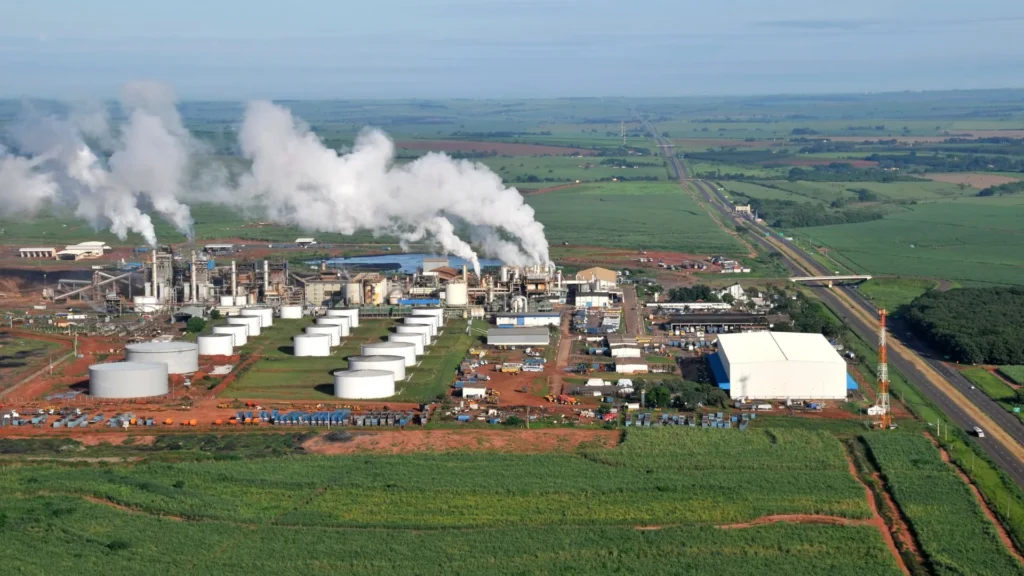
IEA Bioenergy Task 39 highlighted in its 2026 Biofuel News Magazine the role of industrial heat pumps in electrifying bioethanol production. The subject deserves attention because ethanol plants already exist at scale, consume large amounts of process heat and increasingly compete on lifecycle carbon intensity rather than only on fuel volume.
Ethanol production requires heat for distillation, evaporation, dehydration and drying. Many plants still rely on natural gas or other combustion systems for steam. Industrial heat pumps can recover lower-temperature waste heat, upgrade it and return useful heat to the process. As equipment temperature ranges improve, more ethanol duties become technically accessible.
Retrofitting heat can change carbon intensity without changing the molecule
The ethanol molecule is the same whether the plant uses fossil steam, biomass CHP, renewable electricity or heat-pump integration. Fuel policy increasingly treats those cases differently because lifecycle emissions include process energy. A plant that lowers fossil heat demand can improve the carbon intensity of its ethanol and therefore its value in markets that reward lower-carbon fuels.
This matters beyond road fuel. Alcohol-to-Jet projects depend on ethanol as their carbon input. If the ethanol has a lower carbon intensity before conversion, the resulting SAF pathway may have a stronger compliance and offtake position. Heat pumps therefore sit in a strategic part of the value chain: they can improve an existing commodity platform while future ATJ capacity is still being developed.
The economics depend on electricity, temperature and utilisation
Industrial heat pumps are not a universal retrofit. Their economics depend on electricity price, grid carbon intensity, heat-source temperature, required output temperature, operating hours and the avoided cost of boiler fuel. A plant with continuous operation and suitable waste-heat streams has a better case than one with intermittent heat demand or very high-temperature requirements.
Project developers also need to consider electrical connection capacity, redundancy, maintenance and integration with existing boilers. The most financeable configuration may be hybrid rather than all-electric: heat pumps handle stable baseload duties while boilers cover peaks, start-up and resilience. That kind of integration can reduce risk while still lowering fuel use and emissions.
Existing plants are an underused decarbonisation asset
Much advanced-fuels discussion focuses on new refineries, new feedstocks and new pathways. Heat electrification is less dramatic, but it may move faster because it works inside assets that already have permits, feedstock relationships, operators and markets. For ethanol producers, the retrofit question is no longer only an engineering question. It is a market-positioning question.
The next useful evidence will come from plant-level case studies: capital cost, coefficient of performance, heat-duty coverage, downtime, electricity sourcing and verified carbon-intensity improvement. If those data support the theory, industrial heat pumps could become one of the most practical near-term measures for improving ethanol’s role in low-carbon fuel and ATJ supply chains.
Sources and further reading
- IEA Bioenergy Task 39, Biofuel News Magazine, Issue 2-2026, No. 71
- IEA Bioenergy, Task 39 programme and publications
- IATA, Global Feedstock Assessment for SAF Production, 2025.