
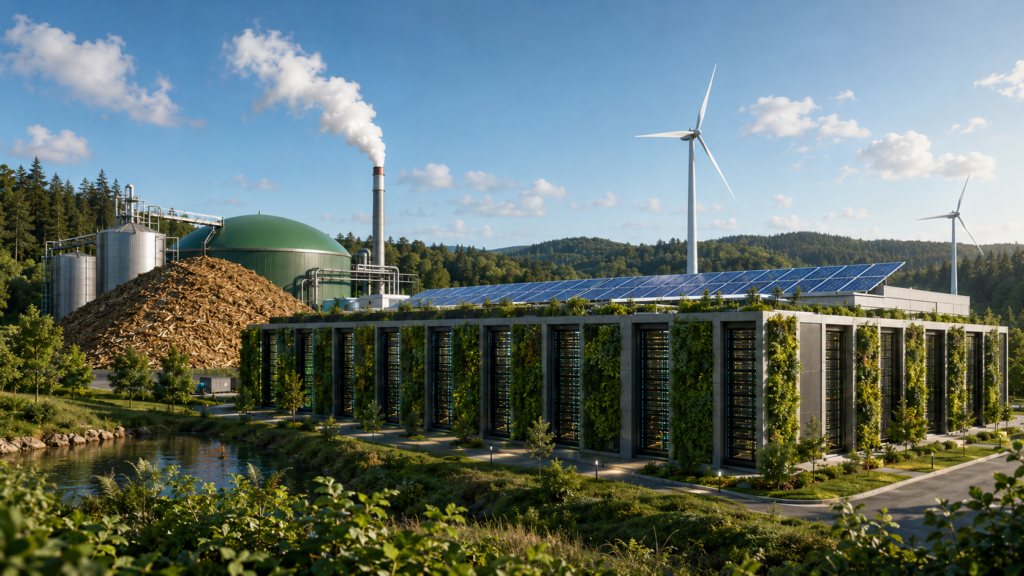
Bioenergy data centers will need more than renewable power certificates. Biomass, biogas, cooling, heat reuse and feedstock basin regions could shape the next generation of sustainable data center energy campuses.
The bioenergy data centers conversation is moving from corporate renewable power procurement to physical energy infrastructure. AI workloads, high-density GPU racks and tighter grid constraints are turning data centers into large industrial energy users that need reliable electricity, advanced cooling, water stewardship, heat management and credible carbon strategies.
The International Energy Agency projects global data center electricity consumption to rise from around 485 TWh in 2025 to around 950 TWh in 2030. AI-focused data centers are expected to grow even faster, tripling electricity use over the same period. In Europe, data center consumption was estimated at just under 100 TWh in 2022 and nearly 150 TWh by 2026, close to 4% of total EU electricity demand. [1][2]
Most of the first wave of green data center strategies has focused on power purchase agreements, low-carbon grids, better power usage effectiveness (PUE), natural cooling and more efficient equipment. Those measures matter. A new generation of sites will also need a more territorial approach: firm renewable power, cooling integration, heat reuse, water management, biomass or biogas supply, carbon removals and local resilience designed together from the start.
Bioenergy is not the whole answer for hyperscale data centers, but it can be the firm, dispatchable and thermal layer that many renewable energy strategies still lack.
What bioenergy can add to data center energy campuses
Solar and wind PPAs can provide large volumes of low-cost renewable electricity. Their challenge is hourly matching, firm capacity, backup and the physical cooling load of a facility that operates continuously. Bioenergy brings a different attribute: it is storable, dispatchable and thermal.
That matters because data centers convert nearly all consumed electricity into heat. The ICEF Sustainable Data Centers Roadmap describes waste heat as a continuous and predictable stream. Liquid cooling is making that stream more useful: modern systems can recover heat at 45-70 °C, and ultra-high-density liquid cooling can capture more than 99% of waste heat at roughly 55-70 °C. Two-phase immersion systems can reach PUE values as low as 1.03-1.05 in some cases. [3]
This creates a direct opening for biomass combined heat and power (CHP), combined cooling, heat and power (CCHP), biogas, biomethane, absorption cooling, heat pumps, district heating, drying, greenhouses, aquaculture, biochar and potentially bioenergy with carbon capture and storage (BECCS). The opportunity is broader than electricity. It is about designing a site where energy, cooling, biomass supply chains and carbon value reinforce each other.
Real-world cases already showing the model
| Case | What is proven | Relevant figures | Why it matters for BEC |
|---|---|---|---|
| Falun, Sweden | Biomass CHP integrated with district heating and cooling, pellet drying, thermal storage and data center heat reuse. | 60 MWth + 15 MWe CHP; around 300 GWh heat and 80 GWh electricity per year; 50,000 t/y pellet plant; 200 km heat grid; 2.2 MW absorption cooler; 30 MW / 450 MWh accumulator. [4] | A mature example of a regional energy system where biomass, heat, cooling, pellets and data infrastructure are connected. |
| Luxembourg / Kiowatt-LuxConnect | Solid biomass cogeneration associated with a wood pelleting plant and a data center. | 3 MW biomass cogeneration; data center requirement around 5 MW; recycled and forest wood; steam at around 400 °C; absorption chillers producing chilled water at +8 °C; reported 85% cogeneration efficiency. [5] | Shows that biomass can directly support cooling through heat-to-cold integration, especially when there is another heat load such as pellet drying. |
| Michałowo, Poland | Planned green data center linked to existing biogas and photovoltaic assets, with green roofs, green walls and water retention. | Existing biogas plant: 600 kWe and 595 kWt; nearby PV farm; planned independent medium-voltage feeds, UPS and backup generation. [6] | A conceptually strong model for biogas + PV + green-blue infrastructure at smaller or modular scale. |
| Grubišno Polje, Croatia | Commercial 5 MWe biomass CHP platform using forestry and agricultural biomass, developing heat offtake, data center trigeneration and BECCS options. | 5 MWe CHP; forestry and agricultural biomass collected within a 65 km radius; long-term PPA; industrial wood drying and agri-food heat services. [7] | A practical Central and Eastern Europe model for biomass supply basin, heat valorisation and future data center cooling. |
These cases are still early compared with the scale of the AI build-out. The ICEF Roadmap notes that the Open Compute Project listed only 12 operating data center heat reuse projects of at least 5 MW and 13 planned projects of that size, with most located in Northern Europe. That limited deployment is exactly why the topic is timely. Heat reuse, biomass CHP and biogas integration are moving from isolated projects toward strategic site selection. [8]
Why data centers need more than renewable PPAs
A large AI campus can easily require hundreds of megawatts. A 100 MW IT load with a PUE of 1.15 consumes roughly 1 TWh per year. Supplying that entirely with solid biomass would require a very large feedstock chain, often hundreds of thousands of dry tonnes per year depending on fuel quality, conversion efficiency, availability and the share of heat recovered.
That is why the strongest model is hybrid. Solar, wind, hydro or grid PPAs can provide the bulk of annual electricity. Biomass CHP, CCHP or biogas can provide firm renewable power, thermal integration, backup, absorption cooling, drying, industrial heat or carbon removals.
In this model, bioenergy competes less as a commodity MWh and more as a reliability and integration layer. For data centers under grid constraints, the most valuable energy is often the energy that is available at the right hour, from a credible source, with physical infrastructure and a long-term supply contract behind it.
Solar and wind can provide the volume of renewable electricity. Bioenergy can provide the firm, dispatchable and thermal layer that makes selected sites more resilient.
Feedstock basin regions: where this could make sense
The most original question may be geographic: where can data centers be sited inside reliable bioenergy basins? A feedstock basin is a territory where residues, biomass crops, agroindustrial by-products, renewable power, water, fibre, cooling conditions and local industrial uses can be evaluated together.
The 2025 Energies review argues that data center sustainability assessment should move beyond PUE and include water use, waste heat utilisation, renewable energy integration, hourly carbon-free matching, embodied carbon and land-use impacts. It also notes that land-use strategies such as blue-green infrastructure, ecosystem services, biomass production and biogas co-location are still underrepresented in the literature. [9]
This is where agronomy and biomass supply become strategic. A data center developer may understand interconnection, fibre and cooling. A bioenergy developer must understand seasonal feedstock, moisture, ash, storage, harvesting windows, competing uses, transport radius, sustainability certification, social licence and reliable biomass logistics delivered to gate.
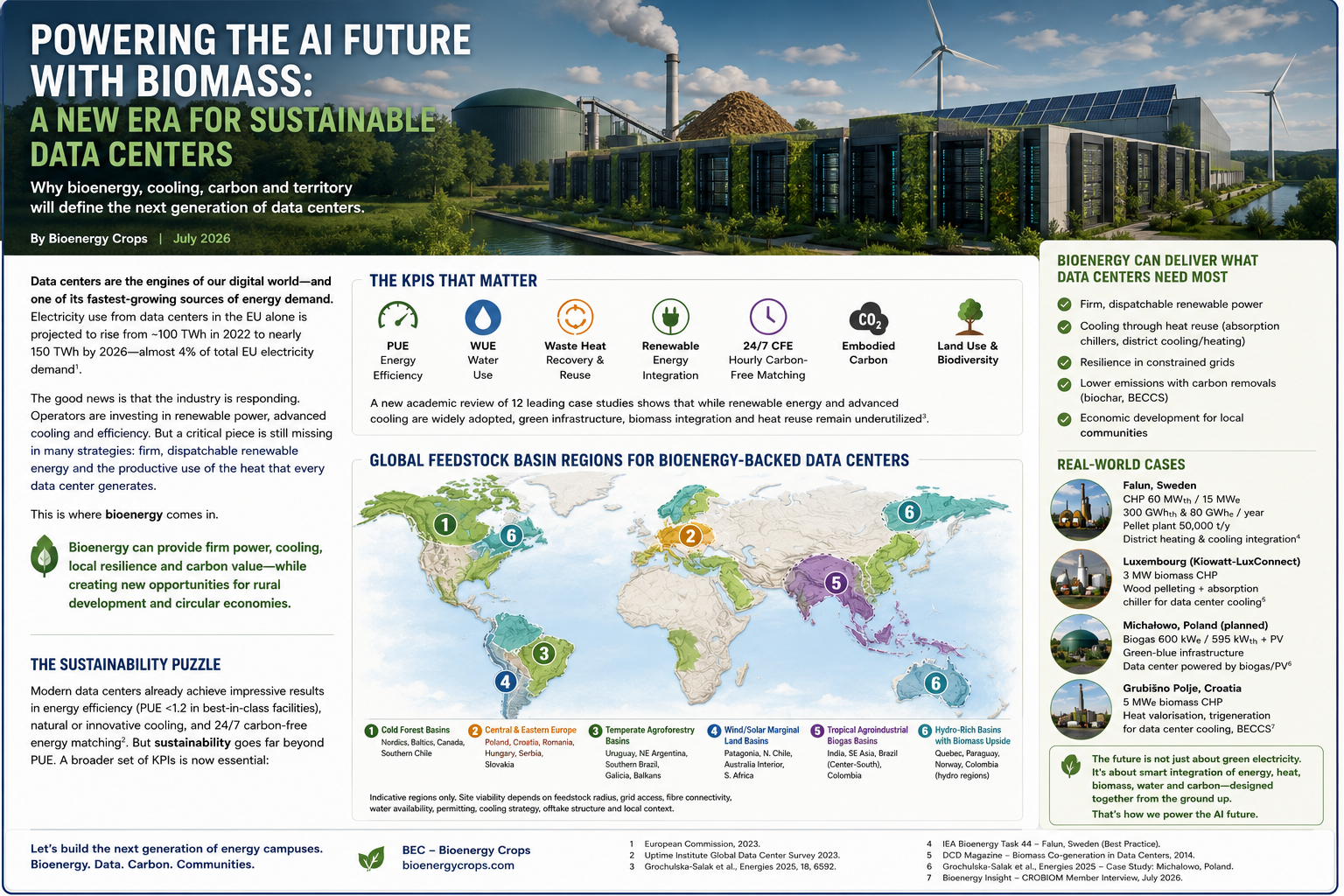
The map groups the opportunity into six readable basin types: cold forest basins, temperate agroforestry basins, Central and Eastern Europe CHP basins, tropical agroindustrial biogas basins, wind and solar marginal land basins, and hydro-rich regions where biomass can add resilience, heat and carbon value.
Where the basin logic could work
| Basin type | Likely bioenergy role | Representative regions |
|---|---|---|
| Cold forest basins | Biomass CHP, district heating/cooling, heat reuse, pellet drying, biochar or BECCS. | Nordics, Baltics, Canada, Southern Chile. |
| Temperate agroforestry basins | Forest residues, sawmills, chips, short-rotation coppice (SRC), short-rotation forestry (SRF), medium-scale CHP/CCHP and carbon projects. | Uruguay, north-eastern Argentina, Southern Brazil, Galicia, Balkans. |
| Central and Eastern Europe CHP basins | Agricultural and forest residues, biogas, PV, CHP, agri-food heat and data center cooling. | Poland, Croatia, Romania, Hungary, Serbia, Slovakia. |
| Tropical agroindustrial biogas basins | Biogas/biomethane for firming, compressed biogas (CBG), residues from sugarcane, palm, rice, manure and food waste. | India, Indonesia, Malaysia, Thailand, Vietnam, Brazil, Colombia. |
| Wind/solar marginal land basins | Large renewable power with biomass as backup, carbon platform or secondary firming layer. | Patagonia, Northern Chile, Australian interior, parts of Southern Africa. |
| Hydro-rich basins with biomass upside | Hydro as low-carbon base power; biomass for balancing, heat, carbon and local resilience. | Quebec, Paraguay, Norway, hydro regions of Colombia and Brazil. |
The technology maturity is stronger than the market maturity
The core technologies are commercial: biomass boilers, steam turbines, organic Rankine cycle (ORC) systems in selected applications, district heating, absorption cooling, biogas plants, biomethane upgrading, gas engines, fuel cells, heat pumps, thermal storage, liquid cooling, biochar and monitoring, reporting and verification (MRV) platforms.
The emerging part is the integrated model. Data centers have strict uptime requirements, while biomass projects depend on feedstock logistics, seasonality and local permitting. The risk is mostly integration and bankability: feedstock contracting, redundancy, emissions control, long-term fuel price, grid relationship, cooling design and project feasibility and due diligence.
Solid biomass works best when there is a thermal strategy. Data Center Dynamics’ biomass cogeneration case explains why: solid biomass uses steam turbines, and the economics improve when extracted steam is used for pellet drying, industrial heat or absorption chillers. Biogas and biomethane have a different advantage: engines, turbines and fuel cells can provide modular firm power with a gas-like operational profile. [5]
Biochar and BECCS can add another layer. They should be treated as carbon and feedstock-value platforms integrated into the campus rather than as simple power systems. A biomass basin that can produce heat, firm power and durable carbon removals has a stronger investment story than a power-only biomass plant.
What investors and developers should assess
| Screening question | Why it matters |
|---|---|
| Is there enough biomass inside a realistic 50-100 km radius? | Transport cost, moisture and reliability can make or break the economics. |
| Is the feedstock residual, cultivated or mixed? | Residual biomass reduces land-use pressure; energy crops on marginal land can improve long-term security when designed on marginal or underused land. |
| Can the heat be used? | CHP/CCHP becomes much stronger with district heating, absorption cooling, drying, greenhouses, aquaculture or industrial heat hosts. |
| Can the data center use liquid cooling or higher-temperature heat recovery? | Higher heat recovery temperatures improve the case for reuse, heat pumps and thermal integration. |
| Is renewable power available at scale? | Solar, wind, hydro or grid PPAs provide volume; bioenergy provides the firm and thermal layer. |
| Is the carbon value credible? | Biochar, avoided methane, BECCS or renewable gas attributes need robust MRV and conservative accounting. |
| Does the site have fibre, water, permits and power redundancy? | The best biomass basin is irrelevant without data center-grade infrastructure. |
What this means for Bioenergy Crops
Bioenergy Crops sees this opportunity from the feedstock side. Data center developers can buy electricity certificates. Building a bankable bioenergy-backed energy campus requires a different skill set: biomass resource assessment and supply-chain design, agronomic potential, logistics, sustainability, land-use planning, engineering procurement and construction (EPC) interface, carbon strategy and long-term feedstock risk management.
The most investable projects will likely combine several layers: solar or wind PPAs for energy volume; biomass CHP or biomethane feedstock strategies for firm power; heat reuse or absorption cooling for thermal efficiency; land and crop assessment for site-level resilience; and biochar, carbon removals and decarbonisation strategy for carbon value.
The strongest sites will be found where the data center is treated as an anchor load inside a wider local energy system. In those locations, bioenergy can support power reliability, cooling, waste valorisation, rural income, lower emissions and carbon removals.
Bioenergy is not the whole answer, but it can be the firm layer
AI infrastructure is creating a new class of energy demand: large, continuous, power-dense and increasingly scrutinised by communities, regulators and investors. Renewable PPAs will remain central. Cooling, firm capacity, heat reuse and territorial sustainability will become just as important.
Bioenergy has a specific role in that transition. It can provide dispatchable renewable energy, convert local residues into power and heat, support cooling through CHP/CCHP, create pathways for carbon removals and strengthen local resilience. The opportunity is highly site-specific, which makes feedstock basin analysis essential.
The next generation of sustainable data centers will be shaped by the places where renewable power, biomass supply, water, cooling, connectivity and carbon value can be designed as one system.
Bioenergy Crops supports biomass feedstock strategy, energy crop development, bioenergy supply chains, sustainability assessment and carbon-oriented project design for emerging bioindustrial and renewable energy infrastructure. For data center developers and investors, the question now includes site-level resilience: where can a reliable energy campus be built?
Selected sources
[1] International Energy Agency, Key Questions on Energy and AI, Executive Summary. Data center electricity consumption projections: around 485 TWh in 2025 to around 950 TWh in 2030.
[2] Grochulska-Salak, M. et al., Green Data Centres: Sustainable Solutions with Green Energy and Green-Blue Infrastructure, Energies 2025, 18, 6592. EU data center consumption and KPI framework.
[3] ICEF, Sustainable Data Centers Roadmap, Chapter 2.4: Heat Reuse, October 2025. Liquid cooling, heat recovery temperatures, PUE and heat reuse opportunities.
[4] IEA Bioenergy Task 44, Best Practices on Flexible Bioenergy: Pellet Production Linked to Combined Heat and Power Plant, Falun, Sweden, 2024.
[5] Data Center Dynamics, Examining the Potential for Biomass Co-generation, February 2014. Luxembourg biomass cogeneration, absorption chilling and cost/performance discussion.
[6] Grochulska-Salak, M. et al., Energies 2025. Michałowo, Poland green data center case study: biogas, PV and green-blue infrastructure.
[7] Bioenergy Europe, Where Biomass Meets Ambition: Croatia’s Energy Pioneer, 2026. Grubišno Polje 5 MWe biomass CHP, heat valorisation, data center cooling and BECCS exploration.
[8] ICEF, Sustainable Data Centers Roadmap, Chapter 2.4: Heat Reuse. Open Compute Project heat reuse project counts and Northern Europe concentration.
[9] Grochulska-Salak, M. et al., Energies 2025. Broader KPIs: PUE, water usage effectiveness, waste heat utilisation, renewable integration, 24/7 carbon-free energy, embodied carbon and land-use impacts.