

Brazil’s SAF Advantage May Be Built in the Landscape Before the Refinery
Honeywell’s modular package for Acelen Renewables links proven Ecofining technology with macaúba, a native perennial oil crop that could create a new dedicated SAF feedstock landscape in Bahia.
The 2026 project update
Honeywell announced in June 2026 that Acelen Renewables’ Bahia project will use modular Ecofining technology, specialised pumps and compressors, and integrated control and safety systems for SAF and renewable diesel production.
The refinery technology had been selected previously. The new announcement adds execution detail and emphasises modular delivery intended to shorten schedules and reduce integration cost.
Macaúba makes this more than another HEFA project
Acelen plans to use macaúba oil, derived from a perennial palm native to Brazil. This creates the possibility of a feedstock system designed alongside the refinery rather than acquired entirely from existing global lipid markets.
Dedicated perennial oil crops can offer multi-year production, deep rooting, year-round soil cover and integration with livestock or agroforestry. Their outcome depends on genotype, planting density, water balance, harvest mechanisation, processing yield and land-use baseline.
The scale-up challenge sits across agriculture and industry
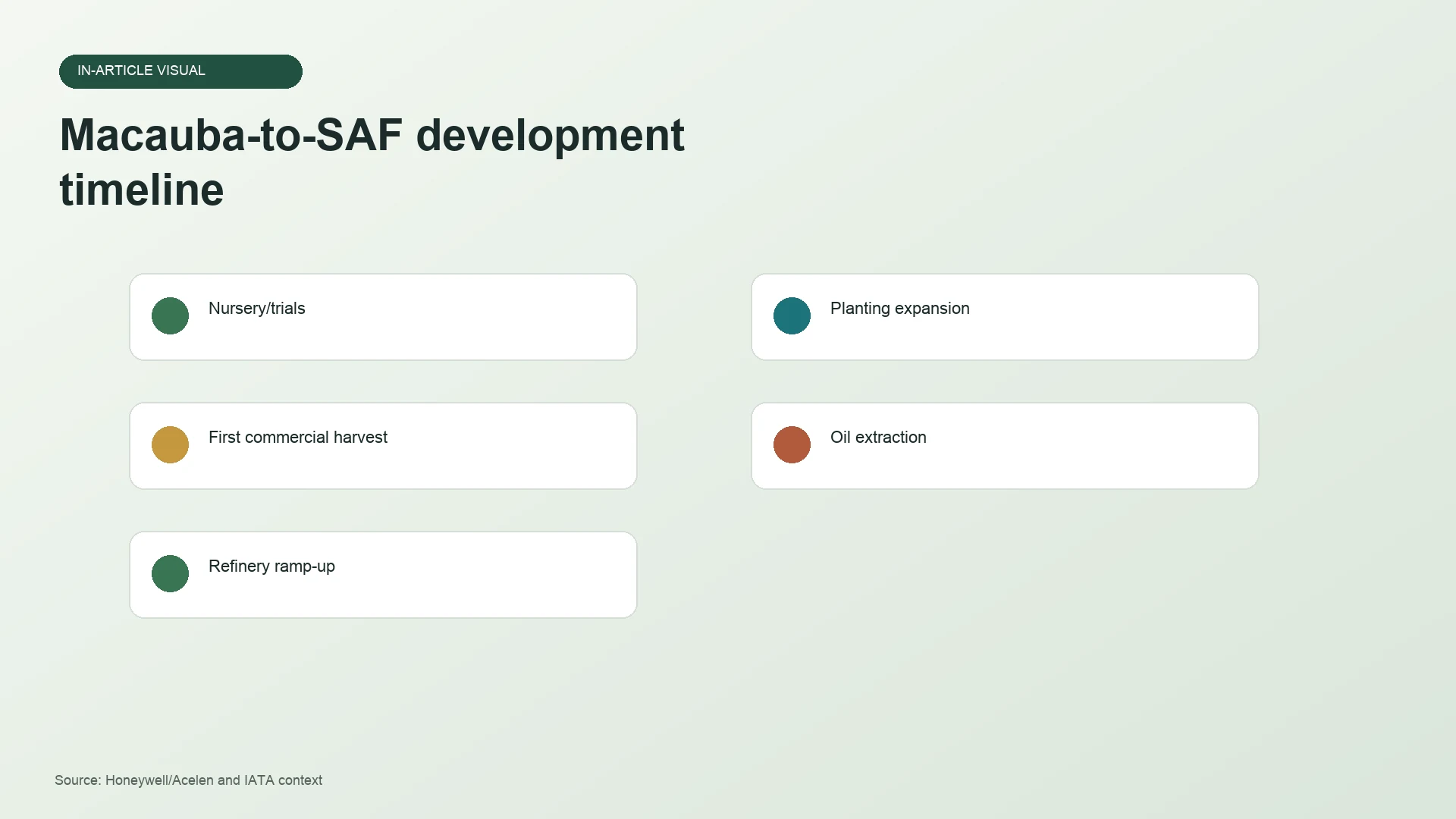
A refinery can be modularised and replicated more rapidly than a plantation landscape. Nurseries, planting material, farmer engagement, extension, harvesting equipment and oil extraction must expand years before full refinery utilisation.
This creates a sequencing requirement. Agricultural development cannot be treated as a late procurement exercise.
Brazil’s wider opportunity
IATA estimated in June 2026 that Brazil could have approximately 18 million tonnes of sustainably sourced ethanol and oil feedstocks available by 2030, representing around 12 million tonnes of theoretical SAF potential. Around 15 announced projects would provide closer to 2 million tonnes if completed.
The gap between potential and announced capacity reflects the work still required in feedstock contracting, certification, capital formation and project execution.
Carbon intensity must be designed at field level
Macaúba SAF performance will depend on previous land use, fertiliser, energy, transport, yields, processing and any soil-carbon change. Establishment on degraded pasture with improved management can produce a very different result from conversion of high-carbon ecosystems.
Traceability, geospatial baselines and farmer-level data therefore belong in the core project design.
BEC perspective
Acelen is one of the clearest current examples of a refinery project whose competitive advantage may originate in agricultural system design.
The decisive milestones will include verified plantation area, mature yield curves, oil recovery, farmer economics, mechanised harvest performance and alignment between plantation ramp-up and refinery commissioning.
Sources and further reading
- Honeywell, “Honeywell Modular Technology to Power and Automate Acelen Renewables’ Biofuel Production,” 17 June 2026
- IATA, “Brazil’s Opportunity to Be a SAF Powerhouse,” 8 June 2026
- IATA, Global Feedstock Assessment for SAF Production, 2025.
Related BEC articles
- Can Lignocellulosic Intermediates Extend the HEFA Infrastructure Model?
- Indonesia’s B50 Mandate Will Reshape More Than Its Domestic Diesel Market
- Brasil puede convertirse en una potencia del SAF, pero el cuello de botella estará en convertir potencial agrícola en suministro financiable
Bioenergy Crops provides agronomic, feedstock and project-development advice for biomass, biofuels and renewable-carbon value chains.