
Can Raw Dairy Biogas Become a Distributed SAF Feedstock?
Circularity Fuels reports a six-month pilot converting raw dairy biogas directly into Fischer-Tropsch jet fuel. The concept could connect manure methane mitigation with modular SAF production.
A striking pilot claim
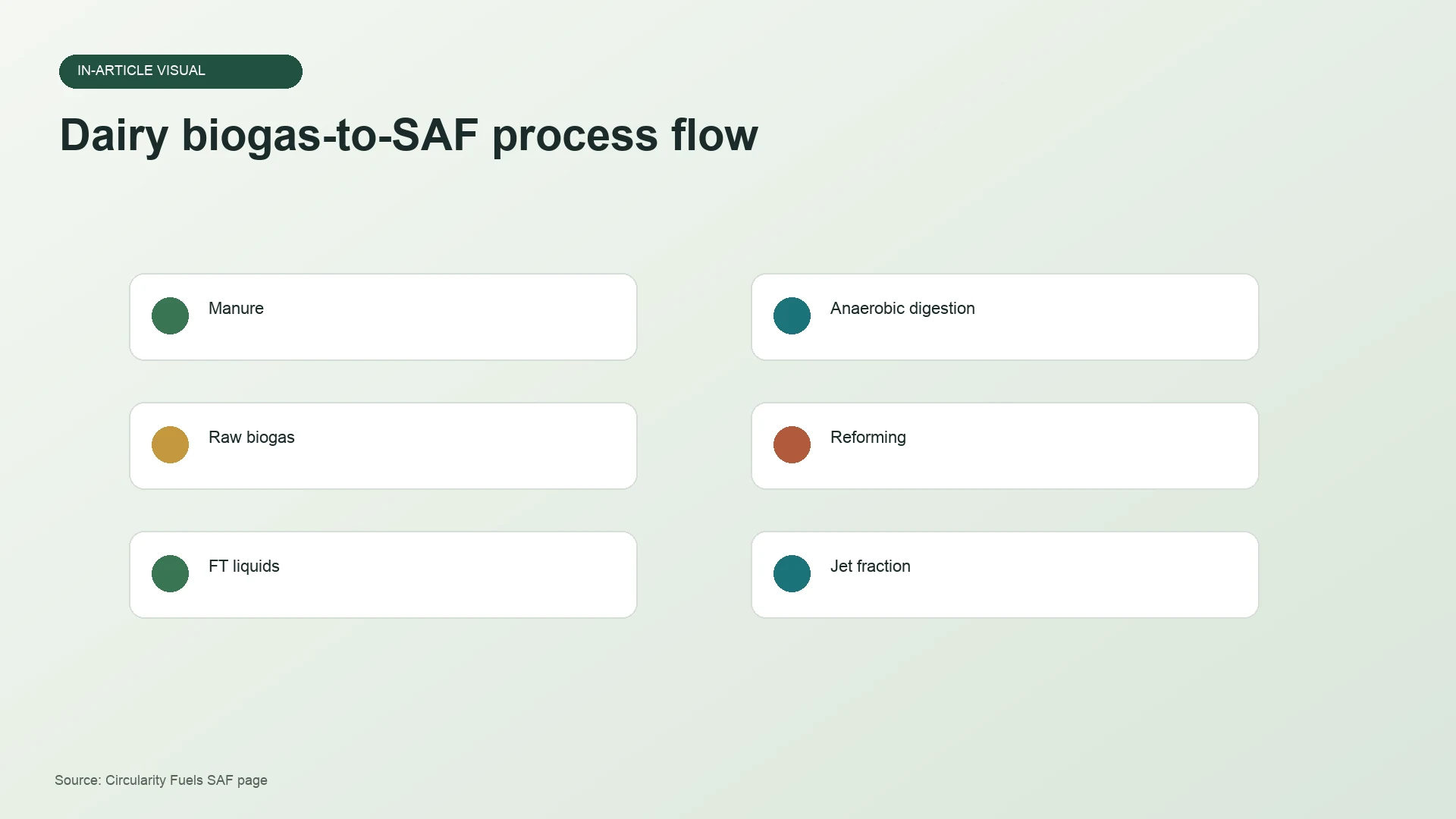
Circularity Fuels reported in June 2026 that a six-month California pilot converted raw dairy biogas into jet fuel meeting ASTM D7566 Annex A1 specifications. The company describes a feed containing roughly 65% methane and 35% carbon dioxide and a modular system combining electrified reforming with Fischer-Tropsch synthesis.
The reported process uses both methane and carbon dioxide without first producing pipeline-quality renewable natural gas.
Why bypassing conventional upgrading matters
Many biogas projects remove carbon dioxide, hydrogen sulphide, water and trace contaminants before injecting biomethane into a pipeline or using it as compressed fuel.
Direct conversion into syngas could use a larger share of the raw carbon stream and avoid some conventional separation requirements. It would still require robust removal or management of sulphur, siloxanes, moisture and other catalyst poisons.
Distributed production changes the project architecture
Dairy digesters are geographically dispersed. Transporting raw biogas is difficult, while small pipelines or upgrading plants can be expensive.
A modular conversion system near the digester could produce a denser liquid product. Commercial performance will depend on minimum economic scale, operating labour, electricity supply, hydrogen balance, Fischer-Tropsch selectivity and product logistics.
The carbon-intensity opportunity
Capturing manure methane can create a large avoided-emissions benefit because methane would otherwise have a high climate impact. The final result depends on the baseline manure system and the rules applied by each regulatory programme.
Extremely negative carbon-intensity figures should be interpreted carefully. They often depend on counterfactual crediting, allocation and project additionality, and may change as manure management becomes regulated.
Evidence required for commercial confidence
- Independent fuel analysis and confirmation of the ASTM pathway.
- Continuous operating hours, production volume and on-stream factor.
- Complete mass and energy balance.
- Contaminant management and catalyst life.
- Electricity consumption and source.
- Verified lifecycle assessment and baseline assumptions.
- CAPEX and OPEX at the proposed one-million-gallon commercial scale.
- Long-term access to biogas and allocation of environmental attributes.
BEC perspective
The pilot deserves attention because it combines two difficult decarbonisation problems: dairy methane and aviation fuel. Its strategic value lies in using an existing biogas resource without requiring a separate RNG market.
Commercial deployment will depend on whether modularisation can offset the scale disadvantages of Fischer-Tropsch synthesis. Independent performance data will be essential.
Sources and further reading
- Circularity Fuels, SAF project information
- Biomass Magazine, “Circularity Fuels converts raw dairy biogas to jet fuel in world first end-to-end pilot,” June 2026
- ASTM information on D7566 synthetic aviation-fuel pathways
Related BEC articles
- Del digestato al biochar formulado: una nueva plataforma agronómica alrededor del biometano
- Heat Pumps Could Decarbonise Existing Ethanol Plants Faster Than New Fuel Pathways Scale
Bioenergy Crops provides agronomic, feedstock and project-development advice for biomass, biofuels and renewable-carbon value chains.